

Microbiome Science Behind Feed Efficiency and Gut Resilience: An R&D Framework for Precision Animal Nutrition
For decades, animal production systems often treated the gastrointestinal tract as a biological black box. Feed was formulated, animals were raised, and performance was measured primarily through final body weight, egg output, feed conversion ratio, mortality, or production cost. What happened inside the gut was frequently interpreted through trial-and-error nutrition, broad antimicrobial control, or general “gut health” claims.
That approach is no longer sufficient. As the global animal nutrition industry moves toward antibiotic reduction, higher feed cost efficiency, better welfare, and more predictable production outcomes, the gut is increasingly understood as a measurable metabolic and immunological interface. At the center of this transformation is gut microbiomics.
From an R&D perspective, gut health is not a vague marketing term. It is a quantifiable biological system where microbial metabolites, epithelial barrier integrity, immune homeostasis, nutrient absorption, and pathogen pressure management interact. When this system is stable, animals can allocate more dietary energy toward growth, egg production, milk production, or reproduction. When it is disrupted, nutrients are redirected toward inflammation, repair, and survival.
Feed efficiency is not only a formulation outcome. It is also a microbiome-driven biological outcome shaped by fermentation efficiency, gut barrier function, immune cost, and resilience under production stress.
1. Beyond Gut Health: Why R&D Needs a Microbiome Framework
The phrase “gut health” is widely used in animal nutrition, but without a clear scientific framework it can become too broad to guide product development. Modern R&D teams need more than descriptive observations. They need measurable mechanisms, predictive indicators, and field-translatable biomarkers.
A microbiome-centered R&D framework helps translate gut biology into practical nutrition decisions. It asks four operational questions:
- Can the microbiome improve energy extraction from complex feed substrates?
- Can microbial metabolites support epithelial barrier integrity?
- Can immune responses remain balanced without excessive inflammation?
- Can biomarkers predict performance risk before visible clinical signs appear?
These questions move microbiome science beyond hype and toward a structured animal nutrition platform.
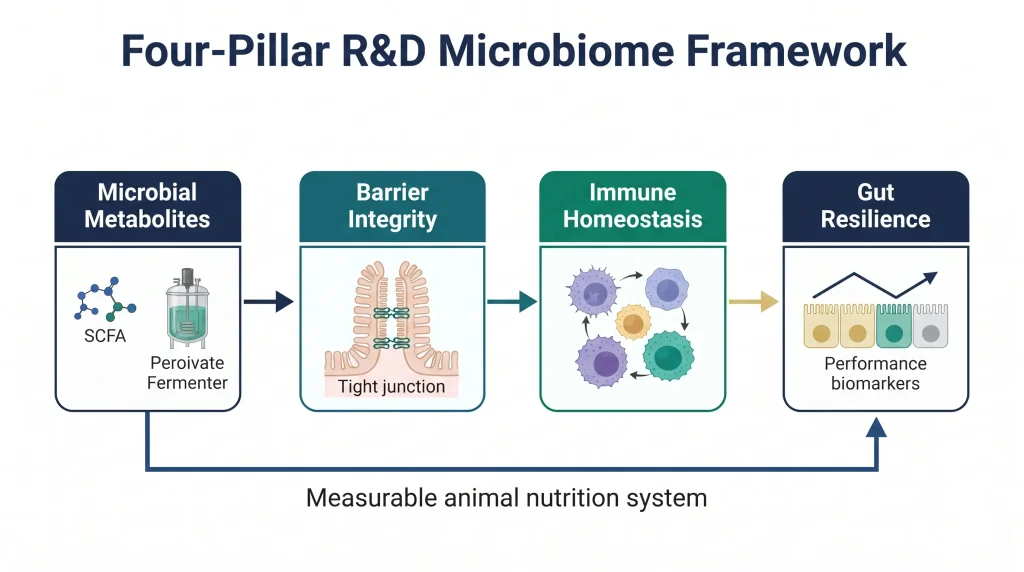
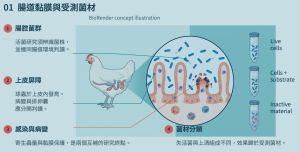
SCFA / VFA / Organic Acids
Villi / Mucus / Tight Junctions
GALT / Tregs / Cytokines
FCR / Stability / Performance
2. The Metabolomic Engine: SCFA Synthesis and Energy Extraction
The gut microbiome can function as a secondary digestive system. While host enzymes digest starch, proteins, and fats, many complex carbohydrates remain partially unavailable to the host. These include non-starch polysaccharides, resistant starch, soluble fibers, oligosaccharides, and other fermentable substrates.
When beneficial anaerobic microbes ferment these substrates, they generate short-chain fatty acids, mainly acetate, propionate, and butyrate. These metabolites are not simply by-products. They are biological signals and energy molecules that influence intestinal cells, microbial ecology, and feed utilization.
2.1 Butyrate as a Local Energy Source
Butyrate is an important energy substrate for colonocytes and is closely associated with intestinal epithelial maintenance. By supporting epithelial cell metabolism, butyrate may contribute to villus development, mucosal renewal, and improved absorptive surface area. A healthier mucosal architecture can support more efficient nutrient uptake and may contribute to improved feed conversion under appropriate production conditions.
2.2 Organic Acids and Luminal pH Modulation
SCFAs and other organic acids can lower intestinal luminal pH. This shift may create a less favorable environment for some acid-sensitive undesirable bacteria, while supporting a microbial ecology more compatible with fermentation balance. In practical nutrition, this is one reason why fiber type, enzyme strategy, probiotic selection, and postbiotic metabolites should be evaluated together rather than separately.
Feed ingredients should not only be viewed as nutrients for the animal. They are also substrates for the microbiome. The same diet may produce different outcomes depending on microbial fermentation capacity.
3. Cellular Defense: Tight Junctions and Mucosal Barrier Integrity
A highly efficient animal is one that allocates more dietary energy toward productive performance and less toward emergency repair. The intestinal epithelium is the frontline where this energy allocation is determined.
The epithelial barrier depends on a network of multiprotein structures known as tight junctions. These include claudins, occludins, and zonula occludens proteins such as ZO-1. Together, they regulate paracellular permeability and help prevent luminal toxins, bacteria, and inflammatory molecules from crossing into systemic circulation.
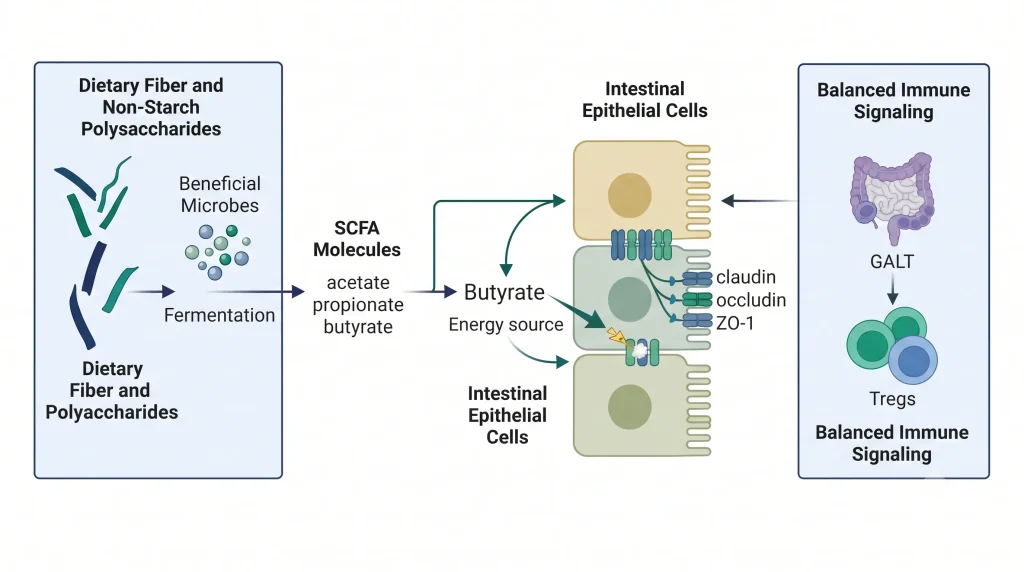
When dysbiosis occurs, microbial imbalance can increase exposure to lipopolysaccharides, toxins, and inflammatory triggers. If tight junction integrity is weakened, intestinal permeability may increase. This condition is often described as “leaky gut,” and it may contribute to systemic inflammation, nutrient diversion, reduced growth efficiency, and higher vulnerability to production stress.
For R&D teams, barrier function should be evaluated through measurable endpoints rather than descriptive claims. Relevant indicators may include tight junction gene expression, villus height, crypt depth, mucus layer status, serum permeability markers, inflammatory cytokines, and histological lesion scoring.
4. Immune Homeostasis: Reducing the Nutrient Drain of Chronic Inflammation
Inflammation is nutritionally expensive. When an animal mounts a strong immune response, amino acids, glucose, minerals, and energy can be redirected away from muscle deposition, egg production, milk synthesis, or growth toward acute-phase proteins, immune cell proliferation, and tissue repair.
This is why immune balance is central to feed efficiency. The goal is not to suppress immunity. Instead, the goal is to maintain a state of controlled readiness: alert enough to respond to pathogens, but stable enough to avoid unnecessary inflammatory energy cost.
The gut microbiome plays a key role in educating the gut-associated lymphoid tissue. Beneficial commensal bacteria and microbial metabolites interact with pattern-recognition receptors such as Toll-like receptors, helping shape mucosal immune tone. Regulatory T cells, anti-inflammatory cytokines such as IL-10, secretory IgA, and balanced innate immune signaling are all part of this homeostatic network.
Every calorie spent on uncontrolled inflammation is a calorie not used for productive output. Microbiome-based nutrition aims to reduce unnecessary immune cost while maintaining mucosal defense readiness.
5. From Biology to Biomarkers: Making Gut Resilience Measurable
The next step in animal nutrition R&D is to translate gut microbiome biology into measurable biomarkers. Instead of waiting until the end of a production cycle to evaluate weight gain or FCR, predictive biomarkers can help identify biological risk earlier.
These markers do not replace performance data. Instead, they explain why performance changes and help R&D teams optimize feed additives, microbial solutions, enzymes, organic acids, postbiotics, and management programs.
| R&D Biomarker Target | What It Measures | Performance Implication |
|---|---|---|
| Butyrate / Acetate Ratio | Microbial fermentation pattern and metabolic efficiency | Supports interpretation of energy extraction, fiber utilization, and gut epithelial fuel supply. |
| VFA / SCFA Profiles | Fermentation dynamics and substrate conversion | Helps validate enzyme strategy, fiber degradation, and microbiome-targeted nutrition. |
| Zonulin / Permeability Markers | Intestinal epithelial permeability and barrier stress | May indicate risk of gut leakage, inflammation, and upcoming performance instability. |
| Calprotectin or Inflammatory Markers | Gut inflammation and immune activation status | Helps identify inflammatory nutrient drain before visible clinical signs appear. |
| Secretory IgA | Mucosal immune deployment | Reflects baseline mucosal protection without necessarily indicating systemic inflammation. |
| Tight Junction Gene Expression | Barrier structure regulation, including claudins, occludins, and ZO proteins | Supports mechanistic validation of gut barrier integrity claims. |
6. Engineering the Future of Feed Efficiency
True advancement in feed formulation requires looking at diets not only as nutrient packages for the animal, but also as ecological inputs for the gut microbiome. Every feed ingredient can influence microbial fermentation, metabolite output, mucosal barrier function, and immune tone.
For modern animal nutrition R&D, the goal is to design feed programs that systematically guide microbial pathways. This may include increasing beneficial SCFA production, stabilizing mucosal barrier integrity, supporting tight junction expression, reducing excessive inflammatory signaling, and improving resilience under production stress.
This is where microbial products, postbiotics, enzymes, organic acids, prebiotics, synbiotics, and precision fermentation-derived metabolites can converge. Rather than acting as isolated feed additives, they can be integrated into a microbiome-targeted nutrition framework.
Fiber / NSP / Protein / Starch
Fermentation / Cross-Talk
FCR / Resilience / ROI
7. HYGEM Perspective: From Gut Microbiomics to Precision BioSolutions
From the HYGEM / GEMBIOZ perspective, the future of animal nutrition will not be defined by single-function additives alone. It will be defined by integrated microbiome systems that connect strain selection, fermentation metabolites, postbiotic stability, feed substrate design, biomarker validation, and field performance.
The key question is no longer whether a product can be described as “good for gut health.” The real question is whether it can produce measurable changes in microbial metabolism, epithelial barrier integrity, immune homeostasis, and production resilience under commercial conditions.
| Technology Direction | R&D Focus | Production Value |
|---|---|---|
| Next-Generation Probiotics | Strain screening, colonization, metabolite output, stability | Supports microbial balance, fermentation efficiency, and gut resilience. |
| Postbiotics | SCFAs, peptides, cell wall components, fermentation metabolites | Provides stable functional inputs that can support barrier and immune balance. |
| Synbiotics | Matching microbes with fermentable substrates | Guides beneficial fermentation and improves substrate utilization. |
| Biomarker Validation | SCFA profiles, sIgA, tight junctions, inflammatory markers, FCR | Connects mechanism to measurable performance outcomes. |
| Field Translation | Commercial trials, production data, ROI, challenge conditions | Confirms whether microbiome strategies work under real production pressure. |
This is the transition from microbiome storytelling to microbiome engineering. The companies that can build evidence chains from laboratory mechanism to field-level ROI will shape the next generation of animal nutrition.
Conclusion: Translating Gut Microbiomics into Predictable Performance
The gut microbiome is no longer a hidden biological black box. It is a measurable interface where feed substrates, microbial fermentation, intestinal barrier function, immune balance, and production performance converge.
By targeting specific microbial pathways, supporting SCFA production, stabilizing tight junctions, reducing unnecessary inflammatory nutrient drain, and tracking predictive biomarkers, animal nutrition R&D can move toward more precise and resilient production systems.
The future of feed efficiency will not depend only on nutrient formulation. It will depend on how effectively nutrition programs can guide the microbiome to transform feed into absorbable energy, stable gut function, and measurable production value.
The microbiome science behind feed efficiency is not about replacing nutrition formulation. It is about adding a measurable biological layer that links microbial metabolism, barrier integrity, immune homeostasis, and predictive biomarkers to resilient animal performance.
Further Reading
- Microbiome Nutrition and Intestinal Barrier Function in Livestock
- Animal Microbiome Solutions: A Next-Generation Precision Pathway for Digestibility, Immune Barrier Support, and Pathogen Pressure Management
- How Lactobacillus plantarum Helps Restore the Intestinal Barrier in Chicks Challenged by Salmonella
References & Notes
Reference directions include peer-reviewed studies and technical reports on animal gut microbiomics, short-chain fatty acids, volatile fatty acids, butyrate metabolism, intestinal epithelial barrier function, tight junction proteins, gut-associated lymphoid tissue, mucosal immunity, secretory IgA, inflammatory biomarkers, feed conversion ratio, and microbiome-targeted animal nutrition.
Disclaimer: This article is intended for scientific communication and educational purposes only. Microbiome-based animal nutrition technologies, probiotics, postbiotics, synbiotics, enzymes, organic acids, and feed efficiency programs should be validated under appropriate species, diet, age, production system, health status, and regulatory conditions before commercial use. Any feed efficiency, gut resilience, pathogen pressure, or performance-related claim should be supported by controlled trials, field data, and approved documentation.