
Plant Microbiome Strategies for Root Health and Nutrient Availability: Unlocking the Power of the Rhizosphere
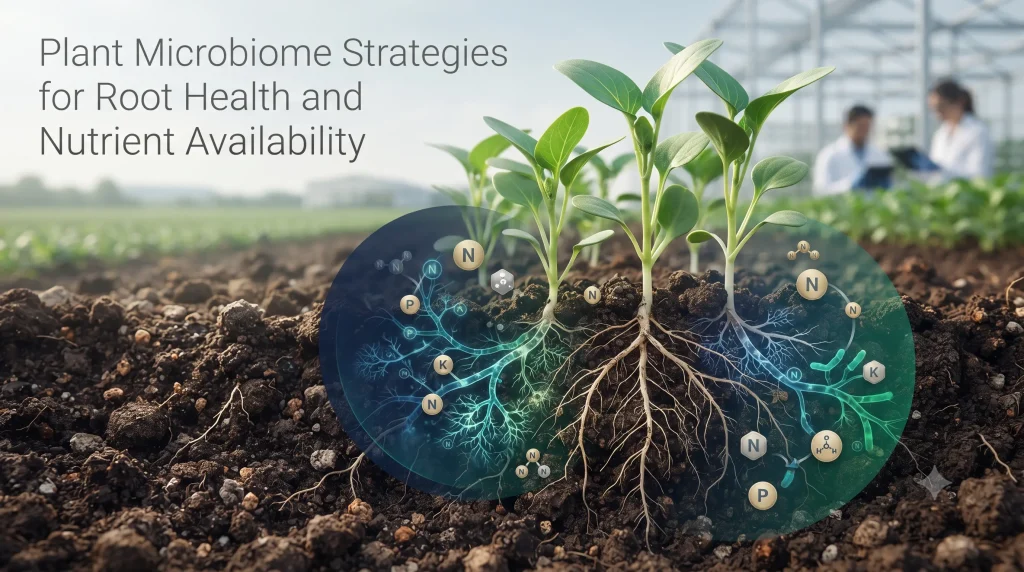
Unlocking the Power of the Rhizosphere
Beneath every healthy plant lies a highly dynamic microbial ecosystem known as the rhizosphere. This narrow zone surrounding plant roots is one of the most biologically active interfaces in agriculture. It is where root exudates, soil particles, nutrients, water, and microorganisms continuously interact to shape plant performance.
The rhizosphere is home to billions of bacteria, fungi, yeast, and other microorganisms that influence nutrient cycling, root development, stress tolerance, soil structure, and crop productivity. In modern agriculture, this root-zone ecosystem is no longer viewed as background biology. It is becoming a central target for sustainable crop production and precision biological management.
As global agriculture faces increasing pressure from soil degradation, nutrient inefficiency, climate variability, water limitations, salinity, and environmental constraints, plant microbiome management is emerging as a powerful strategy for improving crop resilience. By activating beneficial microbial communities, growers can support nutrient availability, strengthen root systems, improve soil biological function, and enhance crop performance under changing field conditions.
The rhizosphere is not simply soil around the root. It is a biological control zone where plant roots, microorganisms, nutrients, and environmental signals interact to determine crop resilience and productivity.
1. Understanding the Plant Microbiome
The plant microbiome consists of diverse microorganisms that live in close association with plant roots, leaves, stems, seeds, and surrounding soil environments. Among these microbial habitats, the rhizosphere is especially important because it directly connects microbial activity with root development and nutrient uptake.
Beneficial plant-associated microbial communities may include:
- Plant growth-promoting rhizobacteria, commonly known as PGPR
- Bacillus species with strong environmental tolerance and spore-forming ability
- Lactic acid bacteria associated with microbial balance and metabolite production
- Nitrogen-fixing microorganisms involved in nitrogen cycling
- Phosphate-solubilizing bacteria that help release unavailable phosphorus
- Potassium-mobilizing microorganisms that support mineral nutrient release
- Beneficial fungi and yeast that contribute to root-zone ecology and organic matter transformation
Together, these organisms form a biological network that supports plant growth, soil fertility, and environmental adaptation. Their value does not come from a single function alone, but from coordinated effects across nutrient cycling, root stimulation, microbial competition, organic matter transformation, and stress response modulation.
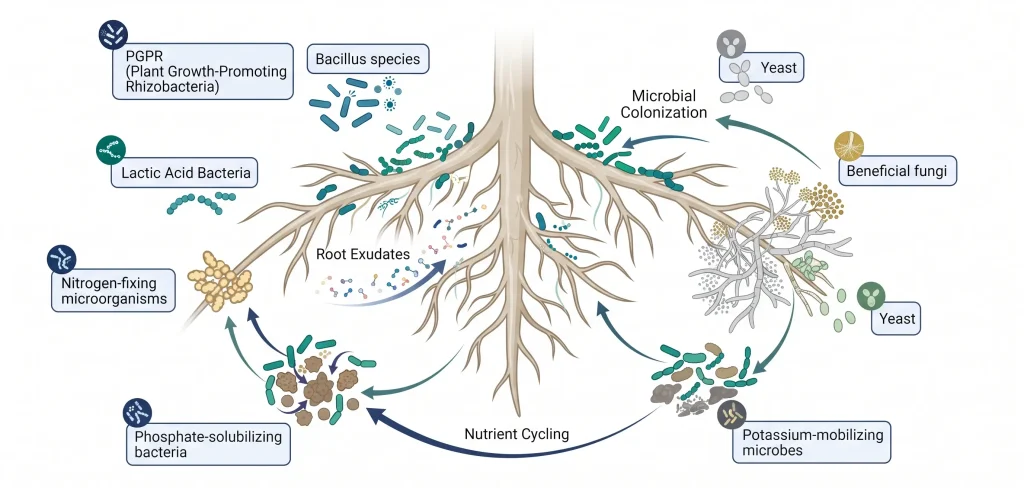
Sugars / Amino Acids / Organic Acids
PGPR / Bacillus / Fungi
N / P / K / Micronutrients
Root Health / Stress Tolerance
2. Root Health: The Foundation of Crop Performance
Healthy roots are essential for water absorption, nutrient uptake, soil anchorage, and plant stability. However, root systems are continuously exposed to multiple pressures, including soil compaction, nutrient limitations, drought, salinity, temperature fluctuation, and pathogen pressure.
Plant microbiome strategies support root health by improving the biological environment around the root system. Instead of working only as direct nutrient suppliers, beneficial microorganisms influence root architecture, rhizosphere activity, microbial balance, and plant stress signaling.
2.1 Root Architecture Enhancement
Microbial metabolites may stimulate root branching, root hair formation, lateral root development, and overall root expansion. A more developed root system allows plants to explore a larger soil volume and access more water and nutrients.
Key benefits of improved root architecture include:
- Greater soil exploration capacity
- Increased nutrient absorption surface area
- Improved water uptake efficiency
- Enhanced drought resilience and transplant recovery
- More stable early crop establishment
2.2 Rhizosphere Activation
Beneficial microorganisms can colonize root surfaces and establish productive microbial communities. Once beneficial microbes are well established in the rhizosphere, they may help maintain long-term root-zone activity through metabolite production, nutrient transformation, biofilm formation, and microbial cross-feeding.
2.3 Biological Protection
A balanced rhizosphere microbiome can help reduce the opportunity for undesirable microorganisms to dominate. Beneficial microbial populations may compete for space and nutrients, produce organic acids or other bioactive metabolites, and support a more stable root-zone ecosystem. This does not replace crop protection strategies, but it can become part of an integrated root health management framework.
Root health should be evaluated not only by visible root length, but also through root surface area, root hair density, rhizosphere colonization, nutrient uptake efficiency, and stress recovery performance.
3. Improving Nutrient Availability Through Microbial-Mediated Cycling
Many nutrients exist in soil but remain unavailable to plants because they are chemically bound, poorly soluble, locked in organic matter, or limited by unfavorable pH and soil conditions. Plant microbiome strategies aim to improve nutrient availability through microbial-mediated nutrient cycling rather than simply increasing fertilizer input.
3.1 Phosphorus Solubilization
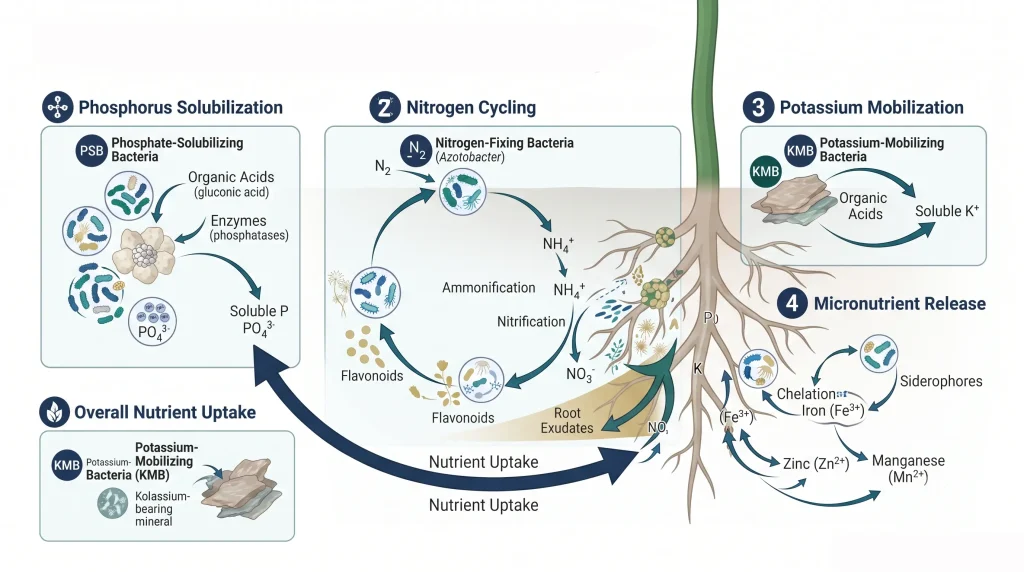
A significant portion of soil phosphorus is immobilized and unavailable to plants. Phosphate-solubilizing microorganisms can produce organic acids, phosphatases, and other metabolites that help release bound phosphorus into forms that roots can access. This can improve phosphorus-use efficiency and support root growth, energy metabolism, and early crop development.
3.2 Nitrogen Utilization
Beneficial microbes can support nitrogen cycling in the rhizosphere through nitrogen fixation, organic nitrogen mineralization, and interactions with soil organic matter. A more active nitrogen cycle may contribute to improved nitrogen uptake, stronger vegetative growth, and reduced nutrient losses under appropriate field conditions.
3.3 Potassium Mobilization
Potassium is essential for enzyme activation, stomatal regulation, water balance, photosynthesis, and stress tolerance. Some microorganisms can facilitate the release of potassium from soil minerals through organic acids, chelating compounds, and mineral-weathering activity, making this essential nutrient more accessible to crops.
3.4 Micronutrient Availability
Micronutrients such as iron, zinc, manganese, and copper are required in small quantities but play major roles in photosynthesis, enzyme activity, oxidative stress regulation, and plant metabolism. Microbial metabolites, including siderophores and organic acids, may help mobilize these trace minerals and improve their availability in the root zone.
| Nutrient Function | Microbial Mechanism | Crop-Level Value |
|---|---|---|
| Phosphorus Availability | Organic acid production, phosphatase activity, mineral solubilization | Supports root development, energy metabolism, and early growth vigor. |
| Nitrogen Cycling | Nitrogen fixation, mineralization, rhizosphere organic matter transformation | Improves nitrogen-use efficiency and vegetative growth potential. |
| Potassium Mobilization | Mineral weathering, organic acids, chelation | Supports stomatal control, water balance, and stress tolerance. |
| Micronutrient Release | Siderophores, organic acids, microbial chelating compounds | Improves enzyme function, chlorophyll formation, and stress response. |
4. Supporting Soil Health Through Microbial Activity
Healthy soils depend on active microbial ecosystems. Soil is not only a physical growing medium; it is a living biological system where organic matter decomposition, nutrient transformation, aggregation, carbon flow, and root interactions are continuously taking place.
4.1 Organic Matter Decomposition
Microorganisms help decompose crop residues, organic fertilizers, compost, and other organic materials. Through enzymatic degradation and fermentation processes, they release nutrients and contribute to soil fertility. This process is especially important in regenerative and sustainable farming systems where organic matter management is central to long-term soil productivity.
4.2 Soil Structure and Aggregation
Microbial exopolysaccharides and fungal hyphae can contribute to soil aggregation. Better soil aggregation helps improve water retention, aeration, root penetration, and soil stability. A well-structured soil environment allows roots and microbes to function more efficiently.
4.3 Biological Diversity
A diverse microbial community creates a more resilient soil ecosystem. Biodiversity helps prevent microbial dominance by opportunistic organisms, improves nutrient cycling flexibility, and allows the soil microbiome to adapt more effectively to environmental fluctuations.
Productive soils are built by physical structure, chemical fertility, and biological activity together. Plant microbiome strategies work by strengthening the biological layer of this soil health system.
5. Enhancing Tolerance to Abiotic Stress
Climate variability is increasing the frequency and intensity of drought, salinity, heat stress, and nutrient stress events worldwide. These stresses often interact with each other, creating complex field conditions that reduce crop stability and yield predictability.
Beneficial microorganisms can help plants better tolerate environmental pressure through root development, osmotic adjustment, antioxidant regulation, nutrient uptake support, and microbial metabolite signaling.
5.1 Drought Stress
Under water-limited conditions, beneficial microorganisms may support root expansion, improve soil moisture retention, and enhance water-use efficiency. Better root architecture allows plants to explore deeper or wider soil zones for available water.
5.2 Salinity Stress
In saline soils, certain microbial communities may support osmotic balance, nutrient uptake, and ion homeostasis. By helping plants maintain root function and physiological stability, rhizosphere microorganisms may contribute to improved crop performance under salt stress.
5.3 Heat Stress
Microbial metabolites may help regulate physiological responses during periods of elevated temperature. While heat tolerance is controlled by many plant and environmental factors, microbiome support may help reduce stress-related disruption in root function and nutrient uptake.
5.4 Nutrient Stress
When nutrient availability becomes limited, microbial nutrient cycling becomes more important. By improving phosphorus solubilization, nitrogen cycling, potassium mobilization, and micronutrient release, beneficial microbes can help crops maintain growth under nutrient-limited conditions.
6. Precision Agriculture and the Future of Plant Microbiomes
Advances in microbiome science, genomics, artificial intelligence, and multi-omics technologies are transforming how microbial solutions are discovered, validated, and applied. Instead of using generalized biological products, the industry is moving toward targeted microbiome management tailored to specific crops, soils, and environmental conditions.
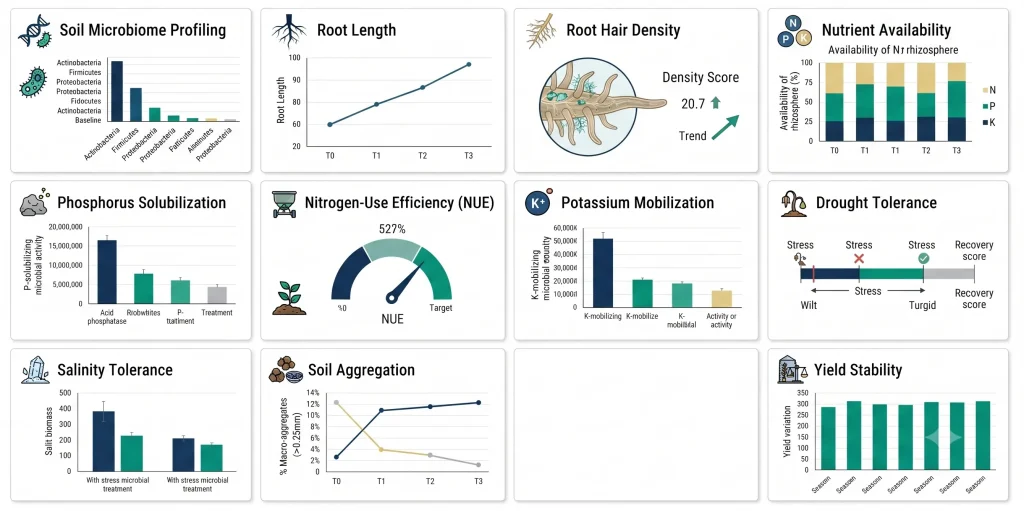
Emerging innovation directions include:
- Soil microbiome profiling and root-zone microbial diagnostics
- Metagenomics and functional microbial pathway analysis
- Synthetic Microbial Consortia designed for specific crop functions
- AI-driven strain discovery and functional prediction
- Precision biological formulations for crop, soil, and climate conditions
- Real-time soil microbiome monitoring and data-driven field recommendations
These tools enable R&D teams and growers to move beyond one-size-fits-all biological inputs and toward measurable, targeted, and adaptive microbiome strategies.
The next generation of plant microbiome products will be defined not only by strain selection, but by the integration of microbiome profiling, functional validation, formulation stability, field performance, and data-driven application models.
7. Applications Across Modern Agriculture
Plant microbiome technologies can be applied across diverse crop systems. The target function may differ by crop, soil condition, and production goal, but the core logic remains the same: support root health, improve nutrient efficiency, stabilize stress response, and enhance long-term soil biological function.
| Crop Segment | Representative Crops | Microbiome Strategy Focus |
|---|---|---|
| Field Crops | Corn, soybean, wheat, rice | Root establishment, nutrient-use efficiency, drought and salinity resilience, yield stability. |
| Cash Crops | Cotton, sugarcane, tobacco | Soil fertility, root vigor, stress tolerance, and long-cycle production stability. |
| Vegetables | Tomato, pepper, cucumber, eggplant | Transplant recovery, root-zone balance, nutrient uptake, and quality consistency. |
| Fruit Trees | Citrus, apple, grapes, mango | Long-term soil health, root regeneration, micronutrient availability, and stress resilience. |
Across these systems, microbial strategies can help improve nutrient availability, root development, crop uniformity, yield stability, and long-term soil health. The most effective applications are usually those that combine microbial products with good agronomic management, irrigation control, organic matter improvement, and balanced fertilization.
Conclusion: Building Resilient Agricultural Systems Through the Rhizosphere
The future of sustainable agriculture depends on improving productivity while reducing environmental pressure. Plant microbiome strategies provide a biologically driven pathway for achieving this balance by activating beneficial rhizosphere microorganisms, improving nutrient availability, supporting root development, and enhancing stress resilience.
As the understanding of microbial ecosystems continues to expand, plant microbiome management will become a cornerstone of next-generation agricultural production. It connects soil health, crop performance, nutrient efficiency, and environmental sustainability through the power of beneficial microorganisms.
For HYGEM / GEMBIOZ, the rhizosphere represents more than a microbial habitat. It is a strategic BioSolutions platform where functional microbes, fermentation technologies, soil microbiome data, and field validation can converge to support sustainable crop production.
Plant microbiome strategies unlock the biological potential of the rhizosphere by connecting root health, nutrient availability, soil microbial activity, and stress resilience into a measurable framework for sustainable agriculture.
Further Reading
- Plant Microbiome Strategies For Root health And Nutrient Availiability.
- Bacillus amyloliquefaciens Improves Maize Salt Tolerance.
- Microorganisms in Sustainable Agriculture: Harnessing the Power of Beneficial Microbes.
- Next-Generation Microbial Platforms for Precision Agriculture and Animal Nutrition.
References & Notes
Reference directions include peer-reviewed studies and technical reports on plant microbiomes, rhizosphere biology, plant growth-promoting rhizobacteria, Bacillus species, phosphate solubilization, nitrogen cycling, potassium mobilization, microbial exopolysaccharides, soil aggregation, abiotic stress tolerance, metagenomics, synthetic microbial consortia, and microbiome-based sustainable agriculture.
Disclaimer: This article is intended for scientific communication and educational purposes only. Plant microbiome products, microbial fertilizers, biostimulants, synthetic microbial consortia, and soil microbiome management strategies should be validated under appropriate crop, soil, climate, formulation, safety, and regulatory conditions before commercial use. Any nutrient efficiency, stress tolerance, soil health, or yield-related claim should be supported by controlled trials, field data, and approved documentation.