

Sustainable Microbial Technologies: Building a Lower-Emission and Circular Bio-Economy for Agriculture
The global agricultural and livestock industries are facing a defining challenge: how to increase food production for a growing population while sharply reducing carbon, methane, nitrogen, and waste-related environmental pressure. As climate regulations, ESG reporting, and supply-chain carbon accounting become more stringent, traditional chemical and mechanical solutions alone are no longer sufficient.
The next frontier is biological.
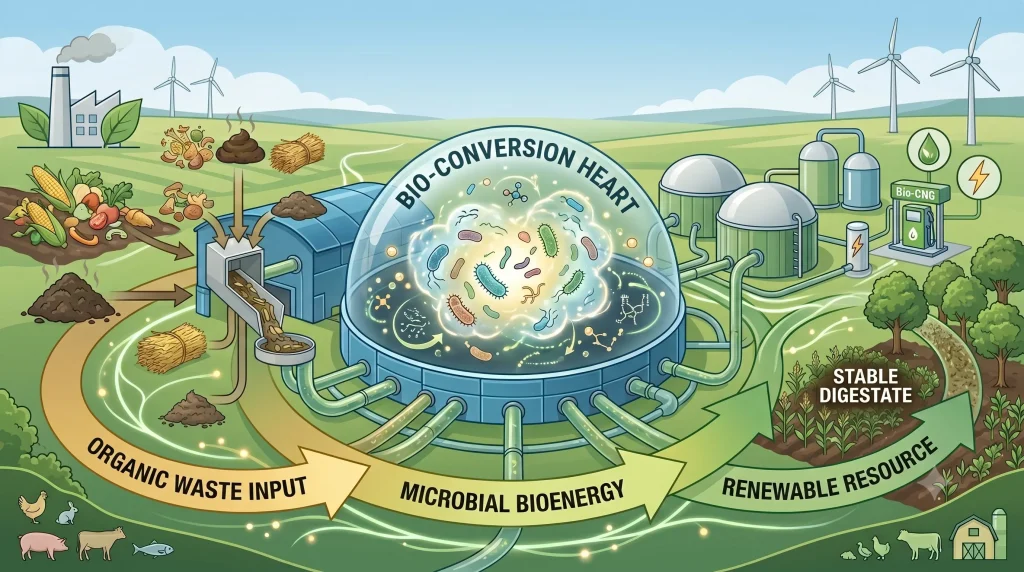
Sustainable microbial technologies are moving from supporting roles into the center of climate-smart agriculture. They are no longer viewed only as tools for gut health or feed efficiency, but as a biological infrastructure capable of reducing waste pressure, improving nutrient conversion, lowering greenhouse gas emissions, and transforming low-value agricultural by-products into higher-value circular resources.
“`
Inputs
Microbial Technologies
Methane / Nitrogen / Waste Pressure
By-Product Upcycling / Resource Recovery
“`
 1. Mitigating Enteric Methane Emissions
Enteric fermentation from ruminants is one of the most important biological sources of agricultural methane emissions. Inside the rumen, methanogenic archaea use hydrogen and carbon dioxide to produce methane gas. From a production perspective, this process also represents an energy loss, as part of the feed-derived energy is released into the atmosphere instead of being converted into milk, meat, or body weight gain.
Advanced microbial technologies are beginning to target this pathway by reshaping rumen ecology rather than simply suppressing fermentation. The goal is not to disrupt digestion, but to redirect microbial metabolism toward more efficient and lower-emission outcomes.
Hydrogen Redirection
Targeted direct-fed microbials and selected bacterial strains may help redirect hydrogen away from methanogenesis and toward beneficial fermentation products, such as short-chain fatty acids. For example, hydrogen-utilizing microbial pathways can shift rumen fermentation toward acetate and other metabolites that support animal energy metabolism.
Methanogen Pressure Management
Selected microbial additives can also be used to influence methanogen activity while preserving the fiber-degrading bacterial populations required for rumen function. This is critical because the objective is not to sterilize the rumen, but to guide a complex microbial ecosystem toward greater metabolic efficiency.
The Efficiency Advantage
Because methane formation can represent a measurable loss of gross energy, reducing this pathway may help retain more feed-derived energy within the animal. In practical terms, methane mitigation should be evaluated not only as a climate strategy, but also as a production-efficiency strategy that may reduce the carbon intensity per kilogram of milk or meat produced.
2. Closing the Loop: Upcycling Agricultural By-Products
A core principle of sustainable agriculture is to keep nutrients circulating within the production system for as long as possible. Every year, agricultural and food-processing industries generate large volumes of low-value fibrous materials, protein-poor by-products, crop residues, distillers grains, fruit pulps, and other organic side streams.
Microbial fermentation can transform these materials into more valuable nutritional and functional ingredients. In this context, fermentation acts as a biological refinery: microorganisms break down complex substrates, reduce anti-nutritional factors, and build new microbial biomass rich in protein, enzymes, peptides, organic acids, and metabolites.
Anti-Nutrient Degradation
Many agricultural by-products contain phytates, tannins, trypsin inhibitors, non-starch polysaccharides, or other compounds that limit feed inclusion rates. Tailored fungal and bacterial fermentation systems can reduce these anti-nutritional barriers, improving digestibility and expanding the usable value of by-products.
Single-Cell Protein and Microbial Biomass Formation
Microorganisms can convert low-value carbon sources and non-protein nitrogen into microbial biomass. This creates a more digestible protein matrix and may reduce dependence on land- and water-intensive protein sources such as soybean meal or fishmeal. When properly validated, this strategy can support both feed formulation flexibility and circular resource efficiency.
“`
& By-Products
Fermentation
Functional Metabolites
Feed Resources
“`
3. Improving Nitrogen Efficiency and Reducing Waste Pressure
Nitrogen inefficiency is one of the major hidden costs of intensive livestock and agricultural production. When diets are not well matched to animal requirements, excess nitrogen and phosphorus are excreted into manure, litter, or wastewater systems. These nutrients can later volatilize, leach, or transform into environmentally harmful compounds, including ammonia and nitrous oxide.
Microbiome management can reduce this pressure through two complementary pathways: improving nutrient utilization inside the animal and stabilizing waste after excretion.
In-Vivo Nutrient Utilization
Within the gut, microbial enzymes can support the breakdown of proteins, fibers, phytate-bound phosphorus, and complex carbohydrates. By improving nutrient release and absorption, microbial technologies may help reduce the amount of undigested nitrogen and phosphorus entering manure systems.
Ex-Vivo Manure and Litter Stabilization
After excretion, targeted microbial cultures can be applied to manure storage, composting systems, or poultry litter. These microbial systems may accelerate aerobic decomposition, stabilize nitrogen into less volatile organic forms, reduce odor generation, and support more controlled composting or biofertilizer production.
The strategic value is clear: nutrient efficiency is not only a feed formulation issue. It is also a waste management, environmental compliance, and sustainability reporting issue.
4. Microbial Technologies as Corporate Sustainability Assets
The impact of sustainable microbial technologies is expanding beyond individual farms. As agrifood companies increasingly track Scope 1, Scope 2, and Scope 3 emissions across their supply chains, verified biological interventions can become measurable sustainability assets.
When microbial solutions are connected to auditable indicators—such as methane intensity, nitrogen efficiency, manure emissions, waste reduction, by-product upcycling, and alternative protein sourcing—they become more than production inputs. They become part of a company’s climate, ESG, and circular economy strategy.
| Impact Vector | Primary Microbial Mechanism | Environmental Dividend |
|---|---|---|
| Enteric Methane | Rumen microbial modulation, hydrogen redirection, and methanogen pressure management | Lower methane intensity and improved retention of feed-derived metabolic energy. |
| Waste Stream Pressure | Accelerated mineralization, nitrogen stabilization, and aerobic manure transformation | Reduced ammonia odor, lower nitrous oxide risk, and improved waste handling efficiency. |
| Alternative Protein Sourcing | Bioconversion of agricultural residues into microbial biomass and functional feed ingredients | Reduced dependence on resource-intensive protein sources and improved circular resource use. |
| Nutrient Efficiency | Microbial enzyme production and improved digestibility of protein, fiber, and phosphorus-bound nutrients | Lower nutrient excretion pressure and improved feed-to-output efficiency. |
Strategic Forward Look
The future of agricultural sustainability will not be achieved by bypassing biological systems. It will be achieved by understanding, steering, and scaling them responsibly.
Sustainable microbial technologies provide a practical bridge between productivity and environmental stewardship. They can help reduce emissions, improve nutrient conversion, stabilize waste streams, and transform agricultural by-products into new value. Most importantly, they allow producers to improve environmental performance without treating sustainability as a trade-off against profitability.
For the next generation of agrifood companies, microbial technologies will not simply be additives. They will become core biological infrastructure for lower-emission, higher-efficiency, circular agricultural production.
Sustainable microbial technologies turn biological complexity into measurable production value: lower emissions, better nutrient efficiency, reduced waste pressure, and stronger circular economy performance.