
Co-Culture of Lactic Acid Bacteria and Acetic Acid Bacteria: Boosting Nisin Production and Functional Biofilm Development
Introduction: Nisin is one of the most recognized bacteriocins in food biotechnology. Produced mainly by selected strains of Lactococcus lactis, nisin is a ribosomally synthesized antimicrobial peptide with broad activity against many Gram-positive bacteria. Because of its established role as a natural food preservative and its expanding research interest in biomedical and packaging applications, improving nisin production remains an important topic in fermentation biotechnology.
Recent research has shown that nisin production does not have to rely only on monoculture fermentation. Instead, microbial co-culture systems can create new biological interactions that improve metabolite production, modify fermentation conditions, and integrate antimicrobial peptides into functional materials. One promising direction is the co-culture of lactic acid bacteria and acetic acid bacteria, especially systems combining Lactococcus lactis subsp. lactis with bacterial cellulose-producing acetic acid bacteria such as Komagataeibacter xylinum.
This article explores how LAB–AAB co-culture may enhance nisin production, support bacterial cellulose integration, and create functional antimicrobial biofilms for food, packaging, and biomaterial applications.
Nisin producer
Cellulose producer
Fermentation
1. Why Nisin Matters in Microbial Biotechnology
Nisin belongs to the lantibiotic family of bacteriocins and is known for its antimicrobial activity against many Gram-positive bacteria. In food systems, it has been used to support preservation, especially in products where control of spoilage or spore-forming bacteria is important.
Beyond food preservation, nisin is also being studied for controlled-release packaging, antimicrobial films, wound dressing concepts, and biomedical material applications. However, these applications require more than simply producing nisin in liquid culture. They require efficient production, stable formulation, controlled release, and compatibility with carrier materials.
This is where co-culture fermentation becomes especially interesting. Instead of producing nisin and a carrier material separately, a co-culture system may allow antimicrobial peptide production and biomaterial formation to occur in a more integrated biological process.
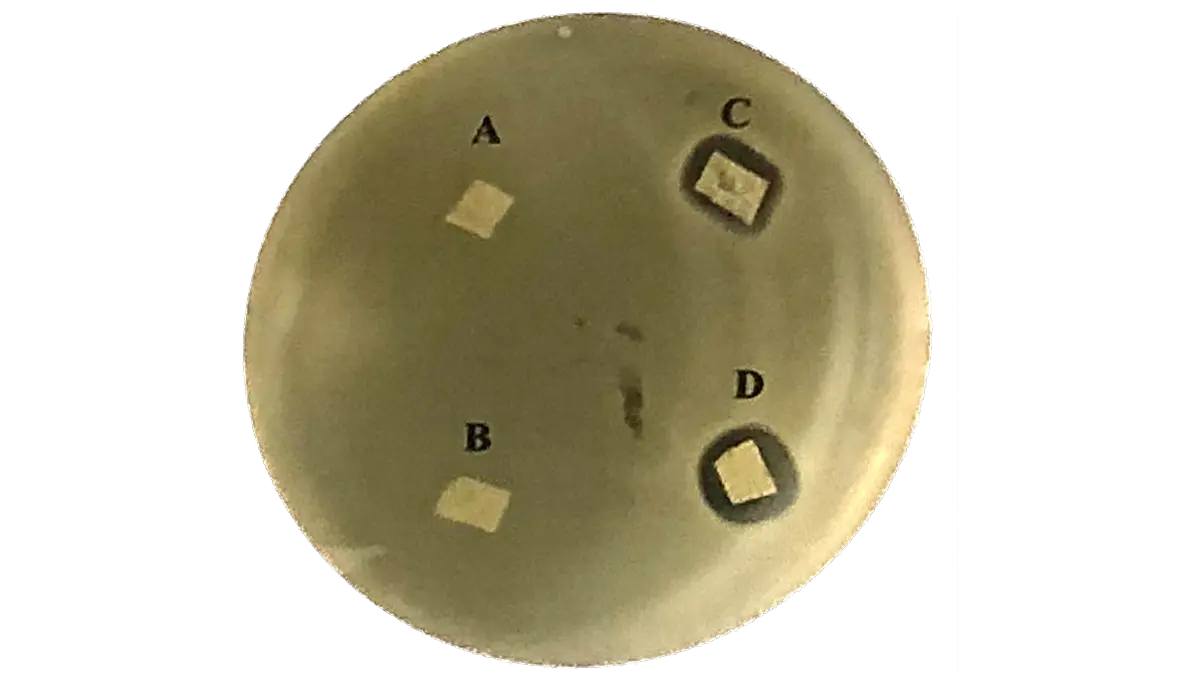
2. The Co-Culture Concept: LAB as Producer, AAB as Matrix Builder
In a LAB–AAB co-culture system, Lactococcus lactis serves as the nisin-producing organism, while acetic acid bacteria such as Komagataeibacter xylinum contribute to bacterial cellulose formation. Bacterial cellulose is a highly pure, nanoscale fiber network with strong water-holding capacity, mechanical strength, and biocompatibility. These properties make it attractive as a carrier matrix for bioactive molecules.
The co-culture strategy creates a biological division of labor:
| Microbial Partner | Primary Role | Functional Contribution |
|---|---|---|
| Lactococcus lactis | Nisin biosynthesis | Produces antimicrobial peptide and contributes to bacteriocin activity in the fermentation environment. |
| Komagataeibacter xylinum | Bacterial cellulose formation | Builds a cellulose network that can act as a carrier, film structure, or functional biomaterial matrix. |
| Co-culture system | Microbial interaction and process integration | Links antimicrobial metabolite production with material formation in a single fermentation strategy. |
Compared with a single-strain system, this approach allows researchers to study not only production yield, but also how microbial interactions influence gene expression, pH, matrix formation, antimicrobial activity, and film properties.
3. Fermentation Variables That Shape Nisin Output
Co-culture fermentation is more complex than monoculture fermentation. Two organisms may compete for nutrients, change the pH environment, produce metabolites that affect each other, or alter oxygen and substrate availability. Therefore, optimizing nisin production requires precise control of several variables.
Inoculation Ratio
The relative starting concentration of LAB and AAB can strongly influence fermentation direction. If the nisin-producing LAB grows too slowly, nisin output may remain low. If the cellulose-producing AAB dominates too early, substrate use and oxygen conditions may shift away from optimal nisin biosynthesis. A balanced inoculation ratio is therefore critical.
Inoculation Timing
Sequential inoculation may produce different results from simultaneous inoculation. Allowing one organism to establish early may change the environment for the second organism. In nisin-focused systems, inoculation timing may affect both nisin gene expression and bacterial cellulose matrix formation.
pH and Organic Acid Dynamics
Nisin production is sensitive to pH and growth conditions. LAB fermentation generates lactic acid, while AAB metabolism can influence acid conversion and oxygen-dependent pathways. In a well-designed co-culture, microbial interaction may create a more favorable environment for nisin biosynthesis than a single LAB culture.
Oxygen and Surface Fermentation
Acetic acid bacteria and bacterial cellulose formation are strongly influenced by oxygen availability, especially at the air–liquid interface. This makes reactor design, surface area, agitation, and oxygen transfer important factors when scaling up BC/nisin co-culture systems.
Ratio
Timing
Dynamics
Transfer
Nisin Production
4. Gene Expression: Why nisA Matters
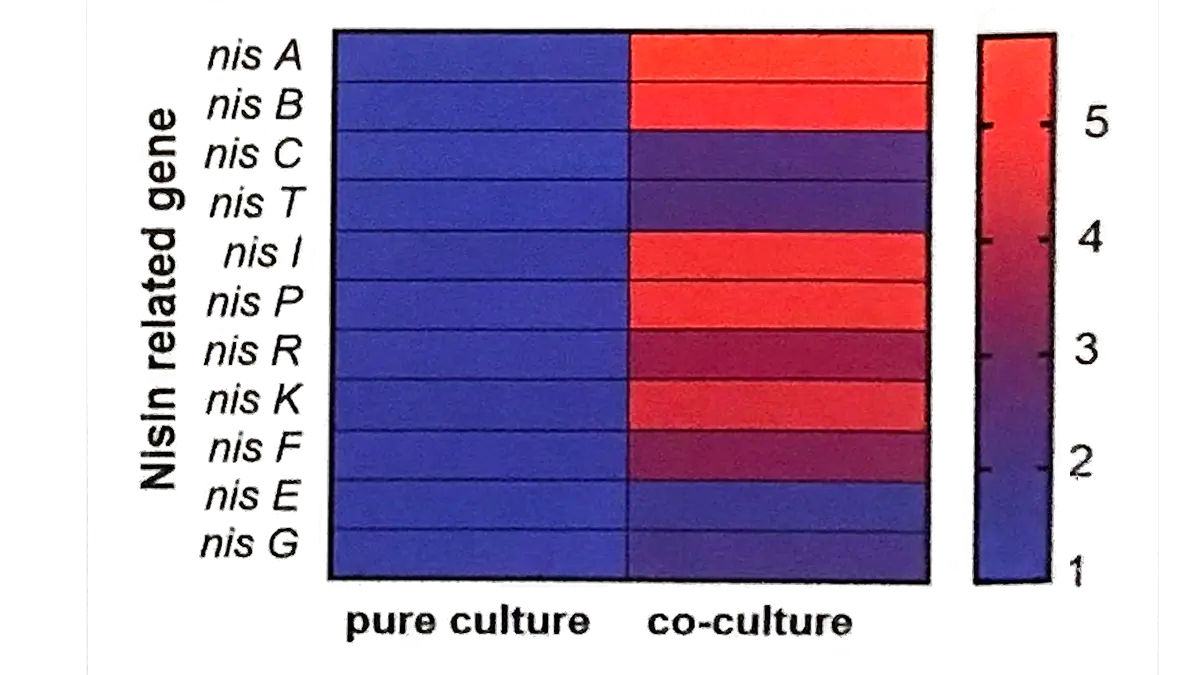
The nisA gene encodes the precursor peptide for nisin biosynthesis. Measuring nisA expression helps researchers understand whether the co-culture environment is truly stimulating the biosynthetic pathway, rather than simply changing final fermentation volume or apparent activity.
If co-culture conditions increase nisA expression, this suggests that microbial interaction may be influencing the regulatory or metabolic state of Lactococcus lactis. This gives the co-culture strategy a mechanistic basis: the system is not only mixing two organisms, but potentially reshaping the physiological environment of nisin production.
For industrial translation, gene expression data should be interpreted together with nisin activity, biomass growth, pH, metabolite profile, and material performance. A strong fermentation process should deliver both biological explanation and practical output.
5. Bacterial Cellulose as a Functional Nisin Carrier
Bacterial cellulose is an attractive biomaterial because of its purity, nanoscale fiber structure, water retention, mechanical properties, and compatibility with bioactive compounds. When nisin is integrated into bacterial cellulose, the resulting BC/nisin composite may function as an antimicrobial film or bioactive material.
This creates a dual-value system:
| Functional Layer | Role in BC/Nisin System | Application Value |
|---|---|---|
| Nisin | Antimicrobial peptide | Supports inhibition of selected Gram-positive bacteria and contributes to antimicrobial functionality. |
| Bacterial Cellulose | Structural matrix | Provides film structure, water retention, and potential controlled-release properties. |
| BC/Nisin Composite | Functional biofilm | Combines antimicrobial activity with material performance for food packaging or biomaterial research. |
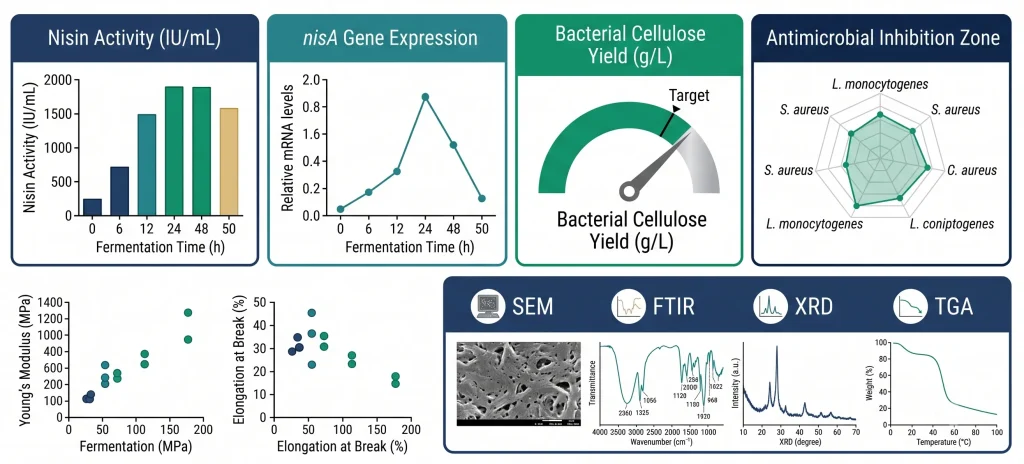
Material characterization methods such as scanning electron microscopy, FTIR, X-ray diffraction, and thermogravimetric analysis can help confirm whether nisin is successfully associated with the bacterial cellulose matrix and whether the film structure has changed.
6. Antimicrobial and Material Performance
A successful BC/nisin composite should be evaluated from both microbiological and material perspectives. Antimicrobial assays can show whether the film inhibits target bacteria, while mechanical and structural analyses can show whether the film remains suitable for practical handling and application.
Key evaluation indicators may include:
| Validation Dimension | Analytical Method | Purpose |
|---|---|---|
| Nisin Activity | Agar diffusion assay, HPLC, bioactivity unit assay | Confirms antimicrobial activity and production level. |
| Gene Expression | qPCR for nisA and related biosynthetic genes | Evaluates whether co-culture stimulates the nisin biosynthesis pathway. |
| Film Morphology | SEM | Observes bacterial cellulose fiber network and surface structure. |
| Chemical Interaction | FTIR | Identifies functional group changes and possible nisin-cellulose association. |
| Crystallinity | X-ray diffraction | Evaluates changes in cellulose structure and crystallinity. |
| Thermal Stability | Thermogravimetric analysis | Assesses thermal behavior and material stability. |
| Mechanical Performance | Tensile testing | Measures Young’s modulus, elongation at break, and handling performance. |
These indicators are important because the final product is not only a fermentation broth. It is a potential functional material, where antimicrobial activity, release behavior, structural stability, and safety all need to be considered together.
7. HYGEM Perspective: From Co-Culture Fermentation to Functional Microbial Platforms
For HYGEM / GEMBIOZ, the LAB–AAB co-culture concept is more than a single nisin production method. It represents a broader platform logic: using microbial interaction to generate functional metabolites, biomaterials, and application-ready biological systems.
This approach aligns with several HYGEM technology directions:
| HYGEM Technology Direction | Connection to LAB–AAB Co-Culture | Development Opportunity |
|---|---|---|
| Synthetic Microbial Consortia | Designs microbial partnerships with complementary functions. | Develops co-culture systems for metabolite production, material formation, or environmental transformation. |
| Fermentation Engineering | Optimizes inoculation ratio, timing, pH, oxygen, substrate, and reactor conditions. | Supports scale-up from laboratory co-culture to pilot and production fermentation. |
| Functional Metabolite Platforms | Links bacteriocins, organic acids, peptides, enzymes, and postbiotic components. | Builds product pipelines for food preservation, feed safety, packaging, and microbiome applications. |
| Biomaterial Integration | Combines microbial metabolites with bacterial cellulose or other matrices. | Creates functional films, controlled-release systems, or bioactive carrier materials. |
In this context, nisin production is not only a fermentation target. It becomes a model case for how microbial consortia can be designed to generate higher-value biological functions.
Conclusion: Microbial Collaboration as a Production Strategy
The co-culture of lactic acid bacteria and acetic acid bacteria provides a promising strategy for improving nisin production and integrating antimicrobial activity into bacterial cellulose-based materials. By combining a nisin-producing LAB with a cellulose-producing AAB, researchers can create a system where metabolite production and biomaterial formation occur together.
For industrial biotechnology, this approach highlights an important shift: microorganisms should not always be developed as isolated strains. In many cases, the most valuable functions emerge from designed microbial collaboration.
Future development should focus on strain compatibility, fermentation control, gene expression regulation, material characterization, antimicrobial performance, release kinetics, safety validation, and scale-up economics. When these elements are integrated, LAB–AAB co-culture may become a useful platform for antimicrobial biofilm development, food packaging innovation, and next-generation microbial manufacturing.
LAB–AAB co-culture transforms fermentation from single-strain production into a collaborative microbial platform, linking nisin biosynthesis, bacterial cellulose formation, antimicrobial functionality, and biomaterial development.
Further Reading
- Bioengineering Microbial Systems from Strain Selection to Field Validation
- Sustainable Microbial Technologies for Lower Emissions and Better Resource Use
Scientific References / Disclaimer
Reference directions include studies on nisin biosynthesis by Lactococcus lactis, LAB–AAB co-culture fermentation, bacterial cellulose production by Komagataeibacter species, BC/nisin composite films, antimicrobial activity assays, nisA gene expression, SEM, FTIR, X-ray diffraction, thermogravimetric analysis, and mechanical property testing of antimicrobial biofilms.
Disclaimer: This article is intended for scientific communication and educational purposes only. Nisin, co-culture fermentation, bacterial cellulose materials, and antimicrobial film applications should be evaluated under appropriate regulatory, food safety, toxicological, and application-specific conditions before commercial use. Any performance data should be confirmed by validated experimental results and approved documentation.