
Microorganisms in Sustainable Agriculture: Harnessing the Power of Beneficial Microbes
Introduction and Background:
Microorganisms play a pivotal role in shaping the future of sustainable agriculture. Bacteria, fungi, actinomycetes and other microscopic life forms influence soil fertility, nutrient cycling, organic matter decomposition, plant growth, stress resilience and biological pressure management. In modern agriculture, these organisms are no longer viewed only as invisible soil residents. They are increasingly recognized as functional partners that can support crop productivity, resource efficiency and long-term soil health.
For HYGEM / GEMBIOZ, the plant-soil microbiome represents a strategic bridge between biological science and field-ready agricultural BioSolutions. Beneficial microorganisms can contribute to biofertilizer development, biocontrol strategies, rhizosphere engineering, stress management and regenerative agriculture. However, microbial technology must be communicated carefully. It should not be presented as a guaranteed replacement for fertilizers, crop protection, irrigation or agronomic management. Its real value lies in building measurable biological support systems that can be validated under field conditions.
The challenge is not whether microorganisms are important. The real challenge is how to translate laboratory discoveries into stable, scalable and field-effective microbial interventions. This requires strain characterization, formulation stability, microbiome engineering, omics technologies, field validation and clear claim boundaries.
1. Why Microorganisms Matter in Sustainable Agriculture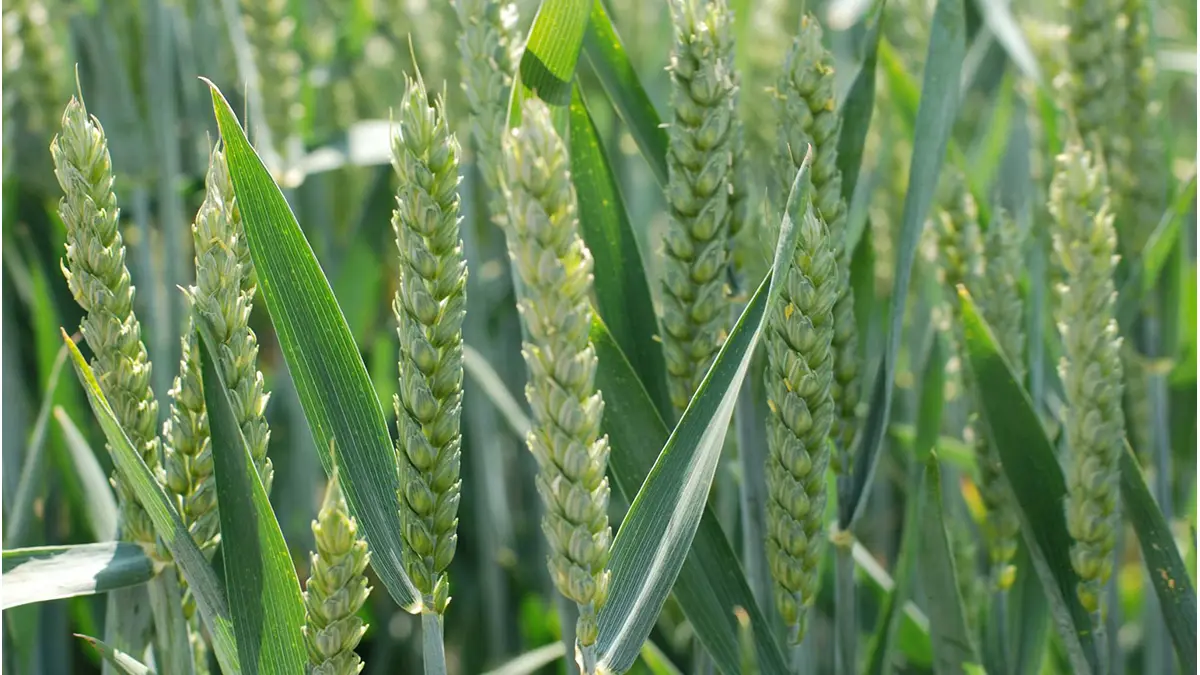
Agricultural productivity depends on much more than seeds, fertilizers and water. Beneath the soil surface, microorganisms regulate many of the biological processes that determine whether nutrients become available, roots develop efficiently, pathogens remain under pressure and plants tolerate environmental stress.
Microorganisms decompose organic residues, release nutrients from soil minerals, participate in nitrogen transformation, contribute to phosphorus and potassium availability, and help build soil structure. Some plant-associated microbes produce signaling molecules, enzymes or metabolites that can influence root architecture, nutrient uptake and stress responses.
In sustainable agriculture, this microbial foundation becomes especially important because growers are under pressure to improve productivity while reducing excessive chemical inputs, protecting soil health, using water more efficiently and adapting to climate variability. Beneficial microbes can contribute to this transition, but only when they are selected, formulated and applied with scientific discipline.
2. Positive Contributions of Beneficial Microorganisms
2.1 Nutrient Cycling and Soil Fertility
Microorganisms are central to nutrient cycling. They break down crop residues and organic matter, releasing nutrients that plants can absorb. Nitrogen-fixing bacteria can convert atmospheric nitrogen into biologically usable forms, while phosphate-solubilizing and potassium-mobilizing microbes may increase the availability of otherwise inaccessible nutrients.
These functions may help reduce nutrient losses and support more efficient fertilizer strategies. However, biofertilizers should not be positioned as universal fertilizer replacements. Their performance depends on crop type, soil condition, climate, formulation quality, microbial survival and application timing.
2.2 Biological Pressure Management
Beneficial microorganisms may contribute to biocontrol by competing with pathogens for nutrients and space, producing antimicrobial metabolites, inducing plant defense responses or altering the rhizosphere environment. This can support integrated pest and disease pressure management when combined with agronomy, monitoring and appropriate crop protection programs.
Responsible communication is essential. Microbial biocontrol should be described as pressure management or support for plant resilience, not as guaranteed disease elimination.
2.3 Stress Resilience Under Climate Pressure
Climate change is increasing the frequency of drought, heat, salinity, flooding and irregular rainfall. Certain plant growth-promoting microorganisms may support stress adaptation through mechanisms such as ACC deaminase activity, phytohormone modulation, antioxidant response support, improved root development and osmotic adjustment.
For growers, the practical value is not a single dramatic claim. The value is a more stable biological foundation that may help crops maintain performance under validated stress conditions.
| Microbial Function | Biological Mechanism | Agricultural Value |
|---|---|---|
| Nutrient Cycling | Organic matter decomposition, nitrogen transformation, phosphorus solubilization, potassium mobilization | Supports nutrient availability and more efficient fertilizer strategies. |
| Root Development | Phytohormone-like signaling, rhizosphere interaction, root architecture modulation | Contributes to root vitality, water uptake and nutrient capture. |
| Biocontrol Support | Competition, antimicrobial metabolites, induced resistance and rhizosphere balance | Helps manage biological pressure as part of integrated crop management. |
| Stress Resilience | ACC deaminase, antioxidant support, osmotic adjustment, microbial metabolite signaling | May support crop stability under drought, heat, salinity or other stress conditions. |
3. The Challenge: From Laboratory Potential to Field Performance
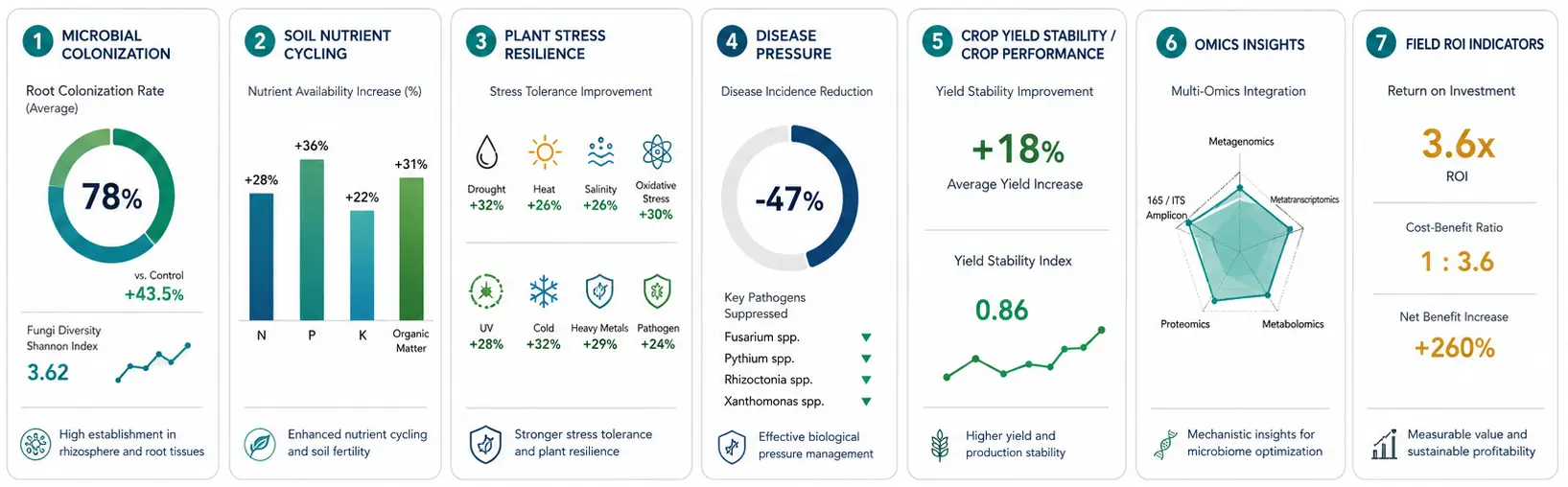 DATA-DRIVEN EVIDENCE FOR SUSTAINABLE AGRICULTURE AND RESILIENT CROPS
One of the greatest challenges in microbial agriculture is field translation. Many beneficial microorganisms perform well in laboratory or greenhouse studies, but their field performance can vary because real agricultural systems are complex and dynamic.
Soil pH, temperature, moisture, organic matter, native microbiota, crop genotype, pesticide residues, fertilizer programs and farming practices all influence whether an introduced microbe can establish, survive and perform its intended function. A microbial inoculant that works in one region, crop or soil type may not produce the same response elsewhere.
This means microbial BioSolutions must be developed with field ecology in mind. Strain selection alone is not enough. Formulation stability, delivery system, compatibility with farm inputs, timing, dose, shelf life and field validation are all essential for commercial success.
4. Microbiome Engineering: Designing More Functional Microbial Communities
Microbiome engineering is an emerging approach that aims to shape microbial communities for defined agricultural functions. Instead of relying only on single-strain inoculants, microbiome engineering considers microbial consortia, environmental modification, host plant interaction and community stability.
The goal is to improve the probability that beneficial functions can persist under field conditions. This may involve designing synthetic microbial consortia, selecting compatible strains, improving substrate support, adjusting soil environments or combining microbial inoculants with organic matter and agronomic practices.
5. Omics Technologies and Next-Generation Microbiome Intelligence
Next-generation sequencing and multi-omics technologies have expanded the ability to understand the plant-soil microbiome. 16S rRNA sequencing, ITS sequencing, metagenomics, transcriptomics, metabolomics and proteomics can help identify not only which organisms are present, but also what functions they may perform and how they interact with plants and the environment.
For HYGEM / GEMBIOZ, these tools support a more precise BioSolutions development pipeline. Instead of relying only on general claims such as “improves soil,” microbial products can be linked to measurable functions: nutrient cycling, root development, stress signaling, disease pressure, metabolite production and crop response.
AI-assisted data analysis can further improve this process by connecting microbial community patterns with soil parameters, crop performance, stress events and field management records. This enables a shift from generic microbial inputs toward precision microbiome agriculture.
6. HYGEM / GEMBIOZ R&D Validation Framework
To build international credibility, HYGEM / GEMBIOZ should organize sustainable agriculture microbiome development into a structured validation framework. This framework should connect microbial discovery, mechanism evidence, formulation quality, field testing and market-safe communication.
| Validation Module | Core Tools | Development Value |
|---|---|---|
| Microbial Discovery | Soil isolation, root-associated sampling, culture collection, genomic identification | Builds a strain library for biofertilizer, biocontrol and stress-resilience functions. |
| Functional Screening | Nitrogen fixation assays, phosphate solubilization, enzyme activity, metabolite profiling | Identifies candidate microbes with measurable agricultural functions. |
| Microbiome Intelligence | 16S, ITS, metagenomics, metabolomics, AI-assisted data integration | Connects microbial structure with soil condition, crop response and field scenarios. |
| Formulation and Stability | Fermentation optimization, carrier testing, shelf-life evaluation, compatibility testing | Ensures microbial technology can move from lab concept to usable field product. |
| Field Validation | Greenhouse trials, field plots, control-treatment comparison, KPI tracking | Translates mechanism into agronomic value under real production conditions. |
7. Application Scenarios for Sustainable Agriculture
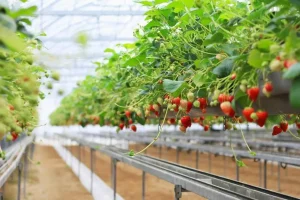
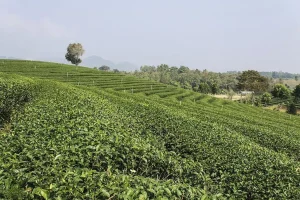
Beneficial microorganisms can support different agricultural scenarios. In row crops, they may be used to improve nutrient-use efficiency and root performance. In horticulture, they may support transplant establishment, stress tolerance and soil biological activity. In regenerative agriculture, they can be integrated with organic matter management, cover cropping and reduced chemical pressure.
For international B2B communication, the key is to avoid vague microbial claims and instead define application scenarios clearly. A product designed for phosphorus mobilization should be evaluated differently from a product designed for biocontrol, drought resilience or soil restoration.
This is where HYGEM / GEMBIOZ can build differentiated value: by connecting microbial function with crop category, soil condition, application timing, validation indicators and customer decision-making.
Conclusion: Beneficial Microbes as a Practical Platform for Sustainable Agriculture
Microorganisms are essential to the future of sustainable agriculture. They influence nutrient cycling, soil fertility, root development, biological pressure management and crop resilience. Yet their potential can only become commercial and agricultural value when microbial technologies are selected, formulated, validated and communicated with scientific discipline.
HYGEM / GEMBIOZ can position beneficial microorganisms not as simple agricultural additives, but as part of an integrated microbial bioengineering and microbiome BioSolutions platform. By combining strain discovery, microbiome engineering, omics technologies, fermentation expertise and field validation, HYGEM can help translate microbial science into practical tools for resilient and sustainable crop production.
Further Reading
Scientific References / Disclaimer
Scientific reference directions include peer-reviewed studies on plant-soil microbiomes, biofertilizers, biocontrol agents, plant growth-promoting rhizobacteria, microbiome engineering, synthetic microbial consortia, next-generation sequencing, metagenomics, metabolomics and sustainable agriculture.
Recommended source directions include Frontiers in Microbiology, Microbiome, Nature Reviews Microbiology, Applied and Environmental Microbiology, Trends in Biotechnology, Biotechnology Advances, Frontiers in Plant Science, Plant and Soil, FAO sustainable agriculture resources and international reports on soil health and regenerative agriculture.
Disclaimer: This article is intended for scientific communication and educational purposes only. HYGEM / GEMBIOZ microbiome technologies are positioned as agricultural resilience and soil health support tools. They should not be interpreted as guaranteed yield improvement, guaranteed disease control, fertilizer replacement, regulatory approval, or substitute for responsible agronomic management and field validation.