Keywords:poultry gut microbiome;short-chain fatty acids;mucus barrier;MUC2;butyrate;feed efficiency
Abstract
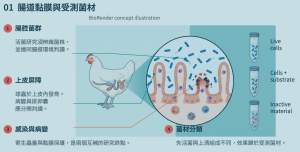
Intestinal health supports nutrient absorption, growth and environmental adaptation in poultry. Gut microorganisms use some carbohydrates that escape host digestion to form short-chain fatty acids (SCFAs), including acetate, propionate and butyrate, and participate in bile-acid transformation. These activities connect luminal substrates with epithelial, mucus and immune responses. The mucus barrier, maintained by goblet cells and mucins, regulates contact between microorganisms and the epithelium and constitutes an important ecological interface. Primary studies show mucus-layer, MUC2 and tissue-repair responses to particular fibers or butyrate interventions. Outcomes depend on intestinal site, age, material and inflammatory context, and local responses need not coincide with overall growth. This review asks how microbial metabolism may influence poultry growth through the mucus barrier, integrating community, metabolite, cellular and animal evidence, comparing divergent findings and considering the scientific and practical implications for microbial nutrition.[1, 2, 3, 4, 5, 6, 7]
1. Introduction | From community profiles to intestinal function
The same feed can produce different digestive and growth responses across flocks. Beyond host genetics and management, microbial processing of residual substrates and the epithelial response add another biological layer. Microbiome research is consequently moving from identifying organisms toward asking what they produce, where they act and how the host changes.[1, 4, 6]
The mucus barrier offers a useful entry point. It lies next to microorganisms while being continually generated by the host. Coordinated mucus secretion, epithelial renewal and local immune regulation allow the intestine to absorb nutrients and defend itself. This review follows substrates and metabolism through mucus and epithelial responses to host and growth outcomes, comparing community interventions with direct metabolite interventions.
2. Microbial metabolic networks: substrates shape the local chemical environment
2.1 Carbohydrate accessibility shapes different community functions
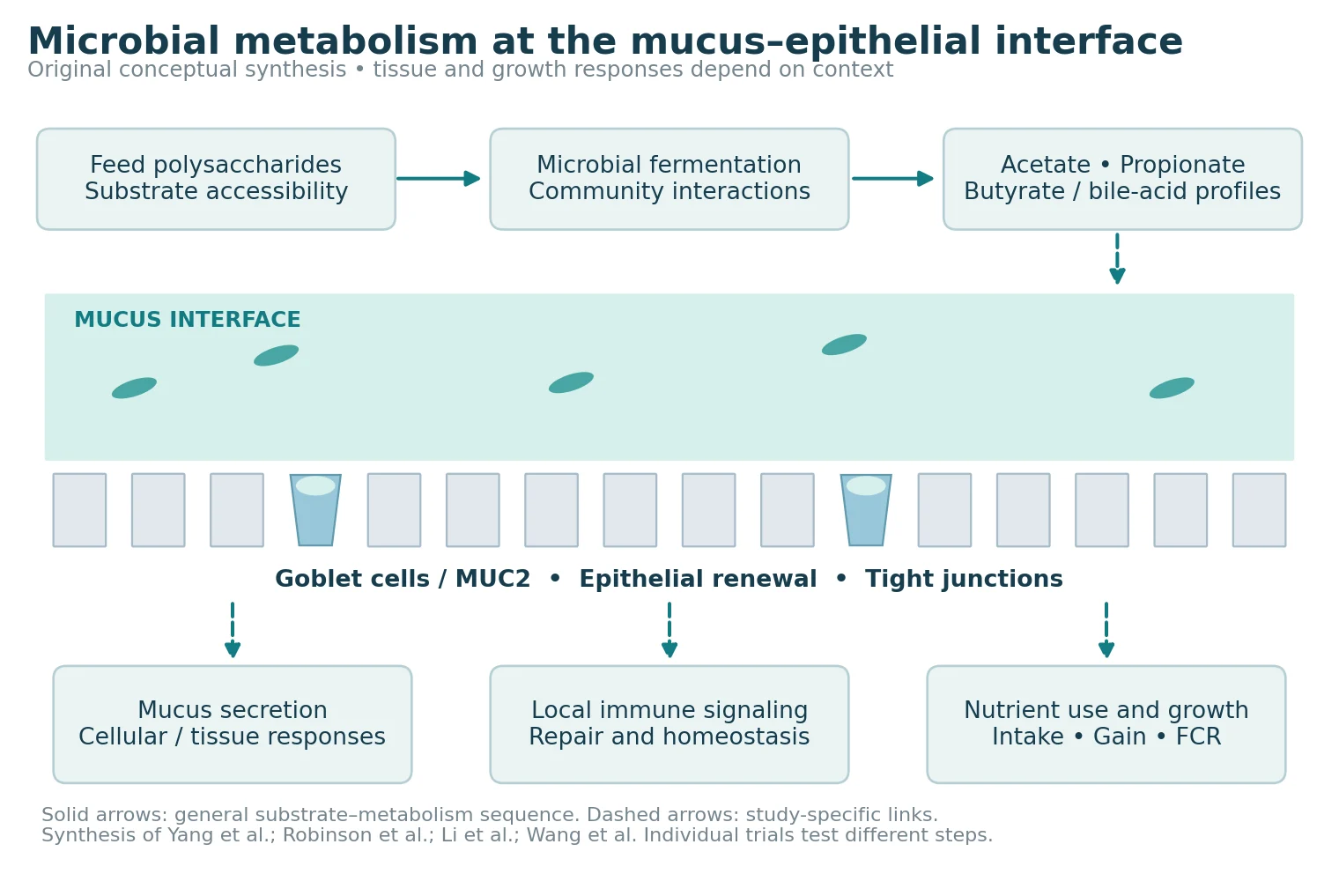
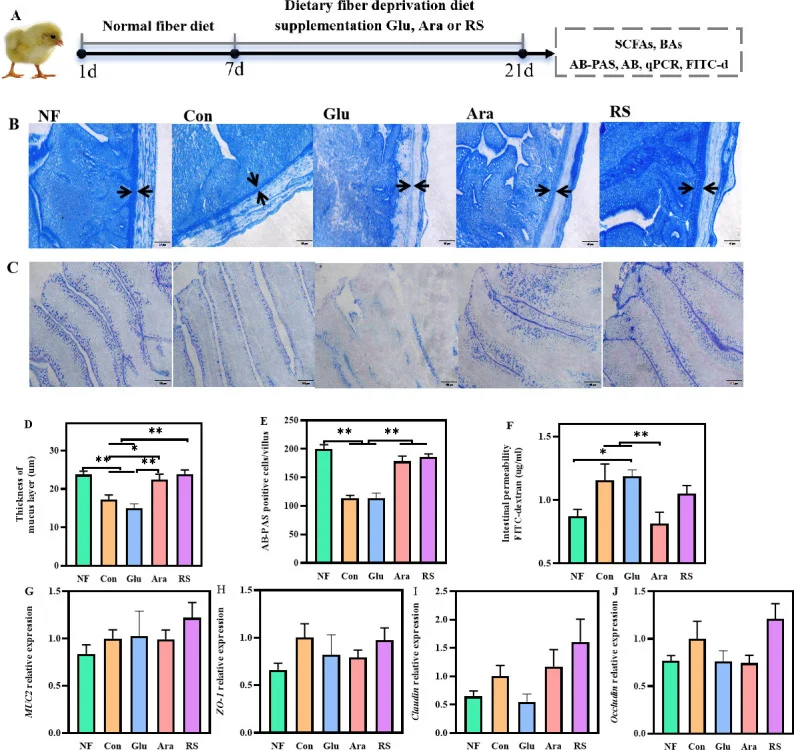
Carbohydrates reaching the distal intestine supply resources for organisms able to use them. Fiber structure and accessibility differ, as do community responses. Yang et al. compared beta-glucan, arabinoxylan and resistant starch by examining cecal-community substrate responses and then comparing normal-fiber, fiber-deprived and supplemented diets in birds. The design reveals interactions between specified substrates and existing communities, rather than one effect shared by every fiber.[1]
2.2 SCFAs and bile acids must be distinguished individually
Acetate, propionate and butyrate are all SCFAs, yet differ in production, utilization and distribution. Fermentation products can provide carbon used by hosts or other microorganisms and participate in cellular signaling. Measured concentration reflects production, absorption and intestinal movement together. In the Yang study, arabinoxylan and resistant starch changed selected SCFA and bile-acid profiles, but butyrate concentrations were similar among groups and cecal propionate differed from the fecal pattern. An increase in metabolites therefore requires a specified molecule and site.[1]
Direct butyrate-salt supplementation and stimulation of community fermentation also represent different evidence streams. The former examines host responses to an administered material; the latter additionally involves substrate use, community competition and metabolite fate. Together they outline a possible chain, with measurements required to connect its individual steps.[1, 2, 5]
3. The mucus barrier: goblet cells, MUC2 and the epithelium
3.1 Mucin secretion creates a continually renewing interface
Mucins secreted by goblet cells form a hydrated mucus interface; MUC2 is an important molecule in intestinal mucus research. This interface regulates contact between luminal contents and the epithelium while providing a setting for microorganisms near the host. Its significance extends beyond thickness to secretory cells, mucin expression and tissue condition.[1, 3]
The Yang study offers a direct broiler tissue comparison. Against fiber deprivation, arabinoxylan and resistant starch groups showed thicker ileal mucus and more positively stained cells, whereas beta-glucan did not show the same response. Some barrier-related messenger RNA measurements did not differ significantly, demonstrating that secretion and tissue changes can occur without matching transcriptional changes. Comparing expression, protein and morphology provides a fuller picture of mucus renewal.[1]
3.2 Mucus, tight junctions and cellular renewal support distinct barrier functions
Mucus regulates lumen–epithelium contact, while tight junctions help regulate permeability between adjacent epithelial cells. In a chemically induced intestinal-injury study, Li et al. observed changes in goblet cells, MUC2 protein, tight junctions and intestinal-stem-cell markers. Butyrate intervention accompanied recovery in these endpoints and epithelial morphology. This evidence connects mucus with tissue renewal and suggests that secretion and epithelial regeneration jointly support the barrier.[3]
4. Cross-study evidence: connecting local barriers with growth
4.1 Butyrate affects defense-related expression at distinct measurement levels
Robinson et al. examined butyrate and forskolin in chicken HD11 macrophages and animal experiments, observing responses in host-defense and MUC2-related genes. Combining the materials produced regulatory patterns different from either alone. The cellular model provides signaling and expression clues; goblet-cell secretion, mucus thickness and overall growth require corresponding tissue and animal measurements. This comparison also preserves the identity of the combination rather than assigning every effect to butyrate.[2]
4.2 Growth and feed conversion can diverge under immune stress
Wang et al. studied 96 male yellow-feathered broilers with sodium butyrate and immune stress as two factors, assessing jejunal barriers, liver metabolism and production. Overall daily gain was 14.05 g/day in the stress group and 15.64 g/day with combined sodium butyrate; the original table letters indicate a difference. Overall feed-to-gain ratio did not differ significantly. Better gain, intake or tissue endpoints therefore need not entail a corresponding change in feed required per unit gain.[5]
4.3 Community and live-strain interventions depend on timing and breed
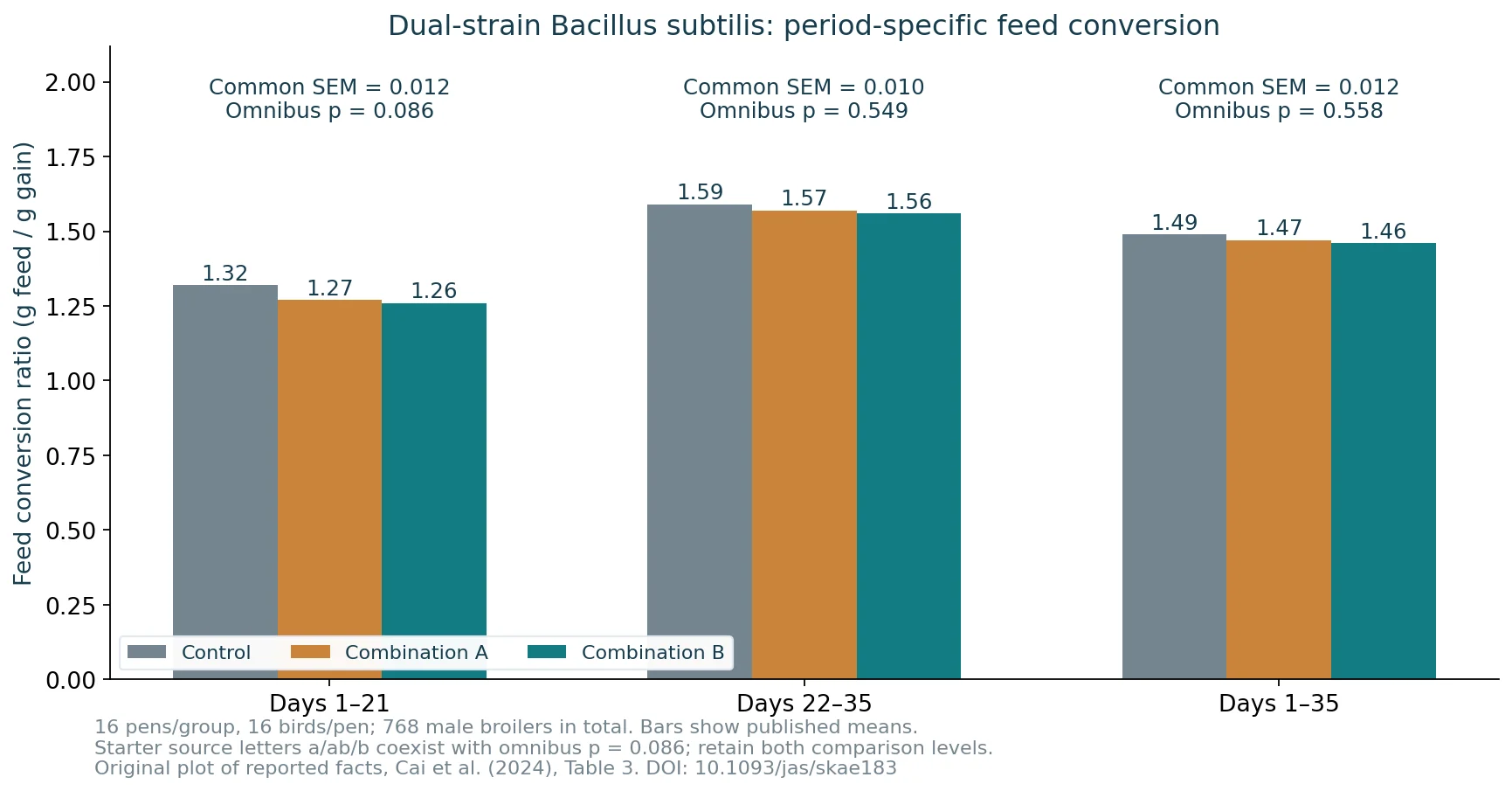
Cai et al. found selected local intestinal responses to a dual-strain Bacillus subtilis combination, but overall FCR means were 1.49, 1.47 and 1.46, omnibus p=0.558. Liu et al. observed jejunal-community, goblet-cell and subsequent body-weight responses after early whole-community intervention in longer-growing chickens. A specified live material and a whole community are distinct interventions; material, sampling site and follow-up duration help explain their different findings.[4, 6]
Another study transferred low-residual-feed-intake communities. Recipient community and metabolite profiles shifted, while mean RFI moved from 5.65 to 4.49 and the source described the production response as a tendency. RFI measures actual minus model-expected intake and answers a different question from FCR. Community changes help locate mechanistic clues, while the production effect must be read from actual endpoints in the same experiment.[7]
| Evidence stream | System and design | Main observations | Interpretation |
|---|---|---|---|
| Fiber and communities [1] | 200 broilers; substrate and fiber context | Distinct mucus, metabolite and expression responses | Specified fibers modify local interfaces |
| Butyrate/forskolin [2] | Chicken cells and animal comparisons; single/combined materials | Defense- and MUC2-related expression | Retain combination and measurement level |
| Butyrate/tissue renewal [3] | 24 broilers; three groups of eight; chemical intestinal injury | Goblet cells, MUC2, stem-cell and epithelial markers | Clues to metabolite–renewal mechanisms |
| Dual-strain live material [4] | 768 birds; three groups, 16 pens/group; 35 days | Local responses; overall FCR p=0.558 | Local and overall responses may diverge |
| Butyrate/immune stress [5] | 96 birds; 2×2 design; four groups, three replicates/group, eight birds/replicate | Daily gain recovery under stress; feed/gain nonsignificant | Host context affects production responses |
| Early community intervention [6] | Different breeds and longer follow-up | Jejunum, goblet cells and later body weight | Material, age and site contribute |
| RFI community intervention [7] | Huiyang bearded chickens; distinct efficiency communities | Community/metabolome shifts; lower RFI as a tendency | Read production outcomes from the trial |
5. Advanced integration: reciprocal epithelial–immune–metabolic regulation
Mucus and epithelium do more than receive microbial signals. Immune-cell responses to metabolites and local conditions interact with repair and secretion; epithelial renewal in turn changes the conditions near the host. Li et al. connected butyrate responses with Wnt/beta-catenin- and Notch-related signaling and stem-cell markers, providing a direct research direction for metabolite–tissue renewal interactions. Signaling changes require interpretation alongside protein, cellular and tissue findings, rather than establishing an entire pathway from one upregulated gene.[3]
A further connection concerns systemic nutrient allocation. Wang et al. examined jejunal, cecal and liver outcomes in the same framework, linking local barriers with lipid metabolism, immune stress and growth. The integrated picture is reciprocal: host state and microbial metabolism affect one another, while growth accumulates multiple physiological processes. The mucus layer is an important interface within this system, rather than its sole point of control.[5]
6. Implications and Future Research
Assessment of microbial nutrition can begin with the host problem and select materials and endpoints accordingly. Fiber studies concern substrates and community function; butyrate-salt studies concern metabolite delivery and host responses; live-strain studies require identification of the tested material and its behavior in the prevailing environment. Aligning material and question explains results more usefully than pursuing more species, higher diversity or a single metabolite concentration alone.[1, 2, 4, 5]
Future studies can follow community function, metabolites and mucus renewal within the same intestinal segment and combine these measurements with intake, gain and FCR to establish timing and persistence. Healthy and stressed flocks, and shorter- and longer-growing breeds, should remain distinguishable. This would identify reproducible mechanisms and those requiring particular diets or host conditions.[3, 5, 6, 7]
7. Conclusions
Poultry microbial metabolism can connect intestinal function and growth through local chemical conditions, mucus secretion, epithelial renewal and immune regulation. Current studies support several comparable links while showing material and contextual differences. Placing the mucus barrier within a shared nutrition–microorganism–host framework brings community profiling closer to function and supports decisions grounded in specific, traceable evidence.
💡 Frequently Asked Questions
Q1:Does increasing butyrate-producing bacteria necessarily improve the mucus barrier?
Actual metabolites and host responses need to be examined together. Genus proportions describe community composition; substrate accessibility, location and host state affect production and downstream responses. In the Yang study, mucus responses did not coincide with increased butyrate concentration.[1]
Q2:Does increased MUC2 expression mean better feed efficiency?
MUC2 provides information about a mucus-related response, whereas efficiency requires intake and gain data. Local barriers can respond without a significant overall FCR difference; each endpoint must be interpreted at its measurement level.[3, 4, 5]
Q3:Why do microbial-nutrition studies produce different results?
Differences include the tested material, basal diet, intestinal site, breed, age, immune stress and observation period. Identifying these conditions before comparing metabolites, tissue and production outcomes helps locate the responding part of the system.[1, 4, 5, 6, 7]
Selected References
- Yang J, Qin K, Sun Y, Yang X, Liu J (2023). Microbiota-accessible fiber activates short-chain fatty acid and bile acid metabolism to improve intestinal mucus barrier in broiler chickens. Microbiology Spectrum 12(1): e02065-23. doi:10.1128/spectrum.02065-23
- Robinson K, Yang Q, Li H, Zhang L, Aylward B, Arsenault RJ, Zhang G (2021). Butyrate and Forskolin Augment Host Defense, Barrier Function, and Disease Resistance Without Eliciting Inflammation. Frontiers in Nutrition 8: 778424. doi:10.3389/fnut.2021.778424
- Li R, Quan T, Chen Y, Gao T (2026). Butyrate improves dextran sulfate sodium-induced imbalance of intestinal stem cell homeostasis in broilers. Poultry Science 105(2): 106307. doi:10.1016/j.psj.2025.106307
- Cai Y, Xiao C, Tian B, Dorthe S, Meuter A, Song B, Song Z (2024). Dietary probiotic based on a dual-strain Bacillus subtilis improves immunity, intestinal health, and growth performance of broiler chickens. Journal of Animal Science 102: skae183. doi:10.1093/jas/skae183
- Wang L, Cheng J, Shan X, Shi Y, Wang Q, Pan S, Lu Y (2026). Sodium butyrate ameliorates lipid metabolism disorder, intestinal injury, and microbial dysbiosis in broilers under lipopolysaccharide-induced immune stress condition. Poultry Science 105(2): 106263. doi:10.1016/j.psj.2025.106263
- Liu Q, Akhtar M, Kong N, Zhang R, Liang Y, Gu Y, Yang D, Nafady AA, Shi D, Ansari AR, Abdel-Kafy ESM, Naqvi SUAS, Liu H (2025). Early fecal microbiota transplantation continuously improves chicken growth performance by inhibiting age-related Lactobacillus decline in jejunum. Microbiome 13: 49. doi:10.1186/s40168-024-02021-6
- Xie C, Liang Q, Cheng J, Yuan Y, Xie L, Ji J (2025). Transplantation of fecal microbiota from low to high residual feed intake chickens: Impacts on RFI, microbial community and metabolites profiles. Poultry Science 104(1): 104567. doi:10.1016/j.psj.2024.104567