
Buying microbial feed additives requires product identity, quality, relevant evidence and actual costs to enter the same decision. Comparing price per kilogram, total microbial counts or one presentation can mix different materials and different promises. This framework is intended for feed mills, livestock businesses and technical purchasing teams. Start with a production problem, request information that matches the product to be delivered, and then decide whether a limited adoption evaluation is justified. No supplier or product is assumed to have passed the assessment.

Start microbial feed additive procurement with a needs statement
The statement should identify target animals, production stage, current management and the main unresolved issue. When feed efficiency is the objective, first establish how it is calculated and recorded. When consistent quality is the priority, identify the specifications that must remain relevant through delivery and storage. Priorities may differ; “improves everything” is not an acceptance criterion.
The buyer should distinguish essential requirements from desirable comparison items. An attractive price or performance percentage should not compensate for untraceable material and supply information. This is a proposed purchasing principle, not a statutory scoring system. Compliance review still depends on the product and destination market.
Microbial feed additive purchasing workflow
Requirements
Product Identity
Efficacy Fit
Cost Boundary
Decision Record
Proposed editorial workflow; not a completed experiment, causal mechanism or statutory approval process.
Documents should identify the delivered material
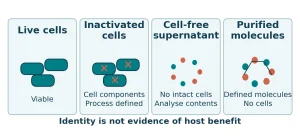
The dossier should connect the trade name, material type, strain or relevant composition, manufacturing batch and analytical records. Live organisms, inactivated preparations and fermentation-derived materials may require different quality indicators. If evidence concerns another formulation, the supplier should explain similarities and differences so that technical staff can assess relevance. Sharing a species name does not establish equivalence.
EFSA’s 2025 microorganism-characterisation guidance treats identity and potential hazards as questions requiring specific information. It helps explain the purpose of such evidence. A genome report alone is neither market authorization nor proof of safety and efficacy in every setting. The EU assessment framework should not be presented as the law of other markets.[2]
| Document | Purpose | Does not establish alone |
|---|---|---|
| Material and batch specification | Identify delivery and traceability | Field efficacy |
| Analytical report | Results for a sample and method[3] | Equivalence across all batches and methods |
| Identity and risk-assessment information | Define material and hazards to assess[2] | Authorization in every market |
| Complete efficacy report | Review material, comparison and outcomes[1] | Identical improvement in every setting |
Compare counts only with compatible methods and units
CFU and PCR signals answer different measurement questions. Catone and colleagues compared culture and PCR in one commercial live-bacteria capsule preparation and showed that the method affects the resulting counts. This was not an animal-efficacy study of a feed additive and provides no universal conversion factor for all products.[3]
A purchasing comparison should therefore record method, unit, sampling time, batch and applicable material beside the numerical result. If suppliers use different methods, mark the values as not directly comparable and request clarification. Higher CFU is also an unsuitable general quality requirement for an inactivated material. Detailed method validation and storage stability belong in the product-specific technical dossier.
Match efficacy evidence to the buyer’s production question
EFSA’s feed-additive efficacy guidance calls for defined test materials, outcomes, comparisons and experimental units. In group housing with shared feed and no individual intake records, animals in one pen should not each be counted as independent treatment replicates. Buyers should request the complete report to examine the sample structure and uncertainty.[1]
A practical comparison can distinguish evidence that matches the current material and setting, evidence that needs a justified bridge, and evidence that does not support the intended claim. These are proposed purchasing categories, not a universal ranking. A larger study on a different material may be less relevant than a smaller, well-matched investigation.
| Evidence status | Purchasing interpretation | Next step |
|---|---|---|
| Material and setting match | Relevant to this evaluation | Review complete report and uncertainty |
| Partly relevant | A justified bridge is needed | Identify differences and missing information |
| Does not support the claim | Do not use it to estimate benefit | Find relevant evidence or narrow the claim |
Compare total cost within the same boundary
Cost comparison should include the product, freight, testing, storage, introduction and necessary technical services over the same period and output boundary. Establish whether services are included, who pays for testing and how nonconforming batches are handled. Missing prices need not be invented. First identify the source, owner and unresolved terms for each item.
Incremental net value can be organized as added revenue plus avoided cost minus additional product and implementation costs. Each term requires its own comparison. Without adequate site data, scenarios may be useful if assumptions remain explicit; projected values must not be presented as realized returns. When feed-efficiency data are used, output, survival and calculation methods also need a compatible basis. Management-related changes should not all be credited to the additive.
Keep reassessment and exit conditions visible
Before a limited adoption evaluation, agree on the main decision indicators, record retention, exception reporting and triggers for reassessment. A changed formulation, nonconforming batch or substantially different production setting may require the original conclusion to be revisited. Purchasing, quality and site staff should confirm these arrangements together and document them rather than relying on an oral sales promise.
Supplier value also includes transparent information: traceable documents, an accurate account of evidence limitations and a workable contact for resolving problems. Those conditions can enter the comparison, but a subjective service score should not hide missing material or quality evidence.
Frequently asked questions
Can suppliers be selected on price per kilogram alone? First determine whether the offers contain comparable materials, quality and services. Even the least expensive option must meet essential requirements and have clear delivery and exception-handling terms.
Does a published paper justify immediate adoption? It is one part of assessment. The delivered material, target animals, setting and comparison still need to match. Preserve a record of what is supported, what remains missing and what cannot be inferred, so that a later update or renewal uses the same basis.
References
- [1] EFSA Panel on Additives and Products or Substances used in Animal Feed (FEEDAP), Bampidis V et al. (2024). Guidance on the assessment of the efficacy of feed additives. EFSA Journal 22(7): e8856. doi:10.2903/j.efsa.2024.8856
- [2] EFSA Scientific Committee, Bennekou SH et al. (2025). Guidance on the characterisation of microorganisms in support of the risk assessment of products used in the food chain. EFSA Journal 23(11): e9705. doi:10.2903/j.efsa.2025.9705
- [3] Catone S, Iannantuono S, Genovese D, Von Hunolstein C, Franciosa G (2024). Viability-PCR for the selective detection of Lactobacillus acidophilus and Bifidobacterium bifidum in live bacteria-containing products. Frontiers in Microbiology 15: 1400529. doi:10.3389/fmicb.2024.1400529
Industry information and purchasing assessment; not evidence of efficacy for a particular company product or site.