
International discussion of livestock antimicrobial stewardship and microbial nutrition is bringing attention back to disease prevention, responsible medicine use and verifiable production management. For feed and livestock businesses, a product described as an “antibiotic alternative” or a reduction reported for one period is insufficient to establish a trend. The underlying years, animal-biomass denominator and destination market matter. This article considers how microbial nutrition can enter business decisions without assuming that any product can replace necessary veterinary treatment.

The latest antimicrobial-use trend is not a continuous decline
The WOAH report published in May 2026 previews a comparable 2022–2024 series: 97 consistently reporting Members, covering approximately 64% of global animal biomass, reported an increase from 91 to 95 milligrams per kilogram of animal biomass. WOAH summarizes the change as 4%. These are aggregated Member data, not a farm experiment or an assessment of microbial feed additives.[1]
WOAH comparable reporting cohort: 2022 and 2024 endpoints
2022
91 mg/kg
2024
95 mg/kg
Common bar scale: 0–100 mg/kg.
97 Members, approximately 64% of global animal biomass; mg/kg animal biomass. WOAH reports a 4% increase; 91 and 95 are rounded endpoints, not a basis for recalculating the exact percentage. No 2023 value or error bars are invented. Members are not farm or animal trial replicates.[1]
Numerical values and source
| Data year | mg/kg |
|---|---|
| 2022 | 91 |
| 2024 | 95 |
WOAH (2026), printed p.178 / PDF p.182. doi:10.20506/woah.3742
The earlier 2025 factsheet reported an approximately 5% decline for 2020–2022 in a different cohort of 85 consistently reporting countries. Different periods and reporting groups must not be joined into one continuous numerical series. A decrease in one interval does not establish a sustained global decline.[2]
Publication year and observation year also need separate labels. A business presentation prepared in 2026 should identify 2024 when that is the year measured. This makes the reporting lag visible. National aggregates should not be transferred directly to a particular species, supply chain or operating site.
Translate international signals into a specific business question
A useful starting point is the pressure a customer actually faces: a changed purchasing specification, incomplete quality records, unstable performance at a particular production stage, or a need for better medicine-use and health records. Each problem requires different information and a different collaboration. Calling all of them a demand for one antibiotic-replacement product obscures those differences.
Export businesses should distinguish national requirements, individual buyer specifications and voluntary company standards. This article does not interpret country-specific law. Before entering a market, the destination, product category and intended claims require appropriate review. A working register can identify the market, source of the requirement, affected products, version date and responsible contact. A local specification should not become an assertion about universal rules.
From industry signals to an evaluation question
Buyer Context
Material Scope
Evidence Fit
Adoption Criteria
Review Cycle
Proposed editorial workflow; not a completed experiment, causal mechanism or statutory approval process.
Identify the microbial material before discussing its value
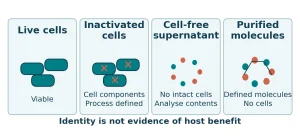
Live preparations, inactivated microbial preparations and fermentation-derived materials may appear in similar commercial discussions, but their efficacy evidence is not interchangeable. The ISAPP postbiotic consensus includes an inanimate microbial preparation and/or its components together with a host health benefit. The absence of live cells alone does not establish that a product meets this definition.[3]
Technical and commercial teams should therefore agree on the material name before discussing target animals and uses. Evidence for a particular live formulation should not be transferred automatically to a different fermentation filtrate or inactivated preparation. The task is to match the material with its claim, rather than to raise expectations through newer terminology.
| Discussion | Clarify first | Do not infer |
|---|---|---|
| Live preparation | Actual strain, formulation and target animals | Equal counts imply equal function |
| Inactivated or fermentation-derived material | Composition, terminology and relevant studies[3] | No live cells means a proven postbiotic |
| International use data | Observation years, cohort and denominator[1, 2] | A product caused a national change |
Turn market information into a bounded product plan
An actionable plan identifies the buyer, setting and unresolved problem before stating what the available evidence can support. Replacing a broad promise of complete antibiotic replacement with a defined production outcome and conditions for evaluation gives research, sales and customer teams a shared question. This is a proposed planning approach, not a report of completed field validation.
Information can be managed in three layers. External trends identify direction; product studies define the claims that may be considered; customer-setting data examine conditions for adoption. The layers complement one another but do not substitute for one another. An international stewardship target is not evidence that a particular additive has delivered the same result.
Supplier communication should retain uncertainty. Preliminary findings can identify a worthwhile question and the information still needed. More developed evidence should identify the material, animal population, comparison and main outcome. This gives the buyer a basis for further evaluation without turning a research possibility into a commercial guarantee.
Monitor more than sales and antimicrobial totals
A recurring business review can track four kinds of information: official indicators with their observation years, changes in target-buyer specifications, the scope of product evidence, and the costs and service conditions required for adoption. Each update should preserve its source and date while distinguishing reported facts from the company’s interpretation. This supports cross-functional decisions better than a collection of unrelated percentages.
For existing customers, product evaluation and wider management changes should be documented separately. If diets, hygiene or husbandry also change, several explanations may account for the observed outcome. Responsible analysis presents that context instead of attributing every change to microbial nutrition. Unfavorable or inconclusive findings should also remain in the record so that later decisions retain the full context.
Frequently asked questions
Does stewardship mean never using antimicrobials?
The direction discussed here is prevention and responsible use. Diagnosis and treatment of sick animals require veterinary judgement. A commercial objective should not delay necessary care, and evaluation of microbial nutrition should not define success as withholding needed treatment.
Can an international trend support product promotion directly?
It can explain why research and management improvement deserve attention. A product claim still requires evidence for the relevant material. A more dependable business approach connects the need, research and adoption conditions step by step, then revisits its interpretation when new information becomes available.
References
- [1] World Organisation for Animal Health (WOAH) (2026). The State of the World’s Animal Health 2026. WOAH, Paris 192 pp.; printed p.178 (PDF p.182). doi:10.20506/woah.3742
- [2] World Organisation for Animal Health (WOAH) (2025). An overview of antimicrobial use in animals. WOAH official factsheet 2025 edition; 2020–2022 trend cohort. Official source
- [3] Salminen S, Collado MC, Endo A et al. (2021). The International Scientific Association of Probiotics and Prebiotics (ISAPP) consensus statement on the definition and scope of postbiotics. Nature Reviews Gastroenterology & Hepatology 18: 649–667. doi:10.1038/s41575-021-00440-6
Industry information and purchasing assessment; not evidence of efficacy for a particular company product or site.