
The functions of microbial preparations depend on the material tested and the context in which it is used. Live microorganisms, inactivated cells, cell-free supernatants and purified metabolites can originate from the same strain while differing in composition and conditions of action. Comparing their value requires connecting material identity and processing with molecular activity and host outcomes. This review uses studies of lactic acid, butyrate, plant-active lipopeptides and broiler fermentation supernatants to examine evidence for sources of activity and results that remain attributable to the preparation as a whole. A recent human study of an inactivated microorganism illustrates progress in a different host setting. [1, 2, 3, 4, 5, 6]
Identify the material before using the term postbiotic
The definition proposed by ISAPP in 2021 describes a postbiotic as a preparation containing inanimate microorganisms and/or their components that confers a health benefit on the host. Both composition and evidence of benefit matter. Under this framework, purified lactic acid, butyrate and individual lipopeptides should be identified by their chemical names. A filtrate without cellular components does not become a postbiotic simply because it comes from probiotic fermentation. This review follows that definition while preserving the terminology used by individual papers. [1]
Cell-free supernatant (CFS) indicates that intact cells have been removed; it does not establish the identity of every active constituent. CFS may contain metabolites and residual culture-medium components, and analysis is still needed to determine whether cell-derived components are present. Complex fermentation preparations may retain cells, substrate and multiple products. Consequently, the effect of a whole preparation cannot be assigned directly to one constituent, and results obtained with live cells do not replace evidence of benefit after inactivation. [1, 4]
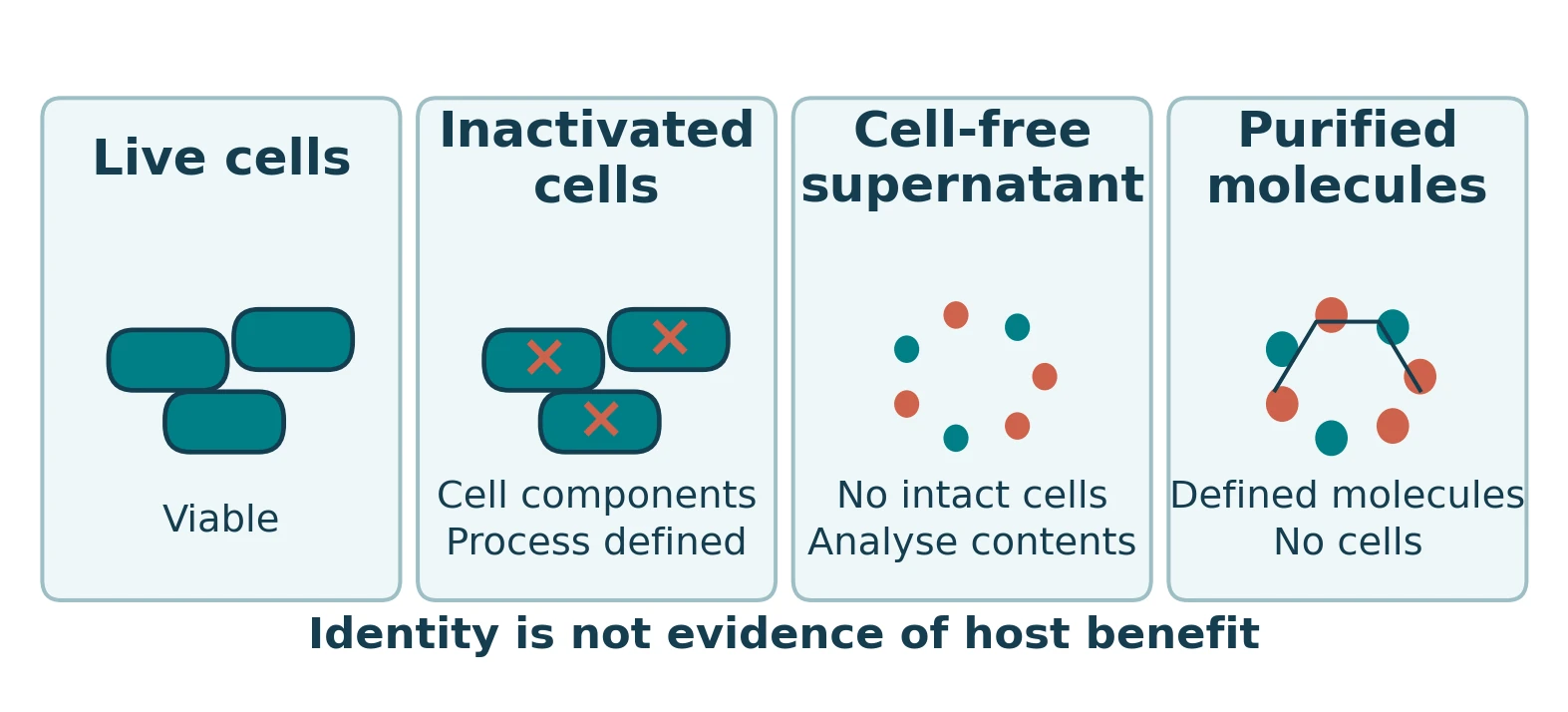
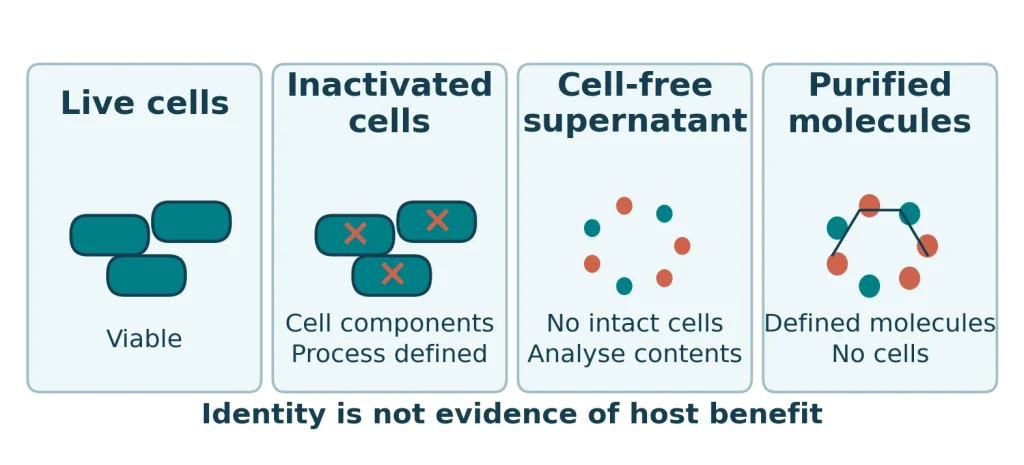
Original conceptual illustration organized around ISAPP material boundaries; it contains no experimental values, sample sizes or statistical comparisons. Live cells, inactivated cells, CFS and purified molecules are identified separately. Whether CFS contains cellular components requires analysis. Dots and rings are category symbols, not chemical structures. Under the definition used here, a preparation is called a postbiotic only if it meets the material criteria and demonstrates benefit in the target host. [1]
Table 1. Material terminology and interpretation
| Material | Identity | Interpretation of benefit |
|---|---|---|
| Live microorganisms | Viable at the time of use | Identify the tested strain, preparation and host |
| Inactivated cells/components | Inactivated, with cells or cellular components retained | May be called a postbiotic when the definition and host-benefit criteria are met [1] |
| Cell-free supernatant | Intact cells removed; composition still requires analysis | The name alone does not establish postbiotic status [1, 4] |
| Complex fermentation preparation | Cells, substrate and products vary with processing | Attribute the effect to the tested preparation as a whole [1] |
| Purified metabolites | Describe chemical identity or homologue composition | Evaluate molecule-specific and host-specific evidence [1, 3, 5] |
Organic acids act through environmental effects and host signaling
The direct effects of lactic acid depend first on the acid–base environment. In an in vitro study, Alakomi and colleagues showed that lactic acid can alter the permeability of the outer membrane of Gram-negative bacteria in addition to lowering pH. This supports distinguishing acidity-related effects from the actions of other constituents when interpreting fermentation supernatants. Translating a membrane effect observed in culture into a host application requires considering intestinal buffering, dilution and the site of action. [2]
A separate functional line of evidence for butyrate comes from host cells. Chang and colleagues studied mouse bone-marrow-derived and intestinal lamina propria macrophages. Butyrate reduced some inflammatory mediators, including IL-6, IL-12 and nitric oxide, without similarly suppressing TNF-α or MCP-1. Evidence related to histone deacetylase inhibition was used to explain this selective response. The findings indicate that a metabolite can alter cellular transcriptional states rather than uniformly switch off immune responses. This is mechanistic evidence from specific mammalian models, not a direct estimate of livestock or poultry growth effects. [3]
Lipopeptide structural differences change plant responses
Lipopeptides also cannot be compared by total concentration alone. In 2025, Ding and colleagues compared surfactin-, lichenysin- and pumilacidin-type materials and found that closely related cyclic lipopeptides did not elicit identical calcium, reactive oxygen species or nitric oxide responses in Arabidopsis. The tested materials were purified mixtures that still contained homologues with different fatty-acid chains. They are not generic substitutes for any Bacillus fermentation broth. [5]
Panels A and B of Figure 2 show more pronounced intracellular calcium responses to Srf and Liche, whereas the Pumi response was not statistically significant. Panels C and D use calcium perturbation to support a calcium-dependent nitric-oxide-related response to Srf. The study also observed plant protection with Srf and Liche. However, although some defense genes were upregulated, mutations in the corresponding genes did not eliminate protection. Gene expression changes and mechanistic necessity therefore remain distinct. These results concern the tested plants and molecules and do not establish general efficacy in crop field settings. [5]
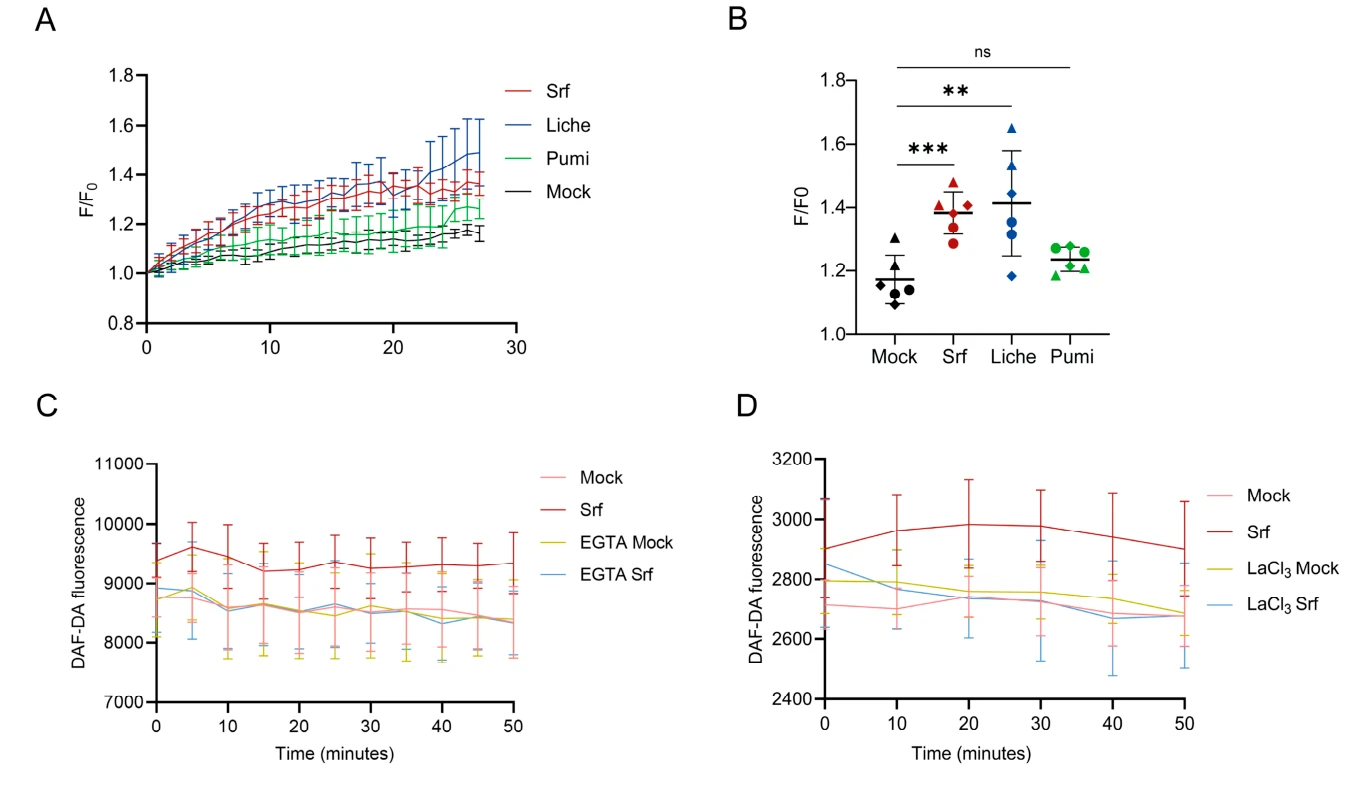
Ding et al., original Figure 4, using Arabidopsis Col-0 roots or root protoplasts and lipopeptides at 10 µM. A shows normalized Fluo-4 calcium fluorescence, F/F0, with n = 6 from three independent experiments; B compares lipopeptides with Mock, with n = 6 from two independent experiments. Srf denotes surfactin, Liche lichenysin and Pumi a mixture of pumilacidin homologues. C and D show nitric-oxide-related signals measured with DAF-DA fluorescence, with n = 8 from two independent experiments. Error bars represent SD. In B, two-tailed t tests use **p < 0.01, ***p < 0.001 and ns for not significant. Visible labels show EGTA in C and LaCl3 in D, whereas the original caption reverses the intervention names. The original panels are preserved and this discrepancy is noted. The reported n represents measurement replicates and must not be treated as a count of independent field-grown plants. [5]
Broiler supernatant studies provide evidence for the whole material
Humam and colleagues compared CFS from three Lactobacillus plantarum strains, RI11, RS5 and UL4, in broilers; the paper calls these materials postbiotics. The study included 252 male broilers in six groups, with seven replicate cages per group and initially six birds per cage. Birds underwent cyclic heat stress from 22 to 42 days of age. By recording the material separately from its classification under the current definition, the study can inform the performance of particular supernatants under particular husbandry stress. It does not estimate an average effect of all postbiotics. [4]
Table 4 reports a feed conversion ratio (FCR) of 1.61 for RI11 and 1.72 for the basal-diet group; values and statistical groupings also differed among the three CFS materials. The abstract, results narrative and discussion repeatedly describe a higher FCR, but the tabulated values and the feed-to-gain definition in the methods indicate the opposite direction. This inconsistency is retained here rather than treating the narrative as numerical evidence. Mortality counts differed, but the overall test gave p = 0.636 and does not support a claim of reduced mortality. High mortality and incomplete information on mortality/culling adjustment also limit extrapolation of the production data. [4]
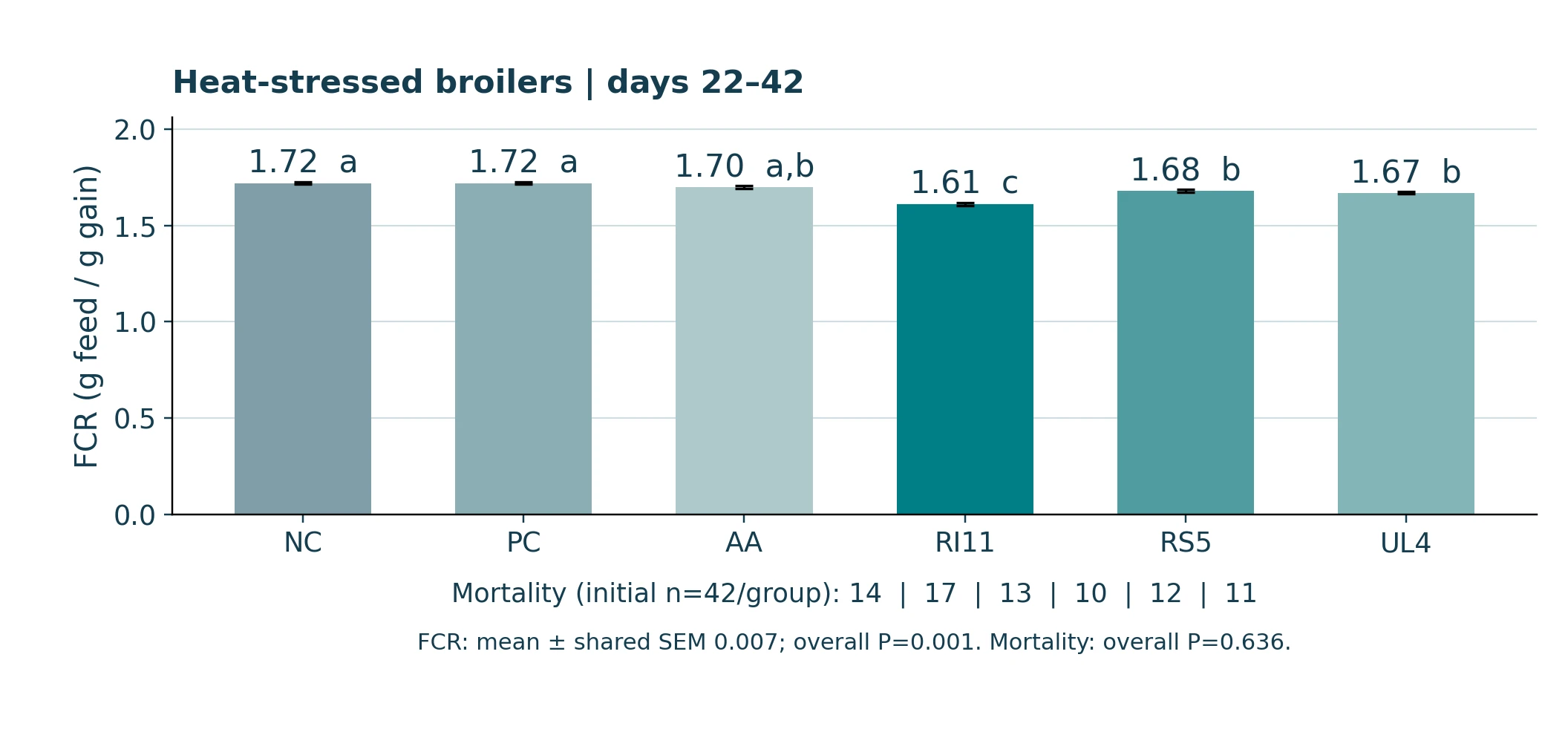
Redrawn from Humam et al., Table 4: male Cobb 500 broilers under heat stress from 22 to 42 days of age. NC is the basal diet; PC is the oxytetracycline comparator; AA is the ascorbic-acid comparator; RI11, RS5 and UL4 are CFS from the respective L. plantarum strains. Each group initially had 42 birds in seven cages of six birds; cages were dietary replicates. Effective endpoint bird numbers per cage were not fully reported. Bars show the published means with a shared SEM of 0.007. FCR is expressed in g/g; lower values indicate less feed per unit gain. The overall p value is 0.001; groups without a shared letter differ at p < 0.05 by the original Duncan test. Mortality counts below the chart are descriptive; the six-group chi-square test gave p = 0.636 and was not significant. No additional mortality error bars or pairwise tests are inferred. The source narrative and FCR table disagree on direction. [4]
Benefits of inactivated microorganisms require matching hosts and endpoints
Inactivated microorganisms can themselves be tested as intervention materials. In a 2026 randomized trial, Mount and colleagues enrolled 90 adults with overweight or obesity. An initial weight-loss phase was followed by a 24-week comparison of pasteurized Akkermansia muciniphila MucT and placebo for weight maintenance. The public abstract reports less weight regain in the intervention group, supporting a measurable human function for this specific inactivated preparation. Only the abstract is used here; the finding is not extended into a comprehensive safety assessment or extrapolated to animal feed or other strains. [6]
Connect material characterization and functional testing into traceable evidence
For a microbial technology platform, comparing materials requires at least two complementary data streams. One describes the strain, viability state, substrate and processing. The other describes measured function, including the physicochemical environment, cellular or tissue responses and target-host endpoints. Molecular concentrations can characterize a batch, while functional assays test whether that batch retains the activity under investigation. Without both, the connection between a research sample and a subsequent product is difficult to establish reliably. [1, 3, 4, 5]
Different levels of data also require different conclusions. Lactic-acid outer-membrane permeability data support a direct physicochemical action; macrophage studies support specific immune modulation; calcium perturbation in plants supports a mechanistic connection; and broiler FCR is a production endpoint for a whole material. Considering these findings together can inform material selection and quality interpretation. It does not justify combining positive findings across materials and species into a complete causal chain for a single product. [2, 3, 4, 5]
An application-relevant specification therefore needs more than a metabolite list or a microbial count. It should state which material was measured, which indicators are reproducible and the host and setting in which benefit has been demonstrated. Public communication can disclose research-material identity, endpoints and limitations, while unpublished company formulations and processing details remain in controlled technical documents. This keeps material terminology, mechanistic inference and application benefits open to verification.
Table 2. Questions answered by different types of evidence
| Material and setting | Direct finding | Scope of support |
|---|---|---|
| Lactic acid / bacteria in vitro | Altered outer-membrane permeability [2] | Direct action, not an animal benefit |
| Butyrate / mouse macrophages | Reduced levels of some inflammatory mediators [3] | Selective modulation of host cells |
| Three CFS materials / heat-stressed broilers | Different FCR values; mortality difference not significant [4] | Whole materials in a specific dietary setting |
| Lipopeptide homologues / Arabidopsis | Different calcium and NO responses [5] | Molecular structure and plant responses |
| Pasteurized MucT / adults | Less weight regain reported in the abstract [6] | Human abstract evidence; no extrapolation to animals |
Figure sources
Figure 1. Microbial material composition and evidence requirements:Original concept illustration based on Salminen et al. (2021);Original artwork; no published figure layout reproduced.
Figure 3. FCR results for different supernatants within the same study:Humam et al. (2019), Table 4; redrawn from published data.;CC BY 4.0; data redrawn with attribution.
Figure 2. Lipopeptide structure, plant calcium signaling and nitric oxide responses:Ding et al. (2025), Figure 4 A–D; complete figure cropped from the original PDF without altering data.;CC BY 4.0; Ding et al.; complete figure cropped.
CC BY 4.0:License terms. Original Figure 4 retains all panels and labels; only surrounding article text was cropped.
References
[1] Salminen S, Collado MC, Endo A, et al. (2021). The International Scientific Association of Probiotics and Prebiotics (ISAPP) consensus statement on the definition and scope of postbiotics. Nature Reviews Gastroenterology & Hepatology, 18:649–667. doi:10.1038/s41575-021-00440-6; Correction records: 10.1038/s41575-021-00481-x, 10.1038/s41575-021-00506-5, 10.1038/s41575-022-00628-4
[2] Alakomi HL, Skyttä E, Saarela M, Mattila-Sandholm T, Latva-Kala K, Helander IM. (2000). Lactic acid permeabilizes gram-negative bacteria by disrupting the outer membrane. Applied and Environmental Microbiology, 66(5):2001–2005. doi:10.1128/AEM.66.5.2001-2005.2000 (abstract only)
[3] Chang PV, Hao L, Offermanns S, Medzhitov R. (2014). The microbial metabolite butyrate regulates intestinal macrophage function via histone deacetylase inhibition. Proceedings of the National Academy of Sciences USA, 111(6):2247–2252. doi:10.1073/pnas.1322269111
[4] Humam AM, Loh TC, Foo HL, Samsudin AA, Mustapha NM, Zulkifli I, Izuddin WI. (2019). Effects of Feeding Different Postbiotics Produced by Lactobacillus plantarum on Growth Performance, Carcass Yield, Intestinal Morphology, Gut Microbiota Composition, Immune Status, and Growth Gene Expression in Broilers under Heat Stress. Animals, 9(9):644. doi:10.3390/ani9090644
[5] Ding N, Dong H, Thomas R, Gilliard G, Pršić J, Ongena M. (2025). Surfactin Structural Variants Differentially Modulate Plant Immune Responses. Biomolecules, 15(10):1479. doi:10.3390/biom15101479
[6] Mount S, Canfora EE, Jocken JW, et al. (2026). Pasteurized Akkermansia muciniphila MucT for weight loss maintenance in people with overweight and obesity: a controlled randomized trial. Nature Medicine, 32(6):2107–2116. doi:10.1038/s41591-026-04394-7 (abstract only)
For research education and technical interpretation; these findings do not establish equivalent benefits for any company product.