
The commercial landscape for microbial feed additives and bio-based solutions has shifted dramatically from a margin-driven commodity market to a high-value, efficacy-proven specialty sector. However, the path to market saturation is frequently blocked by a critical bottleneck: translating complex biotechnology into clear economic value on the production floor.
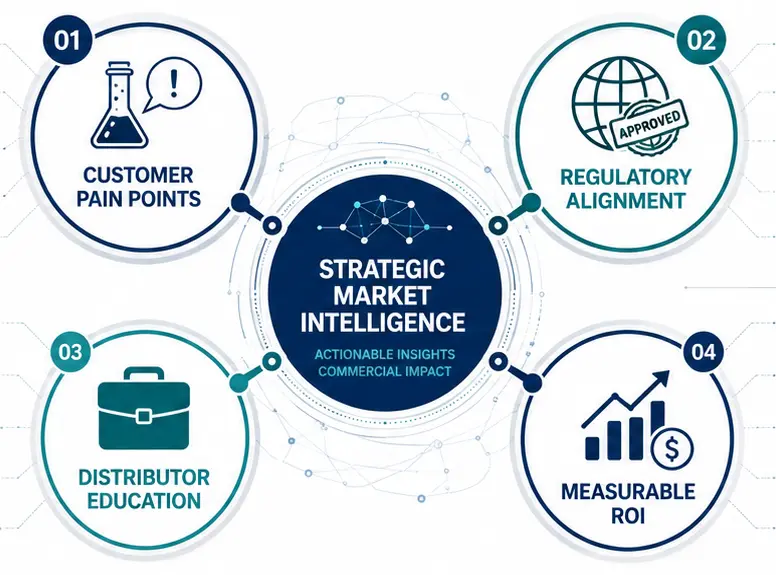
For life science enterprises, long-term commercial success requires a sharp market intelligence framework that bridges the gap between laboratory milestones and field-level realities. Winning global market share demands a tight alignment across four essential commercial axes, creating a closed loop that connects scientific attributes directly to economic returns.
│
▼
[ REGULATORY ALIGNMENT ] ───┼─── [ DISTRIBUTOR EDUCATION ]
▲
│
[ MEASURABLE ROI ]
1. Mapping Technical Attributes to Field Realities
The ultimate buyer—whether an integrator, a feed mill manager, or a farm owner—does not buy a specific bacterial strain or a genome sequence; they purchase a reliable solution to an operational headache. Market intelligence must map scientific claims directly onto day-to-day husbandry or manufacturing bottlenecks:
| Scientific Attribute / Claim | Operational Pain Point Addressed |
|---|---|
| High Heat-Stability (Spore-Formers) | High pelleting temperatures exceeding 90°C destroying enzyme and probiotic viability during intensive feed manufacturing processes. |
| Broad pH Tolerances (2.0 – 8.5) | High stomach/proventriculus mortality of beneficial bacteria before they can successfully reach and colonize the target intestinal site. |
| Targeted Quorum Quenching | Rising operational mortality rates driven by sub-clinical pathogens under increasingly strict antibiotic-free (ABF) production mandates. |
| Enhanced In-Vivo Amylase/Protease Production | Volatile raw material prices forcing the inclusion of lower-quality, high-fiber alternative ingredients without sacrificing growth metrics. |
2. Navigating the Evolving Regulatory Matrix
Modern regulatory frameworks no longer just validate baseline safety; they actively shape market entry timelines and product positioning strategies. Market intelligence must map these barriers globally to optimize R&D pipelines and avoid costly market launch delays:
- EFSA (Europe): Regarded as the gold standard for safety, requiring strict genomic profiling to prove the absolute absence of transferable Antimicrobial Resistance (AMR) genes. Product positioning in this region leans heavily into sustainability indices, carbon footprint reduction, and strict functional claims.
- FDA / AAFCO (North America): Navigating the line between a “feed ingredient” and a “drug” is critical. Technical marketing must focus strictly on “supporting a healthy microbiome” or “improving feed efficiency” rather than anti-infective or therapeutic disease claims to avoid multi-year regulatory backlogs.
- LATAM & APAC: Rapidly evolving frameworks heavily influenced by global export demands. Market intelligence prioritizes local field trial compliance to secure rapid commercial registration and tap into fast-growing, intensive production regions.
3. De-Commoditizing through Distributor and Technical Education
Because the global market is saturated with generic, unformulated microbial products, the distribution channel presents a major point of friction. Distributors frequently struggle to differentiate high-margin, research-backed solutions from cheap, commoditized “bugs-in-a-bag” alternatives.
The solution requires a shift from a transactional sales model to an Educational Enablement Framework. By providing distributors with robust technical toolkits—including digital ROI calculators, live-cell stability validation protocols for feed mills, and diagnostic tool support—enterprises can transform distributors from order-takers into consultative advisors on gut health. This structural education effectively protects premium pricing tiers and locks out low-cost competitors.
4. Engineering a Bulletproof ROI Architecture
In a volatile agricultural economy, the adoption of premium bio-based solutions hinges entirely on financial proof. A successful go-to-market strategy must substitute abstract biological metrics with a transparent, hard-data ROI Architecture that drives executive decision-making:
Producers calculate value based on net margin per animal or per kilogram of meat produced. Market intelligence assets must actively prove that the cost-of-inclusion of a premium microbial solution is significantly outweighed by the operational savings generated from reduced feed conversion ratios (FCR), lower veterinary interventions, and shorter days-to-market.
Strategic Conclusion
Commercializing bio-based solutions is an exercise in precise alignment. By embedding these market intelligence vectors directly into product development and corporate communication, biotechnology providers can confidently defend premium margins, accelerate global regulatory approvals, and turn complex microbiology into a compelling, high-yield business asset.
Further Reading
- The Field Power of Precision Microbiomics: GEMBIOZ Farming Transformation Stories
- How High-Throughput Culturomics Accelerates the Commercialization of Functional Strain Repositories
- Beyond Antibiotics: The Mechanics of Induced Systemic Immunity in Commercial Livestock and Aquaculture