
 Why Newly Hatched Chicks Are Highly Vulnerable to Salmonella Infection
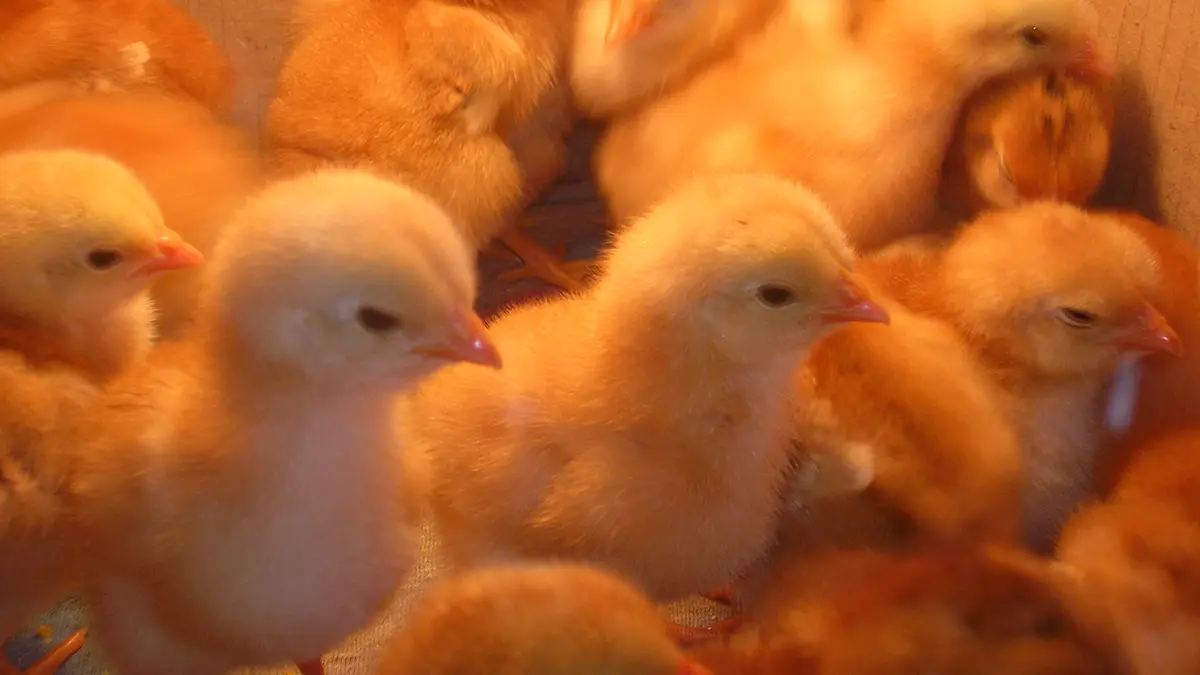
In poultry production, Salmonella infection is one of the major early-life health risks for newly hatched chicks. At hatch, the intestinal microbiota is not yet fully established, and the immune system is still developing. This makes young chicks especially vulnerable to external pathogens.
When Salmonella enters the gut through drinking water, feed, litter, eggshell contamination, or environmental contact, it may rapidly colonize the intestinal mucosa. This can lead to intestinal inflammation, diarrhea, impaired growth, reduced livability, and increased mortality.
From a production perspective, Salmonella infection is not only a disease-control issue. It can also affect feed efficiency, flock uniformity, immune development, and antibiotic-use pressure. Therefore, supporting early gut microbiota establishment, reducing pathogen colonization, and protecting the intestinal barrier are important R&D directions for antibiotic-free poultry production and precision microbiome nutrition.
Intestinal Permeability as a Key Indicator of Chick Gut Health
Intestinal permeability reflects how effectively the gut barrier prevents harmful substances, toxins, and pathogen-associated molecules from entering the body. A healthy gut barrier is maintained by epithelial cells, mucus, immune cells, commensal microbiota, and tight junction proteins.
Among these factors, tight junction proteins such as Occludin, Claudin, and ZO-1 play a key role in controlling the space between intestinal epithelial cells.
During Salmonella infection, pathogenic bacteria may induce intestinal inflammation, damage epithelial structure, and reduce tight junction protein expression. This leads to increased intestinal permeability, often described as a “leaky gut” condition.
Once the gut barrier is damaged, endotoxins, bacterial metabolites, and inflammatory signals can more easily pass through the intestinal wall and enter systemic circulation. For newly hatched chicks, this may reduce feed intake, impair nutrient absorption, and slow early growth performance.
From an R&D evaluation perspective, intestinal permeability, tight junction protein expression, Salmonella colonization level, villus morphology, and inflammatory markers are important indicators for assessing whether a probiotic has gut barrier-protective activity.
The Value of Lactobacillus plantarum in Chick Gut Health
Lactobacillus plantarum is a lactic acid bacterium commonly found in fermented foods, plant-based fermentation systems, and animal gut environments. As a probiotic candidate, it has attracted attention because it may provide multiple functions, including pathogen inhibition, microbiota modulation, organic acid production, immune regulation, and intestinal barrier support.
In poultry applications, the potential value of Lactobacillus plantarum includes:
- Competitive exclusion of pathogens and reduced Salmonella adhesion to intestinal epithelial cells.
- Production of lactic acid, organic acids, and antimicrobial-related metabolites.
- Modulation of gut microbiota structure and reduction of pathogen pressure.
- Support of tight junction protein expression and reduced intestinal permeability.
- Regulation of excessive intestinal inflammation after infection.
- Improvement of early gut maturation, supporting later growth and feed efficiency.
However, these effects are not identical across all Lactobacillus plantarum strains. Functional activity is strain-dependent. Therefore, product development should not rely only on the species name. It should be supported by in vitro pathogen inhibition tests, epithelial cell models, animal challenge trials, safety evaluation, and stability data.
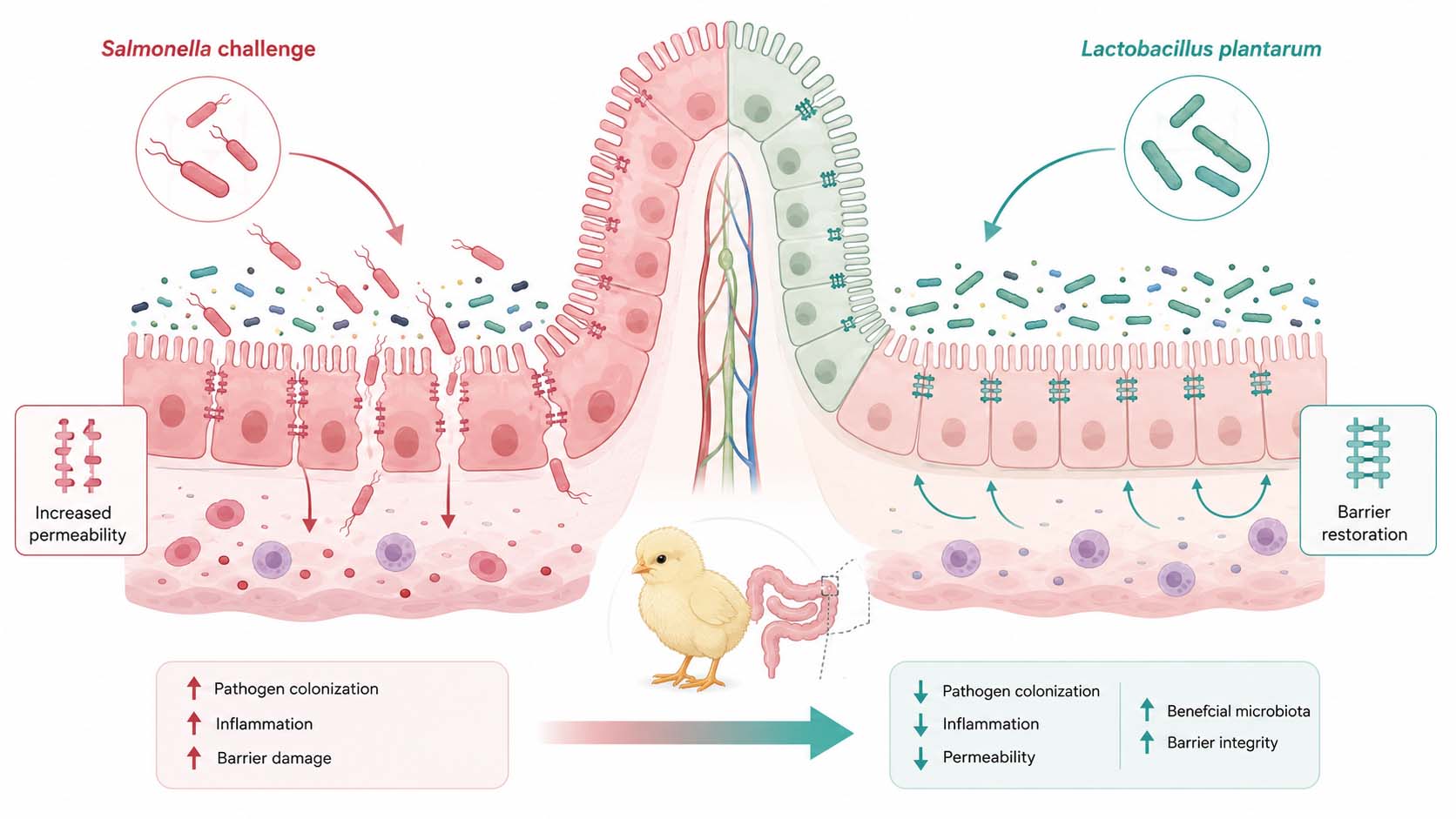
Mechanism 1: Reducing Salmonella Colonization and Systemic Infection Risk
After entering the chick intestine, Salmonella attempts to adhere to epithelial cells and establish colonization. Lactobacillus plantarum may reduce this process through nutrient competition, adhesion-site competition, organic acid production, and local microbiota regulation.
In newly hatched chick models, supplementation with Lactobacillus plantarum has been associated with lower intestinal Salmonella colonization and reduced systemic infection risk. This suggests that Lactobacillus plantarum may serve not only as a general gut-supporting probiotic, but also as an early microbiome intervention tool under Salmonella challenge.
In practical poultry production, this strategy is especially relevant during the post-hatch period, chick placement, early immune development, high environmental stress, or periods with elevated Salmonella risk.
Mechanism 2: Maintaining Tight Junction Proteins and Gut Barrier Integrity
One of the key signs of intestinal barrier damage is the reduction of tight junction proteins. When proteins such as Occludin, Claudin, and ZO-1 are downregulated, the connections between intestinal epithelial cells become weaker, and intestinal permeability increases.
The important value of Lactobacillus plantarum in Salmonella challenge models is its potential to support the recovery of tight junction-related gene and protein expression. This indicates that its function is not limited to pathogen inhibition. It may also involve host epithelial barrier regulation.
From an R&D perspective, this mechanism can be validated through the following indicators:
- FITC-dextran intestinal permeability assay
- Occludin, Claudin, and ZO-1 expression analysis
- Villus height and crypt depth evaluation
- Intestinal inflammatory cytokine analysis
- Salmonella intestinal colonization measurement
These data can support the technical positioning of a probiotic product as a “gut barrier-protective probiotic.”
Mechanism 3: Modulating Gut Microbiota and Reducing Inflammatory Stress
Salmonella infection can disturb the intestinal microbiota by reducing beneficial bacteria and increasing pathogen-associated microbial pressure. It can also trigger inflammatory responses that damage intestinal tissue.
Lactobacillus plantarum may help restore microbial balance after infection. At the same time, its metabolites may reduce excessive inflammatory responses and limit tissue damage.
This is especially important for newly hatched chicks, because excessive immune activation in early life consumes energy and can negatively affect growth and feed efficiency. An ideal probiotic strategy should not simply stimulate immunity. It should help maintain immune balance and improve the efficiency of the host defense response.
Therefore, the R&D direction of Lactobacillus plantarum can move beyond “anti-Salmonella activity” and toward a more complete functional positioning: gut barrier support, microbiota stability, and low-inflammation poultry production.
R&D Application: How to Validate Lactobacillus plantarum for Poultry Gut Health Products
To develop Lactobacillus plantarum as a poultry gut health product, the following R&D process is recommended.
1. In Vitro Functional Screening
Basic functional data should first be established, including acid tolerance, bile salt tolerance, acid production, Salmonella inhibition, adhesion ability, antioxidant activity, and safety evaluation.
2. Cell and Intestinal Epithelial Models
Intestinal epithelial cell models can be used to evaluate whether Lactobacillus plantarum reduces pathogen adhesion, improves epithelial barrier integrity, and supports tight junction-related markers.
3. Chick Challenge Trials
In newly hatched chicks or early-stage broilers, a Salmonella challenge model can be established to evaluate Salmonella colonization, intestinal permeability, villus morphology, inflammatory markers, and growth performance.
4. Field Application Verification
Further validation should be conducted in commercial poultry farms. Key indicators may include mortality, diarrhea incidence, flock uniformity, early body weight, feed conversion ratio, and changes in antibiotic usage.
5. Dosage Form and Stability Development
For poultry applications, Lactobacillus plantarum may be developed as a powder, liquid, or fermented product. If used in feed mills, heat tolerance, storage stability, and mixing uniformity should be evaluated. If used in drinking water or on-farm fermentation, viable count stability, operation convenience, and contamination control should be considered.
Industrial Application: A Microbiome Tool for Antibiotic-Free Poultry Production
Under the trend of antibiotic-free and reduced-antibiotic poultry farming, Lactobacillus plantarum can serve as an important tool for early chick gut health management.
Its value is not simply to replace antibiotics. Instead, it works by supporting early gut microbiota establishment, improving intestinal barrier integrity, reducing Salmonella pressure, and lowering inflammation-related energy loss. These effects help build a stronger foundation for chick health and later production performance.
For feed companies and biotechnology developers, Lactobacillus plantarum products should not remain at the general claim level of “probiotics.” A clearer technical positioning is needed, such as:
- Gut barrier protection
- Salmonella risk management
- Early-life microbiota establishment in chicks
- Support for antibiotic-free poultry production
- Regulation of intestinal permeability and tight junction proteins
This positioning better matches the R&D and market needs of modern animal microbiome products.
Conclusion
Research on Lactobacillus plantarum in Salmonella-challenged chicks suggests that it may help reduce intestinal permeability, maintain gut barrier integrity, limit pathogen colonization, and regulate the gut microbiota.
For newly hatched chicks, early gut barrier development is the foundation for growth, immune maturation, and production performance. The future application of Lactobacillus plantarum in poultry products should not depend only on species selection. It should be supported by clear strain-level functional data, challenge trial evidence, field application results, and stable dosage form technology.
Through the R&D pathway of “probiotics × gut barrier × Salmonella control,” Lactobacillus plantarum has strong potential to become an important microbiome-based solution for antibiotic-free poultry production.
References & Notes
- Wang et al., 2018, Scientific Reports
Lactobacillus plantarum helped reduce intestinal permeability and support gut barrier repair in Salmonella-challenged chicks. - Guan et al., 2024, Poultry Science
Lactobacillus plantarum-derived postbiotics helped reduce intestinal inflammation and barrier damage caused by Salmonella. - Mirsalami et al., 2024, AMB Express
Lactobacillus plantarum improved gut microbiota balance and intestinal mucosal integrity in broilers challenged by Salmonella. - Bae et al., 2020, Poultry Science
Early supplementation with lactic acid bacteria helped reduce intestinal Salmonella levels in chicks. - Hu et al., 2023, Animals
Lactobacillus plantarum-derived postbiotics may reduce Salmonella infection by regulating inflammation and cellular defense responses.