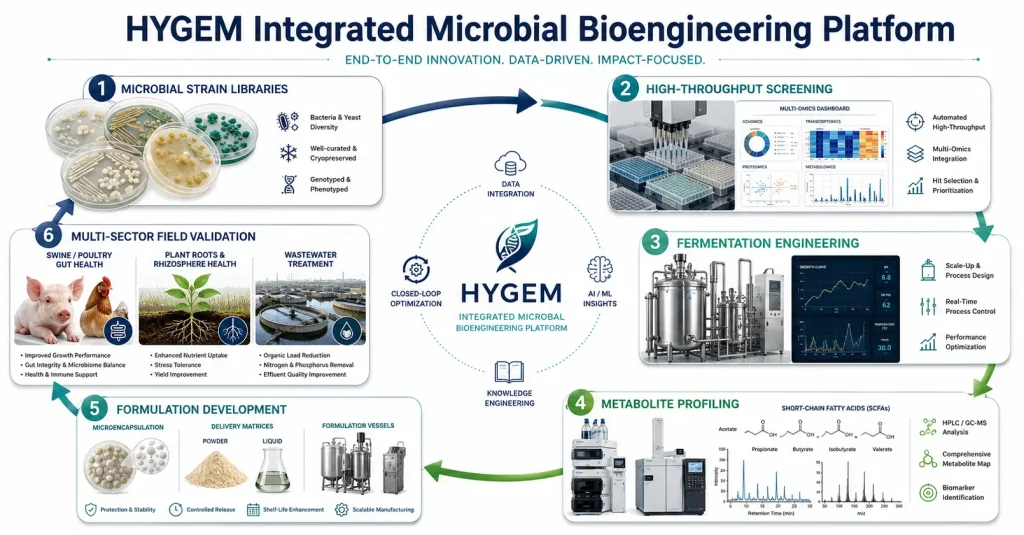


At HYGEM, we have engineered an integrated microbial bioengineering platform that meticulously connects strain discovery, functional high-throughput screening, precision fermentation engineering, metabolite analysis, product formulation development, and real-world field validation. This end-to-end, closed-loop approach enables us to transform raw microbial potential into scalable, stable, and highly measurable biological solutions that deliver consistent commercial returns.
▲ │
│ ▼
[ DATA FEEDBACK LOOP ] ── [ FIELD VALIDATION ] ◄── [ FORMULATION & METABOLITES ]
1. Building the Foundation: Advanced Microbial Strain Libraries
Every breakthrough in microbial technology begins with extensive natural biodiversity. Our proprietary strain library comprises a vast, well-characterized collection of wild-type bacteria, yeasts, and filamentous fungi isolated from highly diverse agricultural, environmental, and extreme industrial ecosystems. Rather than relying on generic, off-the-shelf organisms, HYGEM continuously mines these distinct microbial resources to uncover novel, target-specific biological functions, including:
- Nutrient Assimilation: Upregulation of complex fiber, protein, and mineral digestibility in animal and plant matrices.
- Pathogen Antagonism: Broad-spectrum competitive exclusion and targeted inhibition of economic pathogens (such as PRRSV, PEDV, Coccidiosis, and Brachyspira hyodysenteriae).
- Biochemical Excretion: High-yield production of targeted organic acids, short-chain fatty acids (SCFAs), and functional enzymes.
- Environmental Bioremediation: Advanced capabilities for organic waste degradation, ammonia mitigation, and industrial wastewater treatment.
2. Functional Screening and Precision Selection Architecture
Not all microorganisms that show promise in a petri dish can survive or perform under commercial field pressures. Through our high-throughput screening platform, candidate strains are subjected to stringent selection matrixes to evaluate both their primary biological activities and their robust environmental adaptability. Our core evaluation pillars include:
| Screening Vector | Industrial & Biological Relevance |
|---|---|
| Antimicrobial Activity Assay | Quantifying zone of inhibition against specific target pathogens via cross-antagonism trials and bacteriocin profiling. |
| Enzyme Kinetic Profiling | Measuring the specific activity and yield of extracellular amylases, proteases, cellulases, and phytases. |
| Extreme Stress Tolerance | Evaluating survivability against high temperatures (pelleting emulation >90°C), bile salts, and drastic pH fluctuations (2.0 – 8.5). |
| Synergistic Mutualism | Mapping co-culture compatibility to design complex Synthetic Communities (SynComs) featuring optimized metabolic relays. |
3. Fermentation Engineering and Industrial Scale-Up
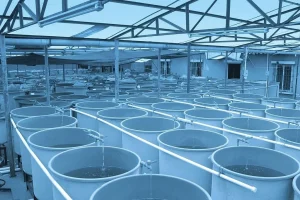
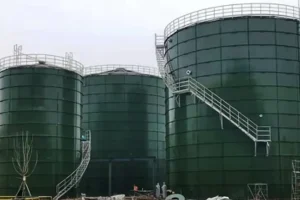
A high-performance microorganism must remain commercially viable during large-scale manufacturing. Our fermentation engineering platform focuses extensively on optimizing upstream and downstream cultivation conditions to maximize cell biomass density, metabolic activity, and structural stability.
During the critical pilot-to-commercial scale-up transition, our engineers evaluate real-time growth kinetics, carbon/nitrogen source utilization rates, and optimal oxygen transfer coefficients. This rigorous industrial optimization guarantees that every batch of GEMBIOZ microecological preparations meets the strict requirements of cell viability, batch-to-batch consistency, and stable product shelf-life.
4. Metabolite Profiling and Functional Characterization
Modern microbiome science reveals that a microbial product’s efficacy is driven not only by live cells but also by the complex array of bioactive compounds synthesized during fermentation. Using advanced chromatography and mass spectrometry platforms, HYGEM maps out the target metabolome to better understand the underlying biological modes of action:
- Organic & Short-Chain Fatty Acids: Lactate, acetate, propionate, and butyrate for direct pH modulation and mucosal tissue integrity.
- Bioactive Peptides & Bacteriocins: Target-specific antimicrobial agents that disrupt pathogenic cell membranes without altering beneficial flora.
- Exopolysaccharides (EPS): Natural biopolymers that facilitate robust biofilm formation, critical for stable colonization in gut and root niches.
5. Formulation Development and Product Engineering
To successfully deliver biological solutions into commercial supply chains, products must possess excellent field compatibility and shelf stability. Our product engineering division designs specialized delivery matrices engineered for real-world handling:
Our Powder and Liquid Delivery Systems are optimized to withstand long-term storage and variable storage temperatures without rapid log-drops in viability. For intensive manufacturing industries, such as feed milling and fertilizer blending, we utilize advanced coating and microencapsulation technologies to protect functional microbes from aggressive chemical and mechanical stresses, ensuring they remain inactive in the bag but rapidly awaken at the target site of action.
6. Multi-Sector Field Validation and Real-World Performance
The ultimate metric of scientific innovation is its verified economic impact under commercial operating conditions. HYGEM’s field trial validation programs span three major industrial bio-sectors:
A. Animal Microbiome & Nutrition
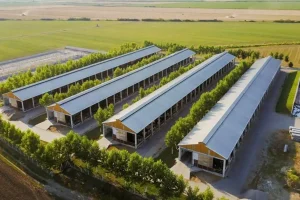
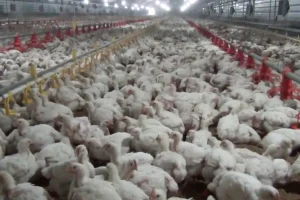
Field trials focus heavily on optimizing Average Daily Gain (ADG) and lowering Feed Conversion Ratios (FCR) across livestock, poultry, and aquaculture operations. By stabilizing the gut microbiome, our solutions support mucosal barrier defense, mitigate severe nursery diarrhea, and enhance overall herd/flock uniformity.
B. Plant Microbiome & Rhizosphere Engineering
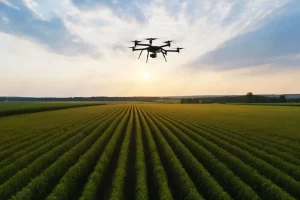
In field applications, our Synthetic Communities (SynComs) are applied to the soil-root interface to stimulate lateral root development, unlock bound soil phosphorus, and improve crop resilience against environmental stresses like drought and soil salinity.
C. Industrial & Environmental Bioremediation
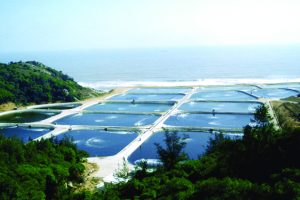
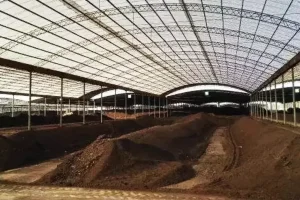
Deploying specialized microbial strains for advanced organic wastewater treatment—such as our successful large-scale industrial remediation deployments in weaving and textile facilities in Binh Duong, Vietnam—enabling significant reductions in Chemical Oxygen Demand (COD), odor compounds, and organic sludge accumulation.
Conclusion: Closing the Loop Between Science and Application
Microbial innovation is most potent when scientific discovery and practical implementation operate as a continuous, iterative cycle. At HYGEM / GEMBIOZ, field data generated by our global commercial integrators and distributors are fed directly back into our research platform. This unique feedback loop continuously guides our strain selection parameters, formulation designs, and fermentation protocols. By tightly linking rigorous laboratory discovery with real-world economic impact, we are confidently defining the next generation of precision microbial bioengineering—from strain selection to field validation.