
Global livestock, feed, aquaculture, and biotechnology exhibitions are important arenas for microbiome technology companies to demonstrate their research capabilities, build commercial trust, and identify potential partners. However, exhibition environments are highly saturated with information. Visitors are exposed to numerous brands, products, and technical messages every day. If a company cannot quickly answer four essential questions — what problem it solves, how the technology works, where it has been validated, and why the discussion should continue — even advanced technologies may be overlooked at the booth.
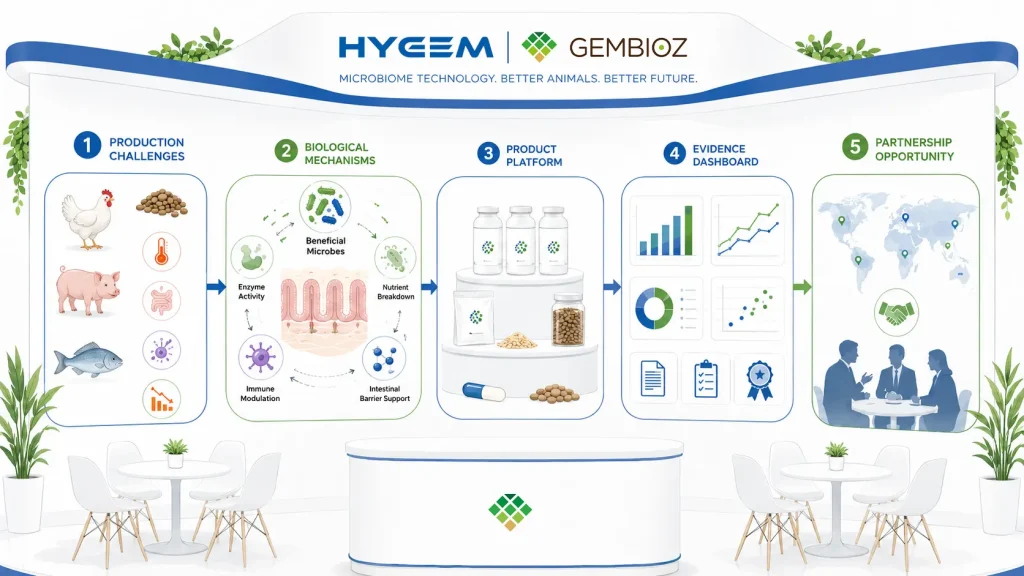
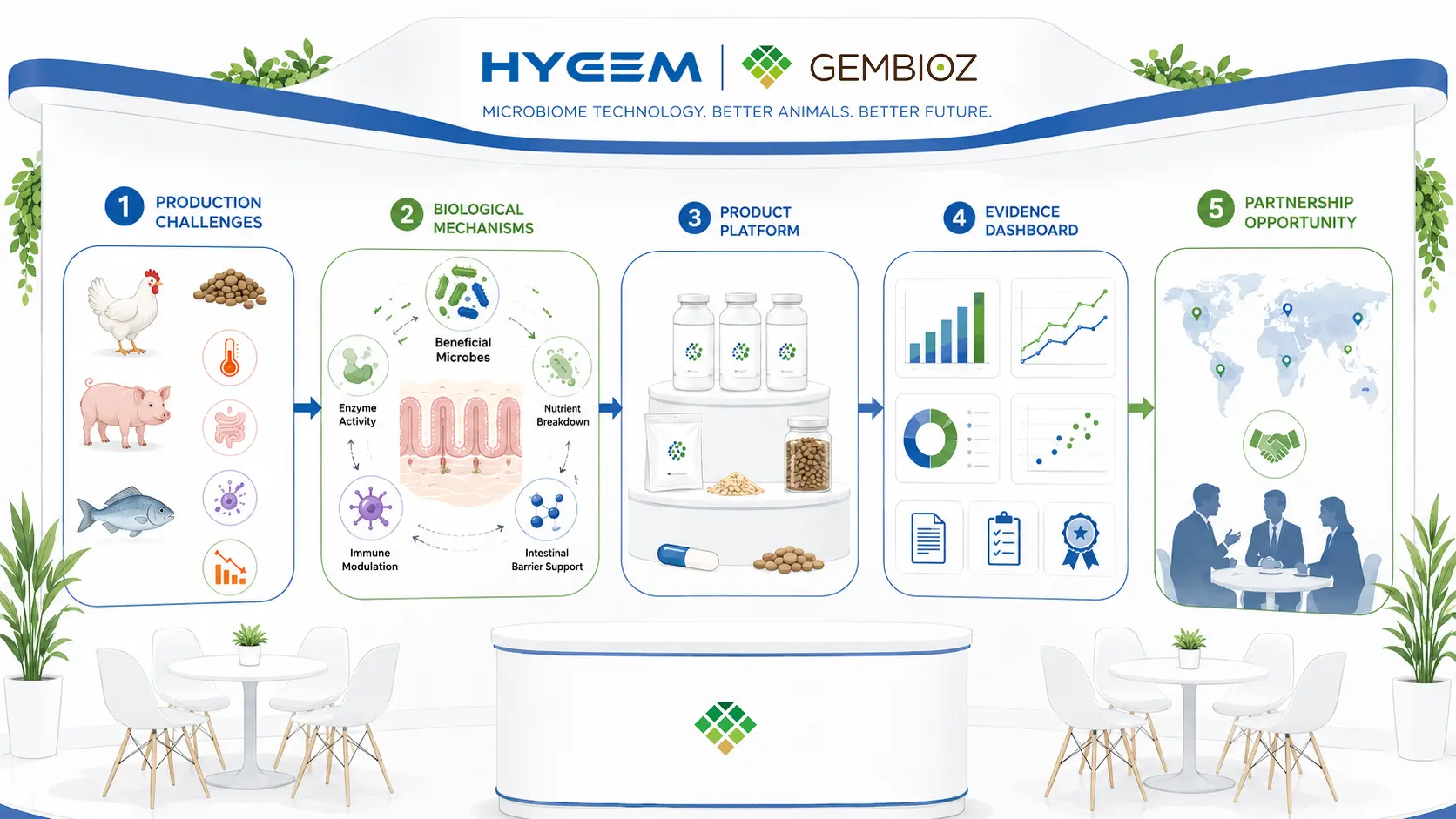
HYGEM has developed a structured exhibition communication strategy for its GEMBIOZ microbiome technology platform. This strategy transforms complex processes such as microbial strain screening, fermentation manufacturing, product application, and field validation into a clear scientific storyline: production challenges → biological mechanisms → product platform → evidence presentation → partnership opportunities.
The goal of this strategy is not merely to increase booth traffic. It is designed to help international customers understand HYGEM’s technological positioning within one minute, and then gradually develop a deeper conversation around research, product development, distribution, and market cooperation over the next hour.
Starting from Production Challenges, Not from Strain Names
Many technology-driven companies fall into a common communication trap: the most visible booth messages focus on Latin strain names, CFU numbers, or manufacturing terminology, while overlooking the customer’s real starting point — the production problem they are currently facing.
For international livestock and aquaculture industries, these problems are usually specific and measurable. Examples include high post-weaning diarrhea incidence in piglets, limited improvement in broiler feed conversion ratio, unstable performance of antibiotic-alternative solutions, Vibrio and AHPND risks in shrimp farming, reduced feed intake under heat stress, or unstable intestinal health and egg quality during peak laying periods.
The first step in HYGEM’s exhibition communication is to place these production challenges at the beginning of all visual and verbal messaging. Instead of first emphasizing how many strains are available, the booth first presents recognizable production scenes and practical problems, such as gut microbiota imbalance, reduced feed utilization efficiency, heat stress, pathogen pressure, or water-quality fluctuation.
When visitors feel that “this company understands my problem,” they are more willing to stop, listen, and explore the solution in greater depth.
Three Connected Biological Mechanisms Make “Efficacy” More Concrete
The most common gap between problem identification and technical explanation is the overuse of simplified efficacy claims. HYGEM’s exhibition communication strategy requires all product messages to return to biological mechanisms that can be explained, measured, and validated. For the GEMBIOZ microbiome technology platform, the core mechanisms can be organized into three connected layers.
Mechanism 1: Gut Microbiome Barrier Restructuring and Pathogen Antagonism
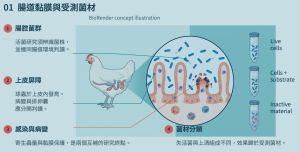
In livestock and aquaculture production, the gut is not only a digestive organ. It is also a dynamic microbiome defense system. When beneficial microbial communities are stable, epithelial barriers remain intact, and mucosal immunity is balanced, pathogens are less likely to colonize and expand excessively.
The GEMBIOZ technology platform uses functional microbial strains and their metabolites to help support a more stable gut microbiome environment. During exhibition communication, HYGEM does not simply use general claims such as “pathogen inhibition.” Instead, the message is translated into more specific scientific language, such as competitive exclusion, interference with pathogen adhesion, local pH reduction through organic acids, bacteriocins or inhibitory metabolites, and intestinal villus structure stability.
Corresponding evidence may include in vitro pathogen antagonism tests, microbiota composition analysis, fecal pathogen detection, intestinal histology, and villus height-to-crypt depth ratio. These data help transform the abstract concept of “disease control” into a technical evidence chain that customers can observe and evaluate.
Mechanism 2: Feed Nutrient Pre-Digestion and Metabolic Efficiency Improvement
Feed cost is usually one of the largest variable costs in livestock and aquaculture production. Therefore, any microbiome-based solution that can improve digestibility, reduce undigested nutrient excretion, and stabilize growth performance has clear commercial value.
Certain functional Bacillus strains and symbiotic fermentation systems can produce proteases, amylases, fiber-degrading enzymes, and other extracellular enzymes. These enzymes may help break down proteins, starches, non-starch polysaccharides, and certain anti-nutritional factors in feed.
In exhibition communication, HYGEM translates “digestive support” into more specific nutritional language, such as apparent crude protein digestibility, feed viscosity, digesta passage rate, fecal condition, weight gain performance, and feed conversion ratio changes.
This approach is especially suitable for communicating with feed mills, nutritionists, and distributors. Their concern is not only whether the strain survives, but whether the product can be integrated into feed formulation, cost management, and end-user production performance.
Mechanism 3: Immune Modulation and Systemic Stress Resilience
Intensive production, animal transfer, transportation, high temperature, vaccination, and pathogen pressure can all place animals under different levels of physiological stress. When stress increases, feed intake, immune function, gut barrier integrity, and antioxidant capacity may be affected. These changes are eventually reflected in growth performance, egg production, survival rate, or meat quality.
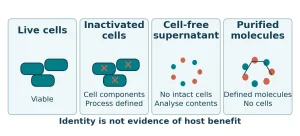
Specific probiotics, postbiotics, cell wall components, and fermentation metabolites may help regulate mucosal immunity, antioxidant pathways, inflammatory balance, and stress-related physiological responses through pattern-recognition receptors and related biological pathways.
When communicating this mechanism, HYGEM avoids vague statements such as “boosting immunity” or “anti-stress effect.” Instead, the message is linked to measurable indicators, such as MDA, SOD, lysozyme activity, immunoglobulins, inflammatory factor expression, heat shock proteins, or the speed of production performance recovery.
This allows customers to understand that a microbiome solution is not a single-point intervention. Rather, it supports animal stability through the interaction between the gut, immunity, metabolism, and environmental adaptation.
Product Platform: A Transparent Story from Screening and Manufacturing to Application
International buyers and partners often have concerns about microbial products because of “black-box manufacturing” and unpredictable performance. Therefore, HYGEM’s exhibition communication does not only present products. It presents the platform behind the products.
The GEMBIOZ platform can be organized into a three-stage engineering narrative: strain screening and safety confirmation, fermentation and stabilization manufacturing, and cross-scenario formulation application.
The first stage is strain screening and functional confirmation. Through a concise process diagram, the booth can explain how strains go through source management, acid and bile tolerance testing, enzyme production evaluation, pathogen antagonism screening, symbiotic fermentation compatibility, and genomic safety assessment. This section addresses the customer’s key concerns: whether the product is safe, whether the source is traceable, and whether the function is reproducible.
The second stage is fermentation and stabilization manufacturing. For microbial products, a strain that performs well in the laboratory does not automatically become a stable commercial product. HYGEM can present process information such as multi-parameter fermentation control, batch quality management, concentration and drying protection technology, viable count stability, moisture content, water activity, and retained sample tracking. If internal stability or accelerated storage data are available, these can be further presented in technical documents according to product lines and regulatory requirements in different markets.
The third stage is formulation application. GEMBIOZ is not limited to a single microbial powder. It can be extended into feed additives, drinking-water applications, aquaculture feed coating, oil suspension, postbiotic products, solid-state fermentation products, or microencapsulated formulations. This helps potential customers quickly evaluate whether the product can connect with their production line, distribution system, and usage scenario.
Evidence Design: Helping Customers Move from Hearing to Believing
In an exhibition environment, the way evidence is presented determines whether a professional conversation can deepen. HYGEM can structure evidence into three layers and reveal them progressively according to the visitor’s time and technical interest.
Layer 1: A 30-Second Value Summary
The first layer of evidence is suitable for exhibition boards, brochure covers, or key visual areas. It uses icons and short phrases to present major application species, core challenges, recommended usage scenarios, and representative performance directions, such as gut stability, feed intake improvement, fecal condition, feed conversion ratio, survival rate, water quality stability, or heat-stress resilience.
The purpose of this layer is not to fully explain the experiment. It is to help customers understand the value proposition within 30 seconds.
Layer 2: Technical Documents and Field Reports
The second layer of evidence is designed for customers who are willing to sit down for a deeper discussion. It should include trial design, animal age, basal diet, dosage, trial duration, statistical method, and major results. For technical procurement teams, R&D managers, and large feed companies, these details are often more important than a single result number because they need to determine whether the trial conditions are close to their own market situation.
Layer 3: On-Site Interaction and Rapid Demonstration
The third layer of evidence can be presented through interactive methods, such as enzyme activity demonstrations, product solubility comparisons, simulated gastric acid tolerance curves, microbial colony growth displays, microscopic images, or data dashboards.
These displays translate abstract data into visible and discussable on-site experiences, helping customers move from “hearing” to “believing.”
Partnership Opportunities: Follow-Up After the Exhibition Is the Real Beginning
HYGEM’s exhibition communication strategy does not end on the final day of the exhibition. True commercial conversion depends on whether the booth conversation can be continued after the event and transformed into specific cooperation plans.
Booth staff can record each potential customer’s market segment, target species, product interest, technical questions, purchasing role, and distribution potential based on the conversation. Follow-up emails should not simply send the same electronic brochure to every contact. Instead, they should provide materials that directly respond to the customer’s specific questions.
For example, aquaculture customers may receive information related to Vibrio control, white feces syndrome, hatchery management, or water quality stabilization. Broiler customers may receive information on feed conversion ratio, intestinal health, heat stress, or post-coccidiosis recovery. Feed mills may receive information on formulation compatibility, heat tolerance, dosage forms, and cost-benefit analysis.
This type of precise follow-up can move exhibition interest toward sample testing, regional trials, distribution evaluation, or co-development projects.
HYGEM Perspective: Making Science Heard and Trust Seen
HYGEM’s exhibition communication strategy is essentially a system for scientific translation. It requires every external message to return to a verifiable logic chain: production challenges define the problem, biological mechanisms explain the action, the product platform ensures stable delivery, evidence supports technical credibility, and the cooperation process turns communication into practical opportunities.
When GEMBIOZ microbiome technology can be clearly understood within one minute and then gradually unpacked during a one-hour deep technical conversation, international exhibitions are no longer only a stage for brand exposure. They become a starting point for HYGEM to build trust, develop cooperation, and advance the internationalization of microbiome technology.
FAQ
Q1: What is the core of HYGEM’s exhibition communication strategy?
A1: The core is a five-stage storyline: production challenges, biological mechanisms, product platform, evidence presentation, and partnership opportunities. This structure helps customers first understand the problem, then understand the technology and cooperation value.
Q2: Why should exhibition communication not focus only on strains and CFU?
A2: Customers first care about whether their production problems can be solved, such as gut health, feed conversion ratio, heat stress, pathogen pressure, or aquaculture survival rate. Strains and CFU are important technical foundations, but they must be connected to application scenarios and verifiable outcomes.
Q3: How does GEMBIOZ microbiome technology build scientific credibility?
A3: Scientific credibility can be built through multiple layers of evidence, including strain screening, safety confirmation, fermentation process control, product stability, in vitro testing, field data, and application reports.
Q4: Why is post-exhibition follow-up important?
A4: Exhibition conversations usually create initial interest. Real cooperation requires precise follow-up based on the customer’s species, market, product format, and technical questions. This helps move the relationship toward sample testing, distribution, or co-development.