
Poultry MG and microbiome research is moving from isolated inhibition findings toward integrated analysis of respiratory communities, metabolites and host barriers. Controlled studies report that selected lactobacilli or Bacillus interventions can accompany lower MG-related molecular signals, less tissue injury or improvements in some production outcomes. Responses still differ by strain and endpoint. This review examines direct chicken studies involving Mycoplasma gallisepticum (MG), distinguishes live organisms from cell-free supernatants and functional mechanism experiments, and does not turn these findings into disease-control promises for all probiotics or commercial products.
Why examine the microbiome in poultry MG research?
MG-associated injury involves local inflammation, epithelial structure and the microbial environment as well as contact between the organism and its host. Researchers therefore examine respiratory and intestinal communities alongside host responses to understand why some interventions accompany less injury. This is a question about host–microbe interaction, not evidence that increasing a beneficial organism necessarily eliminates infection.[1, 2]
Sample location also matters. Respiratory lavage describes a local environment, whereas intestinal or fecal samples represent another ecological compartment. Concurrent changes do not by themselves establish communication between organs. Relative abundances, metabolite concentrations and production outcomes should be reported separately before considering how they support one another.
Lactobacilli: examine the respiratory environment and inflammation together
Wang and colleagues’ 2024 experiment allocated 40 White Leghorn chickens to four groups of 10, comparing an MG model, L. salivarius intervention and corresponding controls. The study examined pathogen-related signals, tracheal morphology, mucosal barriers, immune responses, respiratory communities and metabolites, together with JAK/STAT-related signaling.[1]
Its contribution is to examine the local microbiota and host inflammation within one model. Concurrent changes in metabolites and signaling proteins do not prove that each is a necessary causal step. The total number of animals also does not mean that every omics or tissue measurement used every bird. Sample sizes and statistical information need to be read for the individual measurement rather than copied from the overall group allocation.
What did the KC1 study add to gut–lung mechanism evidence?
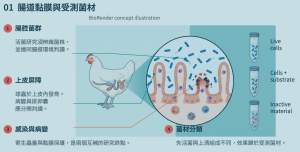
Chen and colleagues investigated Bacillus subtilis KC1 in 2023. Their findings connected enrichment of intestinal Bifidobacterium animalis, altered indole metabolism, pulmonary aryl hydrocarbon receptor (AhR) signaling and barrier-related outcomes. Microbiota-depletion and receptor-antagonist comparisons supported involvement of the microbiota and AhR in the response observed in that model.[2]
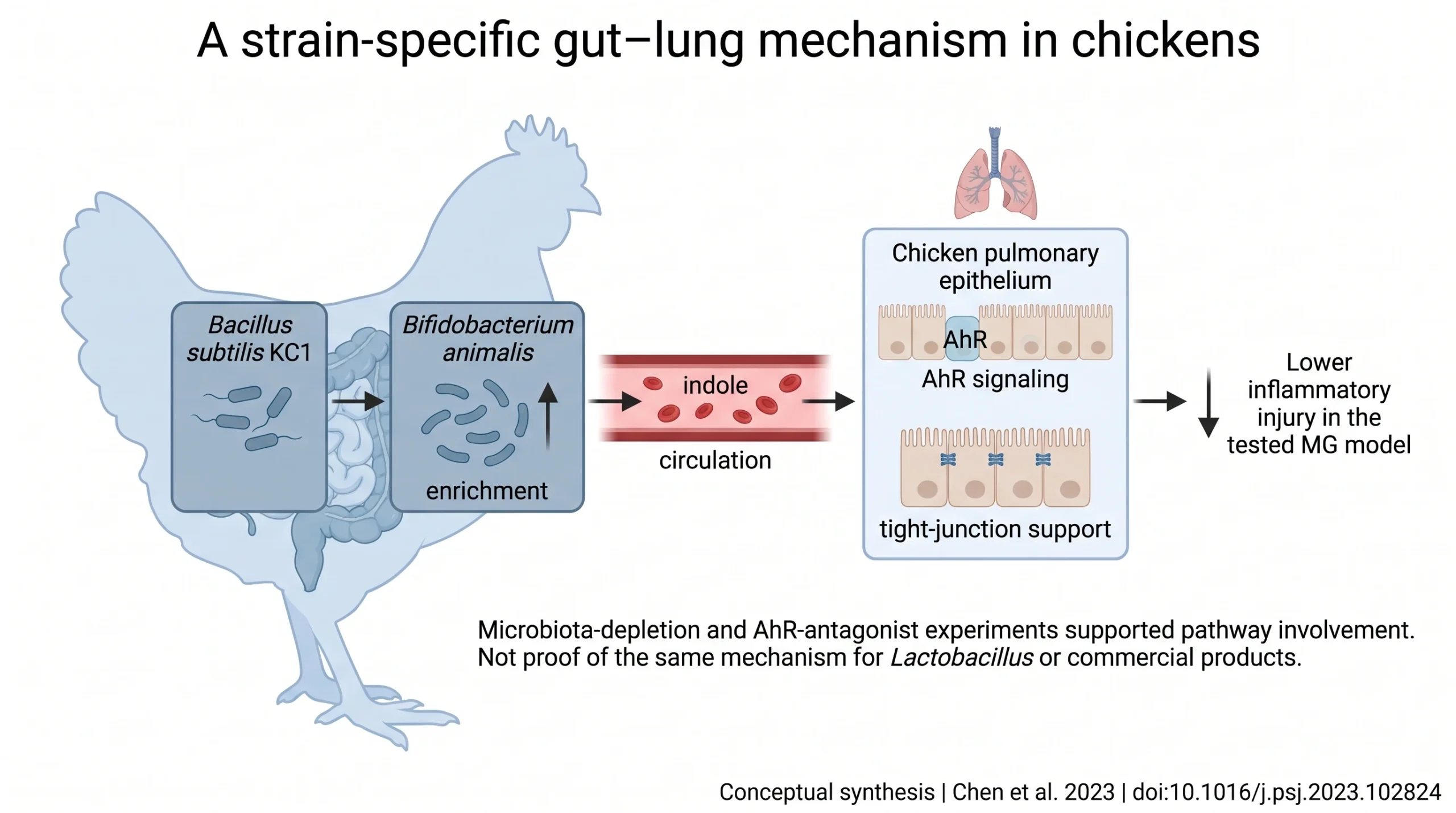
The illustration synthesizes this particular KC1 study. Its functional comparisons add information beyond a correlation between community composition and outcome by examining whether the response persists when parts of the proposed pathway are disrupted. They do not establish an identical pathway in every flock, age or formulation. KC1 is also a Bacillus strain, so its pathway should not be rewritten as a proven common mechanism of all lactobacilli.
Metabolites require equally specific identities. Different tryptophan products should not be treated as one interchangeable component. A metabolite change in one experiment does not establish the same output and host response for a different fermented material. Identify the preparation, measured metabolites and host endpoint before transferring a mechanism.
| Material | Research focus | Interpretation |
|---|---|---|
| L. salivarius,2024 | Trachea, respiratory communities and JAK/STAT-related responses[1] | Local changes and signaling associations |
| B. subtilis KC1,2023 | B. animalis, indole, AhR and pulmonary barriers[2] | Functional comparisons within a strain-specific model |
| Four chicken-derived lactobacilli,2026 | Supernatants in vitro, live interventions and production[3] | Keep preparations and strains separate |
The 2026 strain comparison shows different production responses
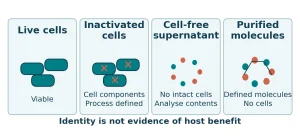
Guo and colleagues selected chicken-derived Lactobacillus crispatus Z2 and Z18, Ligilactobacillus agilis Z22 and Ligilactobacillus salivarius M12. The laboratory experiments used cell-free supernatants, while the animal experiments evaluated the candidate organisms. These are different materials, not one interchangeable postbiotic preparation. The animal study included 450 broilers in 15 groups, with six replicate pens of five birds per group.[3]
The following chart retains all four strains within the same pre-exposure intervention category, alongside the uninfected control and MG model. Mean FCR for days 6–38 was 1.80 in the control,1.98 in the MG model,1.77 for Z2,1.79 for Z18,1.71 for Z22 and 1.78 for M12. These compare a specified model and intervention category; they are not average improvement rates across farms.[3]
Figure 3. 2026 MG model: FCR within one pre-exposure category
C: uninfected control; M: MG model; P: the source pre-exposure intervention category, with Z2, Z18, Z22 and M12. Only this category and its two controls are shown; uninfected probiotic groups and the other timing category are omitted, with no cross-category ranking. Six pens per group, five birds per pen; days 6–38; mean ± SD.
| Group | Mean (common scale) | FCR ± SD | Source letters |
|---|---|---|---|
| C | 1.80 ± 0.04 | cd | |
| M | 1.98 ± 0.06 | a | |
| P-Z2 | 1.77 ± 0.01 | cde | |
| P-Z18 | 1.79 ± 0.01 | cde | |
| P-Z22 | 1.71 ± 0.02 | fg | |
| P-M12 | 1.78 ± 0.03 | cde |
Bars start at zero and show means only; variability is tabulated, not drawn as error bars. Groups without a shared letter differ at source p<0.05; shared letters do not establish equivalence. Independent HTML presentation of published numerical facts, without source artwork. Not HYGEM product data.
FCR: g feed/g gain; scale 0–2.2. [3] Source: Table7; days 6–38; selected coherent subgroup. doi:10.1016/j.psj.2026.107207
Different letters in the original table denote statistical differences. Standard deviations and letters are preserved; five birds sharing a pen are not counted as five independent dietary replicates. The study also reported no significant feed-intake differences between the MG model and probiotic intervention groups in certain intervals and the overall period. Lower FCR should therefore not be described as simultaneous recovery of intake, body weight and every health measure. Strains, intervals and endpoints need separate comparisons.
Pathogen signals, tissue injury and performance answer different questions
Pathogen-related PCR, lung observations and production results provide complementary information. A lower nucleic-acid signal does not establish complete disappearance of infectious organisms. Less tissue inflammation does not establish interrupted flock transmission. Claims about practical benefit require relevant clinical, production and flock-follow-up information rather than one favorable molecular measurement.
| Outcome | Question answered | Separate assessment needed |
|---|---|---|
| Pathogen-related PCR | Change in the target nucleic-acid marker | Infectivity, clearance and transmission |
| Tissue and immune responses | Local injury and host response | Clinical recovery and flock benefit |
| FCR and body weight | Production in the tested conditions | Cross-site reproducibility and economics |
Mycoplasma synoviae (MS) and MG are different organisms. MS studies, general intestinal-health studies without an MG model and experiments using other strains provide different background information; they should not be pooled as one body of direct MG evidence. Live organisms, heat-inactivated material and cell-free supernatants likewise require their own material-to-evidence links.
Turn the research into a question that a field setting can answer
Begin by specifying the unresolved question: a change in pathogen-related measurements, less tissue injury or reduced production loss. Site records should preserve existing health management, ventilation and concurrent changes while keeping delivered materials traceable. Controlled studies help identify useful outcomes, but they do not replace a meaningful comparison or veterinary judgement.
The evidence supports continued investigation of strain-specific host–microbe interactions, especially connections between local ecology, metabolites and barriers. Accurate communication identifies the material, model and outcomes that changed, together with those that did not. It does not compress different organisms, controlled models and commercial settings into a single conclusion that probiotics treat MG.
References
- [1] Wang K, Miao Y, Liu W, Muhammad I, Bao J, Jin X, Wu Z, Li R, Chen C, Li J (2024). Lactobacillus salivarius ameliorates Mycoplasma gallisepticum-induced inflammation via the JAK/STAT signaling pathway involving respiratory microbiota and metabolites. Poultry Science 103(8): 103942. doi:10.1016/j.psj.2024.103942
- [2] Chen X, Ishfaq M, Hu F, Zheng Q, Hu X, Wang J, Huo N (2023). Bacillus subtilis KC1 prevents Mycoplasma gallisepticum-induced lung injury by enhancing intestinal Bifidobacterium animalis and regulating indole metabolism in chickens. Poultry Science 102(8): 102824. doi:10.1016/j.psj.2023.102824
- [3] Guo Q, Che Z, Hu F, Wu J, Lv S, Zhao W, Li S, Wang Y, Peng X (2026). Chicken-derived Lactobacillus strains alleviate Mycoplasma gallisepticum infection and improve growth performance in broilers. Poultry Science 105(9): 107207. doi:10.1016/j.psj.2026.107207
Research and education; not evidence of a particular product’s efficacy or field result. Animal diagnosis and treatment require veterinary judgement.