Nutritional approaches to poultry coccidiosis control have been evaluated in chicken trials comparing microbial preparations, plant-derived ingredients and organic acids. The findings support selecting materials according to the tested formulation and target endpoint. Some materials reduce oocyst shedding, whereas others improve intestinal lesions or growth performance; treatment rankings are not consistent across these outcomes. Direct comparisons within the same trial are more informative for purchasing and formulation decisions than efficacy rankings assembled from improvement percentages reported in separate studies. [1] [2] [3] [4]
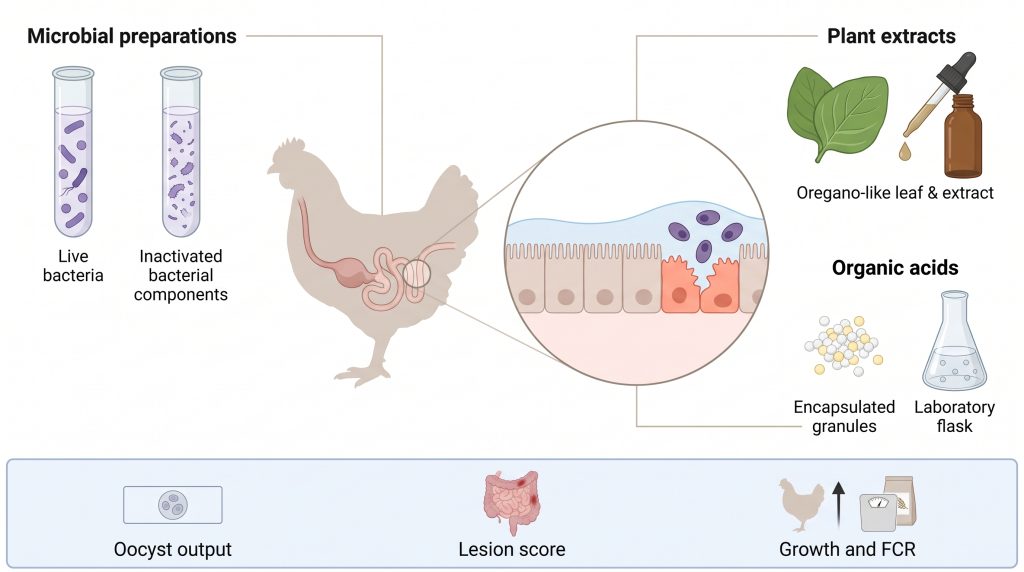
Identify the materials before comparing their effects
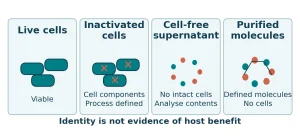
Live lactic acid bacteria, synbiotics, inactivated microbial preparations, plant essential oils and encapsulated organic acids differ in composition and conditions of action. A synbiotic must combine live microorganisms with a substrate selectively utilized by host microorganisms and confer a host health benefit; a formulation containing several ingredients does not in itself demonstrate synergy. A postbiotic centers on inanimate microorganisms and/or their components with a demonstrated health benefit. Purified lactic acid, butyric acid or other individual metabolites cannot be classified as postbiotics solely because they originate from microorganisms. [7] [8]
Product comparisons therefore need to retain information on strain identity, viability status, botanical source, chemical composition and encapsulation. An increase in the host’s lactic acid bacterial population after essential-oil supplementation is a microbiota finding; it does not turn the plant preparation into a probiotic. Organic acids and microbial cell components are also distinct materials. These identities determine which study can support which product. [2] [7] [8]
Table 1 Materials and scope of evidence in direct comparisons
| Original study | Materials and direct comparison | Supported findings | Applicability limits |
|---|---|---|---|
| Javanmiri 2024 [1] | Commercial probiotic, complex synbiotic and plant formulation; drug and vaccine comparators | Tested synbiotic and plant formulation did not reduce mean OPG; synbiotic FCR exceeded infected control | Limited strain-composition details; effects of the enzyme-containing synbiotic cannot be separated |
| Khukhodziinai 2024 [2] | Benzoic acid, oregano essential oil, their combination and salinomycin | All four interventions reduced mean OPG versus infected control; no significant differences among interventions | Unspecified background cocciostat; no equivalence or noninferiority design |
| Nouri 2022 [3] | Encapsulated organic acids; two drugs alone and in combination | ACI and cecal lesions produced different rankings | Infected-litter setting; composite index as defined in the study |
| Santos 2022 [4] | Four phased nutritional programs, drug and infected controls | Some endpoints did not match drug performance; dietary recovery differed from declarations | Multiple ingredients and recovery differences limit single-component attribution |
Microbial and plant preparations show no consistent advantage within one chicken trial
Javanmiri and colleagues allocated 525 broilers to seven groups, each with five pens of fifteen birds. The treatments comprised an uninfected control, infected control, drug, probiotic, complex synbiotic, vaccine and plant preparation. The synbiotic also contained several enzymes; the plant formulation included cinnamon, turmeric, chili pepper and black pepper. The trial compared the tested commercial formulations, so their effects cannot be assigned to a single strain or plant ingredient. [1]
Mean log10 oocysts per gram of feces (OPG) on days 25–33 was 4.28 in the infected control, 4.41 with the probiotic, 4.23 with both the synbiotic and plant preparation, and 3.95 with the vaccine. According to the multiple-comparison letters in the original table, the synbiotic and plant preparation were not significantly lower than the infected control. Whole-period feed conversion ratio (FCR) was 2.26 with the synbiotic, higher than 1.95 in the infected control. Lesion comparisons among infected groups were also nonsignificant. These negative findings show why category names and multi-ingredient designs cannot substitute for measured benefits of the tested formulation. [1]
Figure 1 Microbial and plant preparations compared within the same trial
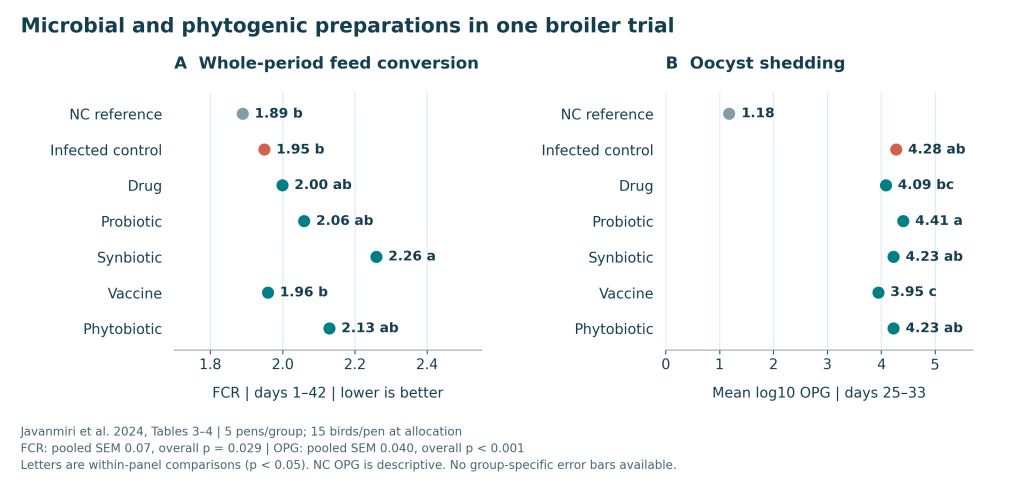 Independently plotted from the numerical values in Javanmiri et al. (2024), Tables 3 and 4; this is not an adaptation of the source artwork. [1] The trial included 525 broilers in seven groups, with five pens per group and fifteen birds per pen. The pen was the unit for growth measurements; OPG used pooled fecal samples within pens. Left: FCR on days 1–42, pooled SEM = 0.07, overall p = 0.029. Right: mean log10 OPG on days 25–33, pooled SEM = 0.040; the source table reports p = 0.000, rendered here as p < 0.001. Letters follow the original tables; groups sharing a letter did not differ significantly. The uninfected control had nonzero OPG and no comparison letter, and is retained as a descriptive reference. No group-specific error bars were added because individual-level raw data were unavailable. OPG with the synbiotic and plant preparation was not significantly lower than in the infected control, while whole-period FCR was higher with the synbiotic. Parasite and production endpoints therefore need to be read together for the same formulation.
Lower oocyst shedding does not establish superiority of the benzoic acid and oregano oil combination
In a study of 252 broilers, Khukhodziinai and colleagues used six pens per treatment to compare benzoic acid, oregano essential oil, their combination and salinomycin. Overall mean OPG across three post-infection sampling times was 2.70 × 10³/g in the infected control and 1.45–1.63 × 10³/g in the four intervention groups. All four were lower than the infected control, but they shared the same statistical letter and did not differ significantly from one another. [2]
The combination had the lowest numerical value, but this is insufficient to establish additivity or synergy in oocyst shedding. The main effect of treatment on whole-period FCR was p = 0.337; better FCR in the final week cannot replace the whole-period conclusion. The original basal diet also listed a cocciostat in another premix without clearly identifying its active ingredient. This formulation limitation must accompany the positive results. The trial was not designed for equivalence or noninferiority, so a nonsignificant difference cannot establish complete replacement of a drug. [2]
Figure 2 Oocyst shedding with benzoic acid and oregano essential oil
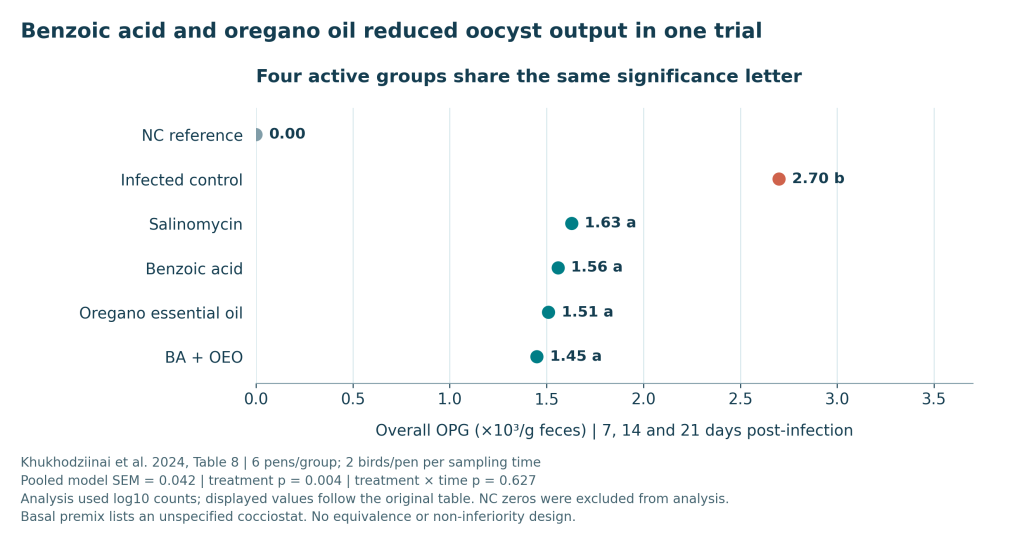 Independently plotted from Khukhodziinai et al. (2024), Table 8. [2] The trial included 252 broilers in six groups, with six pens per group and seven birds per pen. OPG sampling involved two birds per pen at each time point. Values shown are overall means at 7, 14 and 21 days post-infection, expressed as ×10³/g feces. Model SEM (mSEM) = 0.042; treatment p = 0.004, time p < 0.001 and interaction p = 0.627. The original analysis used log10-transformed data; displayed values follow the scale in the source table. All uninfected-group values were zero, and that group was excluded from the original OPG analysis. All four intervention groups share the letter a; this is not evidence of equivalence from an equivalence trial. An unspecified cocciostat in the basal premix limits formulation-specific attribution. Benzoic acid, essential oil and their combination all produced lower values than the infected control. The lowest numerical value in the combination group did not establish an additional advantage in oocyst shedding.
Encapsulated organic acids show formulation and combination specific effects
Nouri’s study of 525 broilers directly compared an encapsulated organic acid blend with maduramicin and diclazuril. At 22 days of age, the anticoccidial index (ACI) was 63 in the unsupplemented group, 139 and 143 with the two drugs alone, and 161 with organic acids alone. Combining organic acids with the two drugs yielded values of 169 and 174. ACI here is the composite index defined in that study, rather than a universal efficacy scale for comparisons across papers. [3]
At the same age, the cecal lesion score with organic acids alone was 3.05, sharing statistical letters with scores of 3.14 and 3.08 for the two drugs alone. Only the two combination treatments further reduced lesions. The different rankings for ACI and lesions distinguish composite performance from tissue injury. The study used exposure through infected litter. Following the original table, the figure retains the six infected groups; the uninfected group primarily informed ACI calculation and was not included in that table’s between-group analysis. [3]
Figure 3 Encapsulated organic acids produce different rankings for ACI and lesions
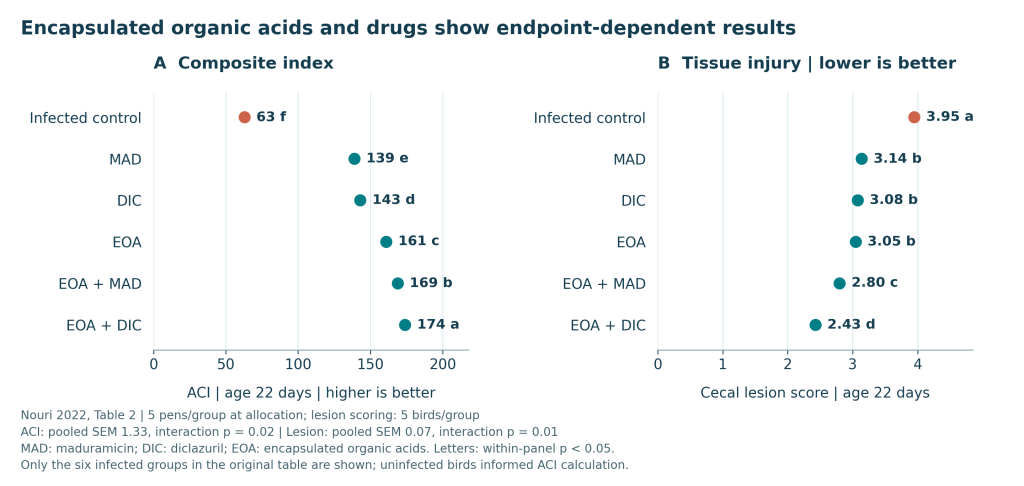 Independently plotted from Nouri (2022), Table 2. [3] The original trial allocated 525 broilers to seven groups, with five pens per group and fifteen birds per pen. This table analyzes only the six infected groups; uninfected birds informed ACI calculation. At 22 days of age, pooled SEM for ACI = 1.33 and treatment interaction p = 0.02; pooled SEM for cecal lesions = 0.07 and treatment interaction p = 0.01. Lesions were assessed in five birds per group. The original factorial analysis used five replicates. Its multiple-comparison letters are retained; the total animal count is not treated as the independent n for every endpoint. MAD = maduramicin; DIC = diclazuril; EOA = encapsulated organic acid blend. EOA alone produced a higher ACI than either drug alone, but its lesion score shared the letter b with both drug groups. Lesions were further reduced only in the combination groups.
Positive evidence for lactic acid bacteria and inactivated preparations remains strain and host specific
A broiler study of Lactiplantibacillus plantarum P8 observed reductions in both oocyst shedding and cecal lesions within the same trial, providing positive strain-level evidence. This does not conflict with the different results for the commercial probiotic described above: strains, formulations and infection contexts differed. Neither study can stand for the entire microbial category. [1] [5]
A Blautia producta L1 paper available online in 2026 compared live and heat-inactivated preparations in 75 male Hy-Line layer chicks. Both improved some oocyst, lesion and inflammatory outcomes, but between-group differences in survival were nonsignificant. Blautia is not a lactobacillus, and the trial included no standard drug comparator. It supports a specific host study of inactivated microbial material, rather than a head-to-head ranking against organic acids, essential oils or drugs used in broilers. The article is listed as Article in Press. [6]
Declared formulations and measured recovery are part of the comparative evidence
In a trial involving 720 broilers, Santos and colleagues arranged probiotics, plant ingredients, and later-phase butyrate and nutritional support into four phased programs, compared with diclazuril and an infected untreated control. Whole-period FCR was best in the drug control, and some nutritional programs did not match the drug on particular coccidial lesion outcomes. All groups were infected; the label NC must not be read as an uninfected healthy control. [4]
The study also found that the expected probiotic was not recovered from the supplemented diets, while measured levels of some plant ingredients and threonine deviated from formulation targets. The findings therefore reflect both the combination strategy and the material actually delivered. Strain traceability, ingredient analysis, post-processing recovery and storage data directly affect whether a trial product is comparable with a commercial product; they are more than notes on a specification sheet. [4]
Use comparative evidence to guide material selection
For parasite-burden objectives, begin with OPG measured at comparable times and in comparable units, together with the original statistical comparisons. For mucosal protection, examine lesions and functional outcomes in the relevant intestinal segment. Weight gain and FCR indicate production value, but the observation period and husbandry context must remain explicit. Selection among microbial preparations, essential oils and organic acids should link these endpoints to product identity, rather than relying on whether an ingredient is natural or a formulation contains many components.
Economic evaluation also requires commercial prices, actual inputs, feed consumption, mortality and culling, and sales conditions. The studies included here do not provide sufficient commercial-farm cost data for a common calculation, so no cost-effectiveness ranking is presented. The most useful contribution of direct comparisons is identifying which material improved which endpoint under which study conditions. Advantages of combinations, drug replacement and farm returns each require corresponding evidence. [1] [2] [3] [4]
Table 2 Selection objectives and priority indicators
| Comparison objective | Priority indicators | Information to retain |
|---|---|---|
| Parasite burden | OPG and original statistical comparisons | Timing, units, transformation scale and infected-group comparator |
| Intestinal mucosal protection | Segment-specific lesions and functional outcomes | Sample size, lesion site, host line and age |
| Production and economic value | Whole-period gain, FCR and actual costs | Period, dietary recovery, inputs and market prices; final-week results do not replace whole-period outcomes |
References
- Javanmiri E, Rahimi S, Karimi Torshizi MA, Nabiyan S, Behnamifar A, Grimes J. (2024). Comparison of the effect of anticoccidial drug, probiotic, synbiotic, phytochemicals and vaccine in prevention and control of coccidiosis in broiler chickens challenged with Eimeria spp. Poultry Science. 103(12):104357. https://doi.org/10.1016/j.psj.2024.104357
- Khukhodziinai JS, Das PK, Mukherjee J, et al. (2024). Effect of Dietary Benzoic Acid and Oregano Essential Oil as a Substitute for an Anti-Coccidial Agent on Growth Performance and Physiological and Immunological Responses in Broiler Chickens Challenged with Eimeria Species. Animals. 14(20):3008. https://doi.org/10.3390/ani14203008
- Nouri A. (2022). Anticoccidial and immunogenic effectivity of encapsulated organic acids and anticoccidial drugs in broilers infected with Eimeria spp. Scientific Reports. 12:17060. https://doi.org/10.1038/s41598-022-20990-2
- Santos RR, Velkers FC, Vernooij JCM, et al. (2022). Nutritional interventions to support broiler chickens during Eimeria infection. Poultry Science. 101:101853. https://doi.org/10.1016/j.psj.2022.101853
- Wang Y, Lv X, Li X, et al. (2021). Protective Effect of Lactobacillus plantarum P8 on Growth Performance, Intestinal Health, and Microbiota in Eimeria-Infected Broilers. Frontiers in Microbiology. 12:705758. https://doi.org/10.3389/fmicb.2021.705758
- Liu J, Yuan C, Zhang G, Zhao C, Zhang Q, Lu M. (2026). Probiotic potential of Blautia producta L1 in mitigating Eimeria tenella-induced intestinal inflammation and dysbiosis in chickens. Parasites & Vectors. Article in Press; online 24 August 2026. https://doi.org/10.1186/s13071-026-07640-6
- Swanson KS, Gibson GR, Hutkins R, et al. (2020). The International Scientific Association for Probiotics and Prebiotics (ISAPP) consensus statement on the definition and scope of synbiotics. Nature Reviews Gastroenterology & Hepatology. 17:687–701. https://doi.org/10.1038/s41575-020-0344-2
- Salminen S, Collado MC, Endo A, et al. (2021). The International Scientific Association of Probiotics and Prebiotics (ISAPP) consensus statement on the definition and scope of postbiotics. Nature Reviews Gastroenterology & Hepatology. 18:649–667. https://doi.org/10.1038/s41575-021-00440-6
Corrections: https://doi.org/10.1038/s41575-021-00481-x; https://doi.org/10.1038/s41575-022-00628-4. The 2021 correction concerns figure labels; the 2022 correction concerns attribution of table citations.