
The Boundary Challenges of Microbial Nitrogen Metabolism in Aquaculture: Dynamic Environmental Factors, Carbon Flux, and Precision Nitrification Engineering
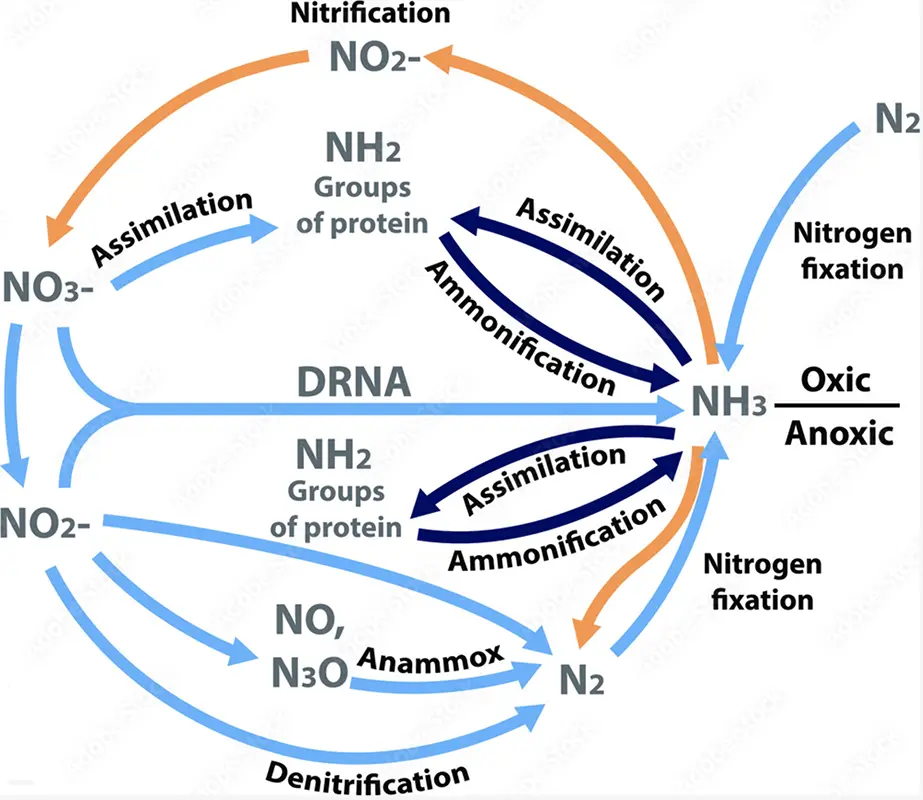
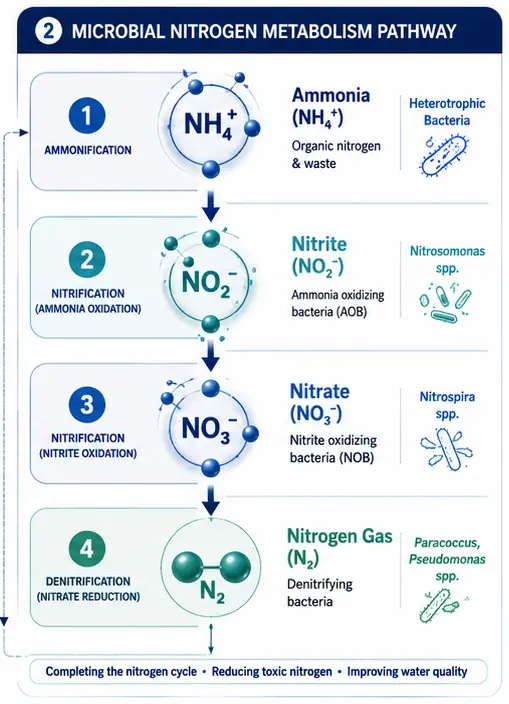
In intensive aquaculture systems, microbial nitrogen metabolism is the core driving force behind water quality equilibrium and biological biosecurity purification. Toxic stress triggered by the chronic accumulation of ammonia nitrogen (NH₄⁺-N) and nitrite nitrogen (NO₂⁻-N) remains the primary catalyst for immune depression, disease outbreaks, and elevated mortality rates in aquatic stock. However, in real-world commercial ponds and Recirculating Aquaculture Systems (RAS), the microbial-driven processes of nitrification and denitrification face a harsh matrix of dynamic environmental challenges.
At HYGEM Biotech, we view aquaculture water treatment not as the arbitrary dumping of generic probiotics, but as a highly disciplined field of biological process engineering. Microbial metabolic rates, degradation kinetics, and community successions are heavily bounded by fluctuating physical-chemical water parameters. This white paper analyzes the underlying biological bottlenecks of the nitrogen loop and outlines standardized engineering protocols for carbon flux control and precision bio-intervention.
│ │
▼ (Aerobic Nitrification: Demands High DO & pH 7.5-8.5) ▼ (Anoxic Denitrification: Requires Precision Carbon)
【 Core Bottlenecks: Environmental Stress, Disinfectant Residuals, Carbon Deficit 】 ──> Toxin Accumulation ──> Blocks Nitrogen Gas (N₂) Release
1. Environmental Boundary Constraints on Microbial Nitrogen Pathways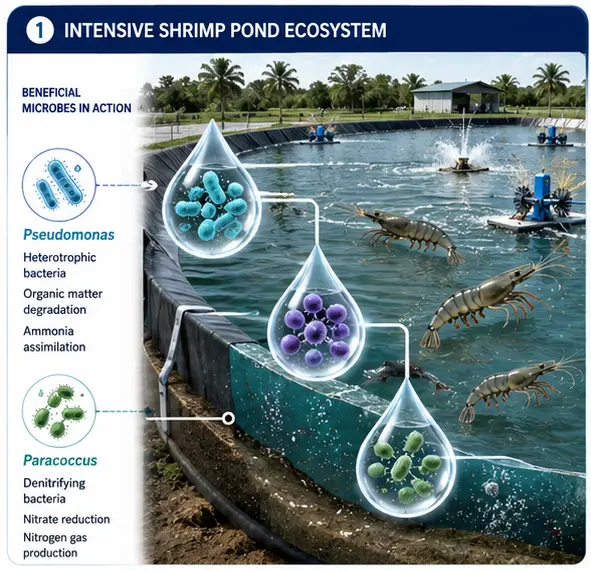
The efficiency of a bioremediation system relies heavily on maintaining strict operating boundaries. When physical-chemical indexes drift from physiological setpoints, target bacterial kinetics slow down, causing an aggressive accumulation of toxic intermediates:
A. The Critical Operational Line of pH
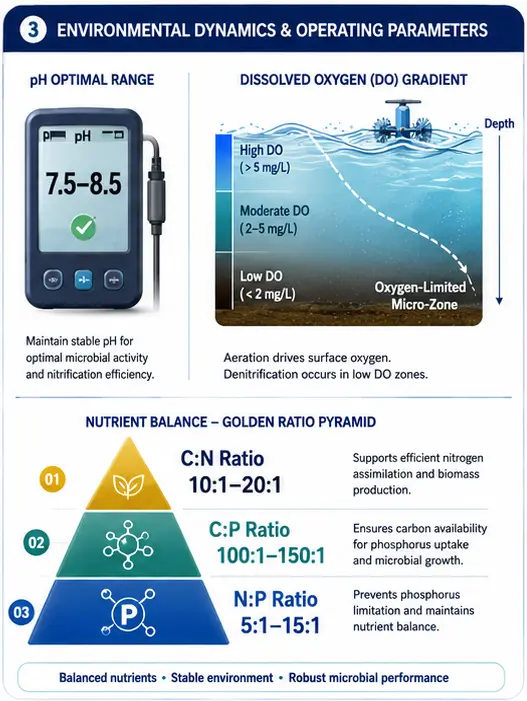
The pH value serves as the primary molecular switch regulating the catalytic configuration of vital denitrification reductases (such as nitrate and nitrite reductases). Functional denitrifying microflora exhibit a narrow optimal pH window of 7.5 to 8.5, where denitrification velocity reaches its peak. Any sharp deviation alters the ionic charge across the enzyme’s catalytic centers, causing a linear collapse in nitrogen reduction rates.
B. Dissolved Oxygen (DO) Equilibrium and Spatial Stratification Hurdles
Denitrifying bacterial consortia are mostly facultative anaerobes that preferentially route their electron transport chains toward molecular oxygen if present. Thus, spatial DO allocation completely controls electron flux:
- The Necessity of Anoxic Conditions: In the strict absence of dissolved oxygen, denitrifying bacteria are forced to utilize nitrate (NO₃⁻) or nitrite (NO₂⁻) as terminal electron acceptors for respiration, reducing them to inert nitrogen gas (N₂).
- Excessive Bottom Aeration and Nitrite Stagnation: If a farm over-deploys mechanical bottom aeration, high DO levels suppress the transcription of denitrification genes. This breaks the reduction pathway, preventing nitrite from converting completely into nitrate and causing acute nitrite toxicity spikes.
C. Seasonal Temperature Fluctuations and Sludge Retention Time (SRT) Tuning
Denitrifying consortia operate optimally between 20°C and 40°C. When temperatures drop below 15°C during colder seasons, cellular enzyme activities and cell membrane fluidities plunge. In field bioprocess engineering, this metabolic deficit must be actively balanced by extending the Sludge Retention Time (SRT), lowering feeding biomass loads, and expanding the Hydraulic Retention Time (HRT).
2. Multidimensional Eco-Challenges Facing Applied Commercial Probiotics
 Beyond basic water parameters, commercial probiotic formulations must withstand competitive and chemical interferences native to commercial farming environments:
- Substrate Inhibition from Acute Waste Concentration: When native ammonia and nitrite levels exceed standard biological capacity, they exert substrate inhibition, disrupting bacterial cell membrane permeability and delaying the remediation cycle.
- Chemical and Heavy Metal Bioaccumulation: Residual heavy metal ions (e.g., copper, zinc) and antibiotics left from pond preparation can bind with microbial metabolic enzymes, directly inactivating nitrification.
- Niche Competition with Indigenous Microflora: Introduced probiotics must compete with wild, native microflora for limited micronutrients and substrates. Formulations that lack strong initial metabolic activation are easily marginalized.
- Viability Loss Across the Supply Chain: Poor transport conditions, heat exposure, or improper on-site activation can severely reduce cell viability, rendering the product ineffective upon application.
3. Chemical Neutralization and the Maintenance of Core Denitrifying Consortia
To establish a functional nitrogen loop, it is vital to clear the water of residual chemical sanitizers (disinfectants, oxidizing agents, surfactants) and secure the absolute cell density of key functional taxa:
Chemical Neutralization: Before introducing microbial cultures, any lingering disinfectant traces must be completely neutralized. Probiotic performance relies on achieving critical biomass thresholds to trigger Quorum Sensing (QS) pathways and synchronized degradation cascades.
Core Denitrifying Bacterial Genera in Aquaculture Bioprocessing
- Pseudomonas: The primary heterotrophic driver across natural ecosystems, possessing aggressive nitrogen-removal pathways.
- Paracoccus & Rhodobacter: Purple non-sulfur photo-reactive consortia balancing photoautotrophic growth with metabolic denitrification.
- Bacillus: Endospore-forming strains capable of enduring extreme physical stresses and rapidly resuscitating at target sites.
- Thiobacillus: Obligate autotrophic denitrifiers that couple nitrogen reduction with the oxidation of sulfur compounds.
- Thauera: A crucial player in industrial wastewater loops, possessing a complete enzyme network to reduce nitrate directly into N₂.
- Supporting Genera: Acinetobacter, Cupriavidus, Chromobacterium, Halobacterium, Methanomonas, Achromobacter, Vibrio, Agrobacterium, and Flavobacterium function as vital auxiliary components to secure structural functional redundancy.
4. Precision Dosing and Stoichiometric C:N:P Ecological Dosing Strategies
 Microorganisms require ample carbon sources to serve as energy drivers and cellular building blocks during nitrogen assimilation. An unbalanced nutritional ratio will lock microbial conversion loops:
A. Precision Dosing to Accelerate Bio-Cycling
Technical service crews must calculate specific dosing interventions based on actual water pollution indexes. Standardized Recommendation: Inoculate the water body with 1 ppm of composite functional microbial culture liquid (or 10 ppm of highly active on-site activated solution), repeated 3 to 5 times sequentially until parameters drop below safety thresholds.
B. Kinetic Profiling of Denitrification Carbon Sources
The maximum metabolic velocity (Vmax) of denitrification depends heavily on the chosen carbon architecture:
- External Carbon Sources (Fast-Acting): Methanol, ethanol, glucose, starch, and complex proteins. In intensive industrial aquaculture, methanol and specific low-molecular-weight polysaccharides deliver the fastest conversion rates.
- Internal Wastewater Carbon (Moderate): Large-molecule organic carbon native to pond sediment and waste streams, requiring extracellular enzyme breakdown.
- Endogenous Respiration Carbon (Slowest): Occurs during severe carbon deficits, where bacteria consume internal cellular reserves (such as PHB). This pathway is too slow to mitigate acute ammonia spikes.
C. Standardized C:N:P Eco-Pyramid Ratios
To maximize the cell division and nitrogen-removal kinetics of applied microflora, the elemental ratios of the water body should be dynamically maintained within these international benchmarks:
| Ecological Ratio Index | Standard Control Target Range | Engineering & Biological Rationale |
|---|---|---|
| Carbon-to-Nitrogen (C:N) | 10:1 to 20:1 | Secures sufficient energy for heterotrophic nitrification and denitrification, eliminating nitrogen limitation boundaries. |
| Carbon-to-Phosphorus (C:P) | 100:1 to 150:1 | Sustains bacterial phospholipid cell wall synthesis and ATP generation, avoiding division lockouts. |
| Nitrogen-to-Phosphorus (N:P) | 5:1 to 15:1 | Regulates microalgae-bacteria dynamic symbiosis, reducing the risk of toxic cyanobacterial blooms. |
Conclusion: Holistic Engineering for Sustainable Aquaculture
Microbial water treatment in intensive aquaculture is a highly dynamic balancing act between physical parameters and microbial ecosystems. Relying on single-strain inputs or uncalculated dosing fails to mitigate advanced nitrite and ammonia toxicity. True operational control requires the deployment of **GEMBIOZ** systems engineering—marrying precision pH and dissolved oxygen micro-zone management with the maintenance of core functional taxa and strict stoichiometric C:N:P ratios. Integrating environmental parameter tracking with precision microecology ensures long-term water purity, guiding the global aquaculture sector toward a sustainable, green production paradigm.
Further Reading
- Bioengineering Microbial Systems: From Strain Selection to Field Validation Platform
- The Prospects of Black Soldier Fly as a Feed Additive: Insect Protein, Fishmeal Substitution, and Waste Bioremediation Applications
- Regulatory Pathways for Agricultural Microbial Products: A Compliance Guide from Lab to Field
Technical Notes & Reference Alignment
This technical blueprint is designed in strict compliance with modern water quality bioengineering and denitrification kinetic principles. The listed 14 core denitrifying genera, aerobic/anoxic DO spatial micro-zone controls, and standardized C:N:P stoichiometric balancing models are field-verified assets engineered to assist global intensive systems and RAS operations in establishing standardized microecological prescriptions.