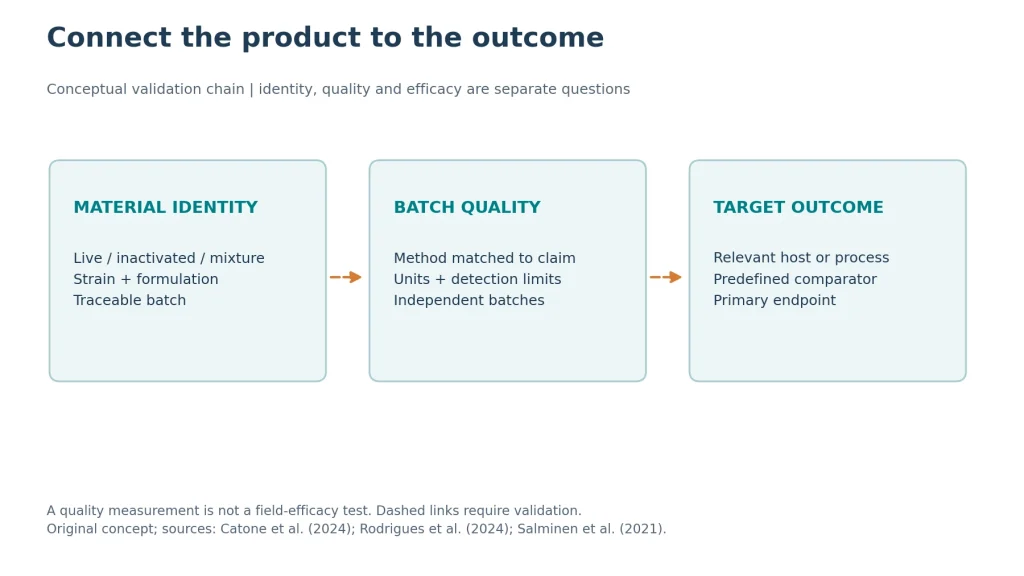

Validation of a microbial product should connect three questions: does the delivered material match its description, can relevant quality be maintained across batches, and does the target setting show a predefined improvement? Strain identification, detectable viable organisms or an increased metabolite are not synonyms for field efficacy. A useful evidence chain preserves material identity and batch traceability, selects measurements that answer the intended question and evaluates outcomes against a meaningful comparison. The following cross-sector framework is a proposed approach, not a completed company trial.
Define the material before choosing quality indicators
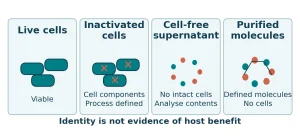
First establish whether the test item contains live microorganisms, inactivated cells, a fermentation mixture or separated metabolites. These materials require different functional and quality assessments. Strain identity, cultivable counts and condition after storage matter for live products, whereas CFU alone may be inappropriate for non-living preparations. Carriers and other ingredients remain part of the tested formulation; its overall effect cannot arbitrarily be assigned to one strain.
Link each batch to sampling and analytical records, retaining methods, units, detection limits and uncertainty. Passing an initial test does not establish equivalent quality after shipping and storage. This article focuses on connecting evidence to outcomes; specific storage conditions and stabilization strategies require product-specific studies rather than a universal rule.
CFU, qPCR and viability measures answer different questions
Colony-forming units, or CFU, measure organisms able to form colonies under specified conditions. qPCR measures target nucleic-acid signals, which alone do not establish reproductive capacity. Viability-PCR using a membrane-integrity dye attempts to exclude contributions from some damaged cells. Its interpretation remains organism- and matrix-dependent and requires appropriate controls.[1]
Catone and colleagues analyzed five capsules of a commercial preparation containing Lactobacillus acidophilus and Bifidobacterium bifidum, comparing culture, qPCR and viability-PCR. Figure 2 reconstructs the means labeled in their original Figure 6. Culture counts were below the two PCR estimates, and the authors discussed a possible viable-but-non-culturable fraction. The measurement difference did not establish a particular health or production benefit from that fraction.[1]
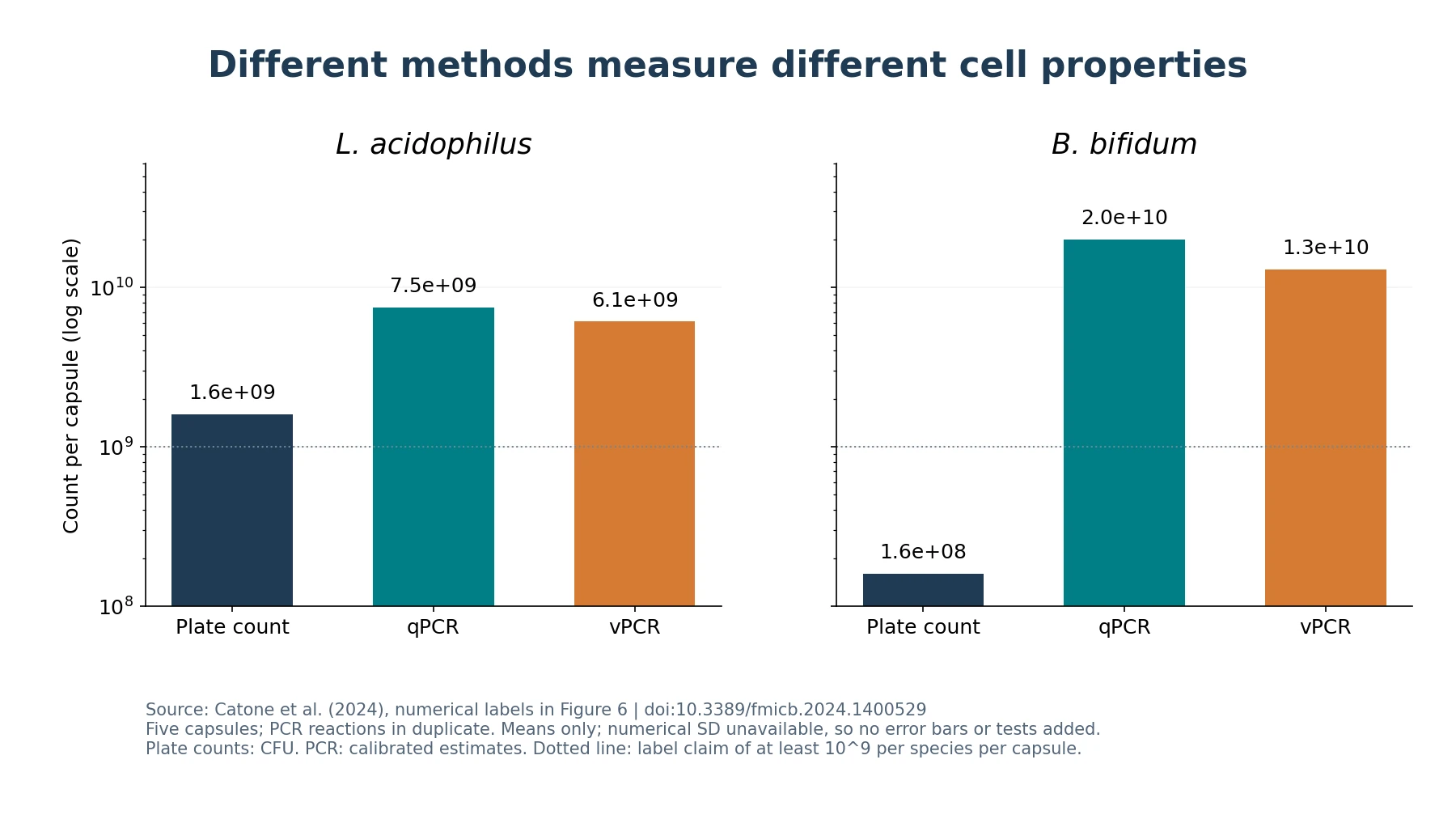
The two panels show the species means labeled in the original figure. Numerical SD values are unavailable, so error bars are not estimated from the artwork. Five capsules are not five independent manufacturing batches, and technical PCR repeats are not additional product samples. The source reports culture-versus-PCR p-values below 0.001, while the two PCR methods did not differ significantly. This example supports method matching, not a universal conversion equation.[1]
| Method | Primary question | Does not establish alone |
|---|---|---|
| Strain identification | Identity of the target organism | Field efficacy |
| CFU culture | Cultivability under specified conditions | Viability of every cell[1] |
| qPCR / viability-PCR | Target DNA / membrane-integrity-informed signal | Host or production improvement[1] |
| Functional assay | Function of the tested preparation | Equivalent effects across formulations and settings |
Connect functional indicators to the primary field outcome
Laboratory enzyme activity, nutrient transformation or microbial interactions can motivate an application, but outcomes also depend on the host, inputs, environment and management. Select a primary endpoint before testing: accepted crop yield, feed efficiency or treatment cost per unit pollutant load, for example. Community, metabolite and physiological measurements can help explain outcomes without replacing the production problem the trial was intended to address.
Rodrigues and colleagues evaluated a maize inoculant in field and pot experiments over two years. Mean field dry-matter yield was higher with inoculation but did not differ significantly in either year; pot responses also varied between years. The field design used three replicates per treatment, with treated and untreated areas more than 50 m apart; spatial differences also warrant consideration. This does not show that all microbial products are ineffective. It shows why material, environment, precision and endpoint must be interpreted together, rather than selecting a favorable mean as a general yield promise.[2]
Conversely, a non-significant result does not prove complete absence of an effect. Examine the estimated difference, confidence interval, variability and effect size the study could reasonably detect. A predefined minimum practical benefit helps distinguish a statistically detectable but commercially unimportant difference from a potentially useful trend that remains too imprecisely estimated.
Define the comparison before starting field validation
Where feasible, use contemporaneous randomized blocks to compare the test preparation with existing management or an appropriate carrier control. Define experimental units according to treatment allocation: plots, pens, tanks or treatment lines. Repeated measurements within one pen can improve its description but do not create additional independent treatment replicates.
For before-and-after comparisons, record season, production batch, feed or fertilizer, process loading and simultaneous management changes. Limit conclusions to observed associations. Sample size should depend on historical variability in the primary endpoint, the smallest relevant difference and clustering, rather than a fixed number of farms. When these inputs are unavailable, feasibility work and variance estimation are more defensible than claiming adequate statistical power.
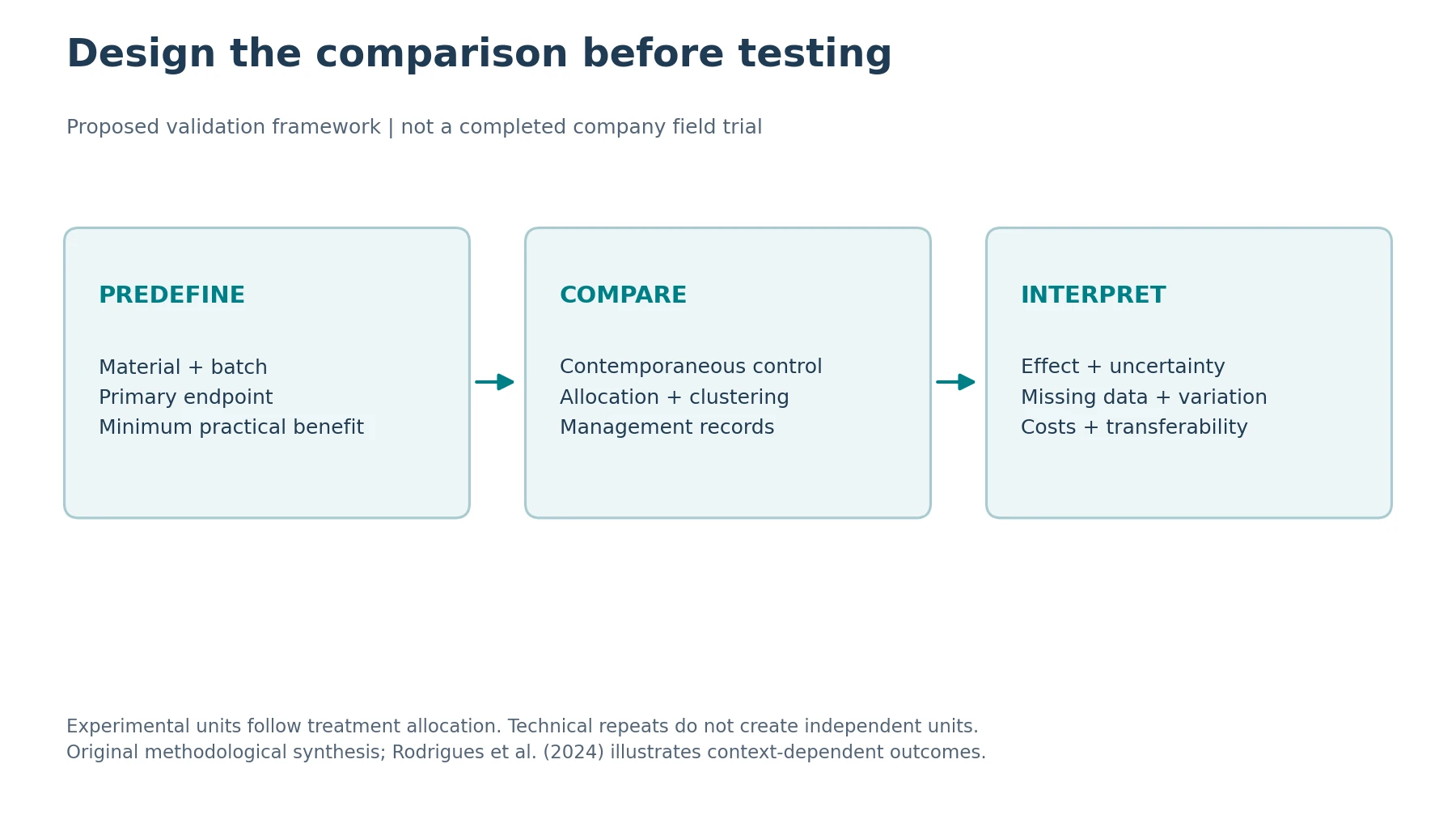
| Validation component | Record before testing | Interpretation |
|---|---|---|
| Materials and batches | Identity, formulation, batch and quality method | Technical repeats are not batch replication |
| Primary outcome | Minimum relevant difference, period and experimental unit | Microbiome endpoints do not replace production outcomes |
| Comparisons and variability | Allocation, management and missing-data handling | Before–after comparisons need confounder assessment |
| Economic value | Inputs, prices, revenue and avoided losses | A calculation plan is not demonstrated ROI |
Translate findings into an appropriately bounded claim
Use accurate terminology for inactivated and fermentation-derived materials. The ISAPP consensus defines postbiotics around preparations of inanimate microorganisms and/or their components that confer a host health benefit. Absence of live cells alone does not establish an efficacious postbiotic, and evidence for a purified metabolite cannot automatically be exchanged with evidence for a complete inactivated preparation.[3]
Reports should identify the batch, material, setting, comparator and endpoint. Economic claims also need added revenue, avoided losses and additional costs, with explicit prices and time periods. Without a comparator or cost records, an observation can still be retained, but should not be presented as a demonstrated product return on investment.
Frequently asked questions
Does a higher viable count mean a better product? Establish the material and intended use first, then compare quality using compatible methods and relevant outcomes. Counts from different methods cannot simply be ranked, and total counts do not establish equivalent function across strains or formulations.
Is one successful site enough for general adoption? A site can provide valuable information, but batch, season and management differences still matter. A stronger technical claim combines traceable materials, suitable quality measurements and repeatable outcomes under target conditions, rather than treating an analytical method or one favorable result as complete validation.
References
- [1] Catone S, Iannantuono S, Genovese D, Von Hunolstein C, Franciosa G (2024). Viability-PCR for the selective detection of Lactobacillus acidophilus and Bifidobacterium bifidum in live bacteria-containing products. Frontiers in Microbiology 15: 1400529. doi:10.3389/fmicb.2024.1400529
- [2] Rodrigues MÂ, Correia CM, Arrobas M (2024). The Application of a Foliar Spray Containing Methylobacterium symbioticum Had a Limited Effect on Crop Yield and Nitrogen Recovery in Field and Pot-Grown Maize. Plants 13(20): 2909. doi:10.3390/plants13202909
- [3] Salminen S, Collado MC, Endo A et al. (2021). The International Scientific Association of Probiotics and Prebiotics (ISAPP) consensus statement on the definition and scope of postbiotics. Nature Reviews Gastroenterology & Hepatology 18: 649–667. doi:10.1038/s41575-021-00440-6
Scientific information and validation planning; not evidence of efficacy for a particular company product or site.