
Four distinct layers of functional evidence
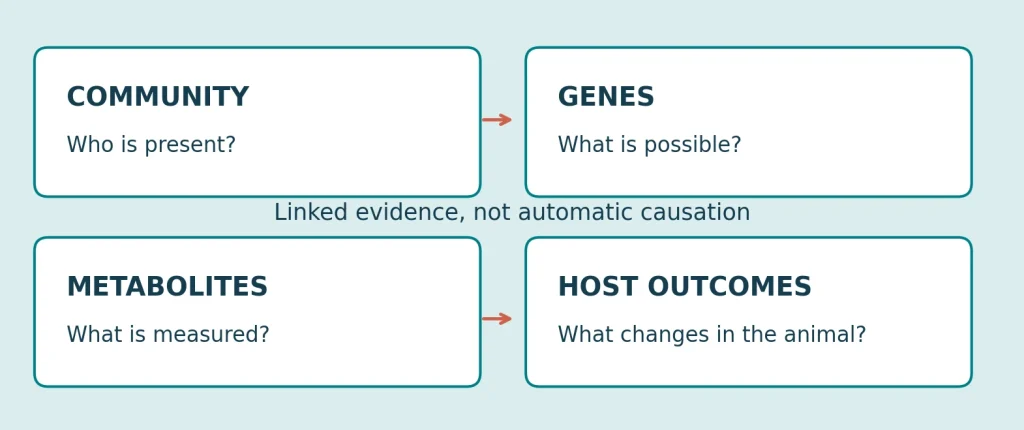
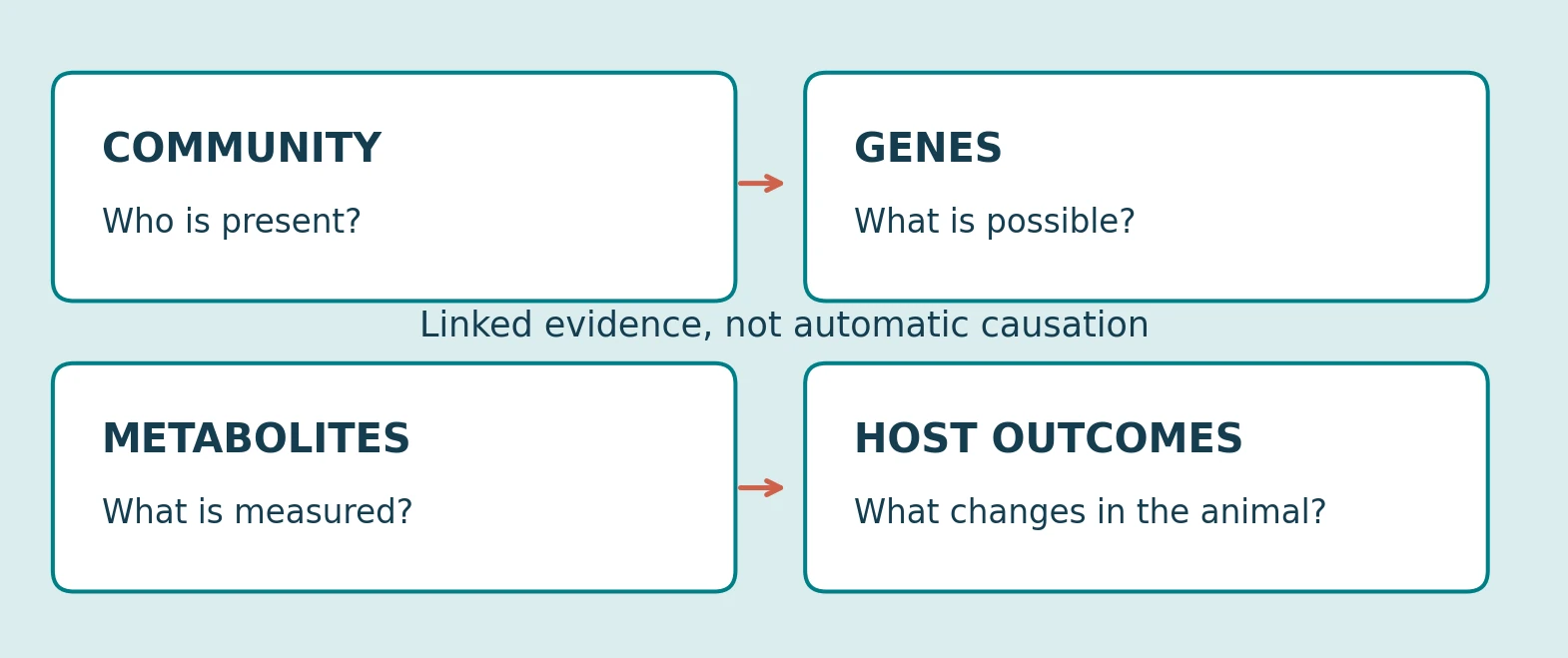
Animal gut microbiome research has moved from lists of organisms towards comparisons of functional genes, metabolites and host responses. These measurements answer different questions. Community profiles describe who is present; metagenomics describes potential capabilities; metabolite analysis captures chemical signals remaining at sampling; and health or growth measurements describe host outcomes. Connecting these layers can narrow an explanation, but no single layer automatically proves a microbial contribution to production benefits. This narrative review focuses on pig and broiler studies, with feline and methodological examples illustrating the limits of functional inference. [1, 2, 3]
16S rRNA gene amplicon sequencing primarily measures a taxonomic marker. Even full-length sequences do not directly capture every metabolic gene. Tools such as PICRUSt2 infer functions from marker sequences and reference genomes. Their outputs are predicted functions, suitable for generating hypotheses, and should not be confused with functional gene reads directly recovered by shotgun sequencing. Reference coverage, differences between related organisms and uncharacterized communities influence these predictions. [5]
Shotgun sequencing retrieves a broader range of sample DNA for taxonomic classification, functional annotation and genome reconstruction. DNA detection does not establish cell viability or ongoing enzyme activity. Gene presence, transcription, proteins and metabolites should retain their separate names in reports, allowing investigators to identify whether biological activity or host outcomes remain unmeasured. [4, 5]
Beyond proportions: microbial load and strain resolution
Relative abundance depends on the other components in a sample. A higher proportion can reflect growth of the organism itself or a decline in other organisms. Vandeputte and colleagues combined cell enumeration with microbiome profiles in humans, showing why total microbial load changes community interpretation. This methodological principle can inform animal data analysis; human load distributions and health boundaries cannot be transferred directly to livestock. [6]
For field questions, proportional signals can be compared with appropriately calibrated total-load or target-quantification data. Faecal water content, sampling site, preservation and analytical batch should be retained. Repeated samples from one animal are not additional independent animals. These are principles for avoiding misleading interpretation, rather than evidence of product efficacy. [1, 6]
Strain-level assignments require particular care. Shared genus or species labels do not guarantee identical metabolic genes. A metagenome-assembled genome (MAG) is not an isolated, preserved living strain. Functional attribution should consider assembly completeness, contamination, coverage and possible mixing of closely related organisms. Long reads can strengthen gene-to-genome linkage, but do not eliminate insufficient data or incorrect assignments. [4]
Table 1. Methods and interpretation
| Method | Main signal | Interpretation boundary |
| 16S / PICRUSt2 [5] | Taxonomic marker / predicted functions | Not direct measurement of all functional genes |
| Shotgun / MAG [4] | DNA and genome potential | Not viability, expression or metabolic flux |
| Metabolomics [2, 3] | Chemical features and candidates | Requires identification confidence and source attribution |
| Host performance [1, 2] | Clinical state / biological endpoints | Association does not establish microbial mediation |
Longitudinal pig data: farm and timing change interpretation
Pérez-Pérez and colleagues followed microbiota before and after disease at two pig farms. The analysis included 26 pigs and 102 faecal samples: 13 cases and 13 non-cases. Taxonomic and functional annotations were examined with farm and sampling time incorporated into the analysis. The design addresses changes across clinical states rather than simply comparing two static microbiome profiles. [1]
At the first sampling, neither taxonomic nor functional differences between groups were significant. Higher Shannon diversity in non-cases was only a trend, with p = 0.087. Samples closer to disease onset and farm-stratified analyses produced different signals. Thus, ‘before disease’ is not a fixed biological state: early samples and samples immediately preceding symptoms should not be pooled indiscriminately, and farm effects may exceed the effect of interest. [1]
The practical lesson is to define the comparison clearly. A single increase or decrease in a candidate organism can motivate follow-up, but does not justify labelling it protective or a disease collaborator. Changes in functional annotation still represent community DNA potential, rather than measured production of the corresponding metabolite. [1]
Table 2. Study units and evidence boundaries
| Study | Experimental or observational unit | Support and limitations |
| Longitudinal pigs [1] | 26 pigs; 102 repeated samples | Field association; strong farm and timing effects |
| Broiler multi-omics [2] | Ten metabolomic samples/group; management allocated in pens | Exploratory association; no significant global difference |
| Captive Felidae [3] | 14 host species; different omics subsets | Genes and assays complement each other; no feed-benefit guarantee |
| Long-read methods [4] | Standard community / digester samples | Method benchmark; not animal field performance |
Broiler multi-omics: candidate networks can coexist with a non-significant global result
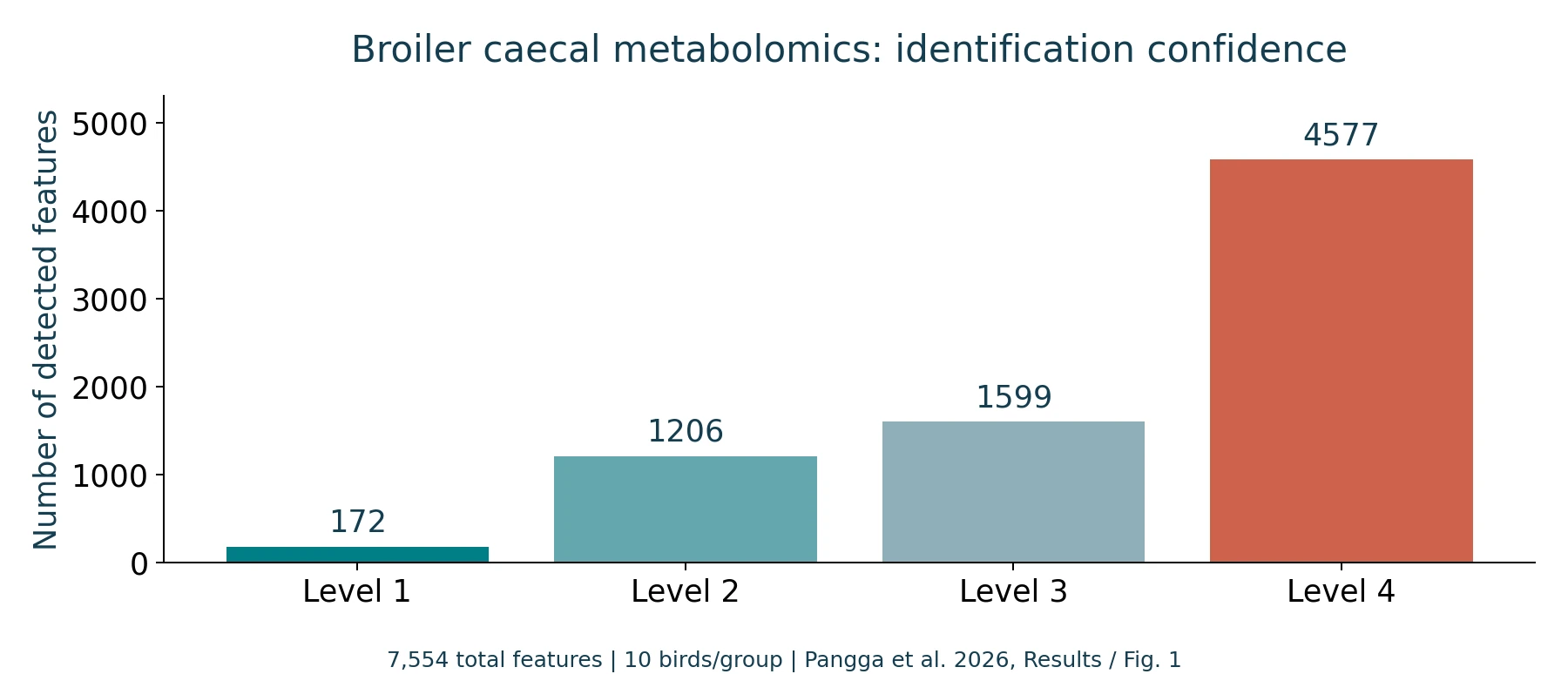
Pangga and colleagues compared ionophore and vaccination management in Ross-308 broilers, selecting ten biological samples per group for metabolomics. They detected 7,554 putative metabolite features; 172 achieved the study’s level-1 identification, with the remainder assigned to lower-confidence levels. Figure 2 redraws these counts to show why detected features should not all be treated as confirmed compounds. [2]
Global metabolic profiles did not differ significantly: PERMANOVA R² = 0.18 and p > 0.05. Supervised integration nevertheless identified candidate MAG–metabolite associations. These analyses answer different questions: the former tests global structure, while the latter selects features that distinguish predefined groups. Candidate networks from small samples require validation and do not establish strain-specific product origins or intervention efficacy. [2]
Faecal or caecal metabolites may originate from feed, host processes or microorganisms. Correlation with a MAG narrows candidate sources, but chemical identification and suitable functional experiments remain necessary to establish participation in production or transformation. Concordant changes in genes, metabolites and clinical endpoints improve explanatory consistency; consistency alone is not causation. [2, 3]
From more complete genomes to testable functional explanations
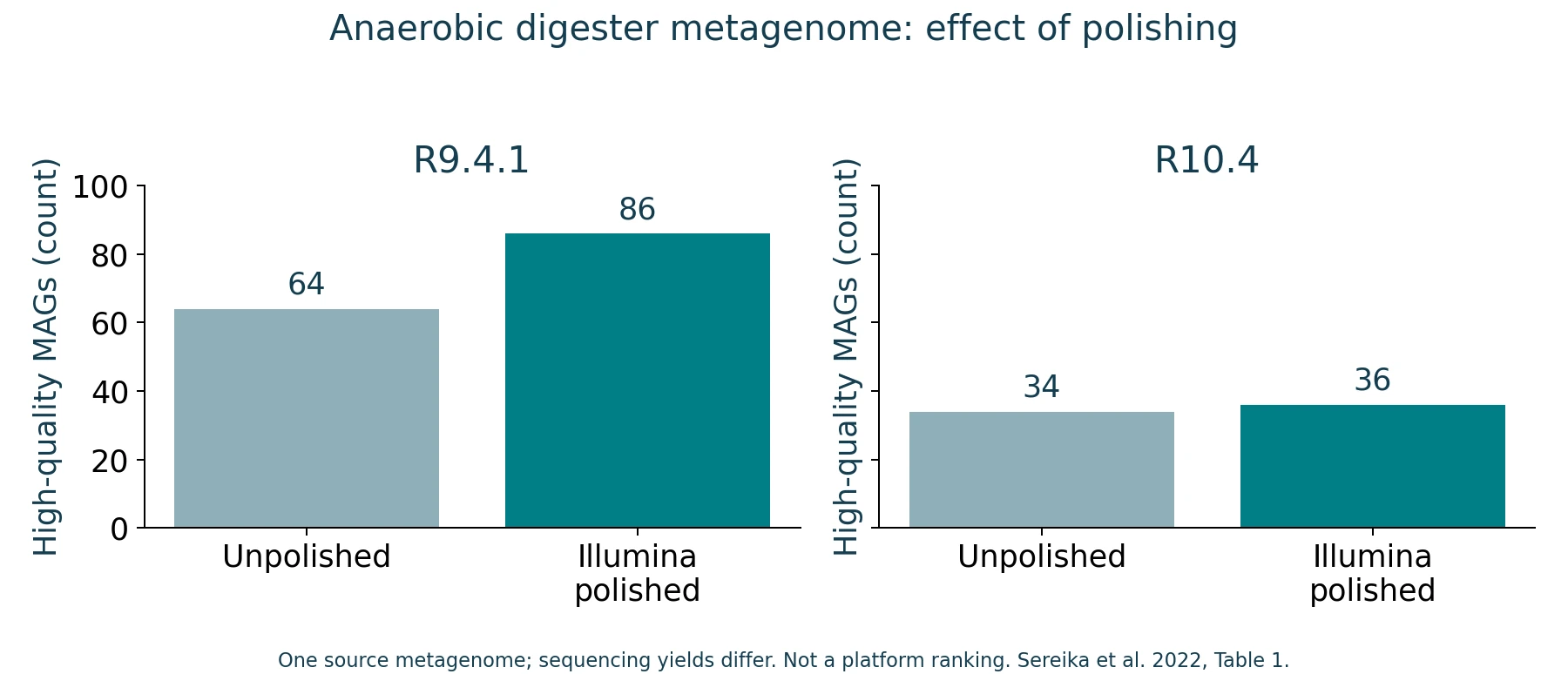
Sereika and colleagues used a standard community and anaerobic digester data to demonstrate the capacity of R10.4 long reads to improve assembly accuracy and continuity. Figure 3 retains high-quality MAG counts before and after short-read polishing within R9.4.1 and R10.4 workflows. Differences in sequencing yield and processing prevent a simple platform ranking by total MAG count. This study does not establish universal performance in animal gut samples. [4]
Culture and biochemical evidence provide another complement to gene annotation. Hu and colleagues studied 14 captive Felidae species using metagenomics, metabolomics, proteomics and enzyme assays of isolates. This design advances candidate functions towards measurable activity. Culture conditions nevertheless differ from the host gut, and protease or lipase activity does not establish feed-use safety or benefits in animals. [3]
The value of a microbial research platform lies in cross-checking its data. Taxonomic markers can screen communities; shotgun and long-read data can investigate functional attribution; metabolite and protein measurements add activity clues; and target-host studies assess biological and production relevance. Method selection should begin with whether the question concerns presence, capability, activity or benefit, followed by the corresponding evidence and limitations. This turns microbiome differences into useful, traceable research judgments. [1, 2, 3, 4, 5, 6]
References
[1] Pérez-Pérez L, Arguello H, Cobo-Díaz JF, et al. (2026). From predisposition to recovery: field evidence of interactions between the gut microbiota and Brachyspira hyodysenteriae infection. Veterinary Research 57:25. https://doi.org/10.1186/s13567-025-01646-1
[2] Pangga GM, Richmond A, Hughes C, et al. (2026). Integrated metabolomics and metagenomics reveal divergent caecal metabolic signatures following commercial gut health interventions in broilers. Animal Microbiome 8:99. https://doi.org/10.1186/s42523-026-00596-z
[3] Hu D, Sun C, Xin T, et al. (2026). Integrated analyses of metagenomics, metabolomics and culture-based assays reveal functional roles of gut microbiota in Felidae. npj Biofilms and Microbiomes 12:187. https://doi.org/10.1038/s41522-026-01066-9
[4] Sereika M, Kirkegaard RH, Karst SM, et al. (2022). Oxford Nanopore R10.4 long-read sequencing enables the generation of near-finished bacterial genomes from pure cultures and metagenomes without short-read or reference polishing. Nature Methods 19:823–826. https://doi.org/10.1038/s41592-022-01539-7
[5] Douglas GM, Maffei VJ, Zaneveld JR, et al. (2020). PICRUSt2 for prediction of metagenome functions. Nature Biotechnology 38:685–688. https://doi.org/10.1038/s41587-020-0548-6
[6] Vandeputte D, Kathagen G, D’hoe K, et al. (2017). Quantitative microbiome profiling links gut community variation to microbial load. Nature 551:507–511. https://doi.org/10.1038/nature24460
Narrative review for research education; not evidence of a specific product effect or site-specific diagnosis. Figures 2 and 3 redraw verified counts under CC BY 4.0: https://creativecommons.org/licenses/by/4.0/.