A community signal becomes useful when it can be traced to a strain
The practical value of gut microbiome research depends on linking community signals to strains with a clear identity, reliable availability and measured functions. A genus associated with healthy animals can generate a hypothesis. An archived isolate and its genome allow researchers to examine what that organism actually does. Pig intestinal collections, human commensal resources and recent competitive-exclusion studies are helping connect these evidence stages. Collection size, activity in vitro and host benefit nevertheless answer different questions and require separate interpretation.[1, 2, 3]
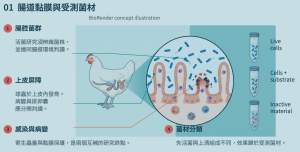
Culturomics uses diverse cultivation and identification approaches to turn microorganisms detected in sequence datasets into physical research resources. It complements metagenomics: sequence analysis helps locate diversity that is still missing from collections, while strains enable functional comparisons, material characterisation and reproducible work. Figure 1 connects these evidence stages. Its arrows indicate relationships between evidence types, rather than completion of every stage for every strain.[1, 3, 4]
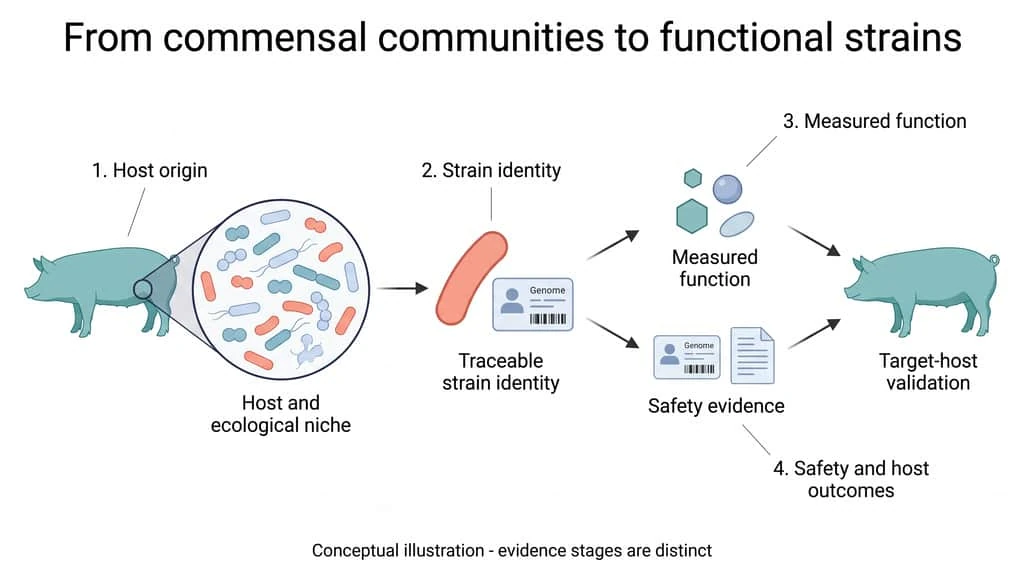
Conceptual illustration. Host origin, strain identity, measured function and safety information support subsequent target-host research. This is not an experimental result or evidence that every strain has completed validation. Sample size and statistics are not applicable. Created with BioRender from the cited concepts.[1, 3, 5, 6]
A useful collection links identity with availability
The PiBAC study archived 117 strains representing 110 species and linked them with genomes and source information. This allows another research team to obtain the same material, rather than merely detect a similarly named genus. The authors also noted that the collection did not capture the full extent of strain-level diversity. Expanding species coverage and comparing different strains within a species are separate objectives.[1]
In 2025, the human HiBC resource reported 340 strains representing 198 species, with access to genomes, plasmids and source information. Its value lies in reusable materials and the associated information architecture; it does not establish a health benefit for all 198 species. Animal platforms can learn from this approach to data management, while health associations, host adaptation and safety conclusions still need to be assessed for the actual strain and target host.[3]
A strain record should therefore contain more than a name and a single activity score. Each functional result should link to the actual material, comparator, experimental unit and statistics, while retaining subsequent revisions. Deposit numbers and alias mappings maintain continuity when names change or research teams use different codes. This approach allows new findings to extend the evidence while preserving inconsistent and non-significant results.[5, 6, 7]
Host and sampling site shape the meaning of a resource
The same pig-derived strain sequences covered different fractions of amplicon datasets from different hosts. Figure 2 preserves the original PiBAC coverage distributions for pig, human and mouse gut datasets and illustrates why a shared bacterial name does not establish equivalence across hosts. The figure axis describes OTU coverage. This is a sequence-matching measure, not a colonisation success rate or the fraction of all intestinal functions that has been captured.[1]
Sampling site is equally important. A 2025 pig tonsil study established 518 isolates spanning 23 genera from five samples from healthy pigs, while analysing community profiles in a separate set of 101 samples. Genome mining and in vitro tests identified antagonistic potential in some isolates. This evidence concerns an oropharyngeal niche; it does not establish intestinal colonisation or disease control on farms. Sampling site, donor numbers and isolate numbers should be recorded separately so that many colonies are not mistaken for many independent animals.[4]
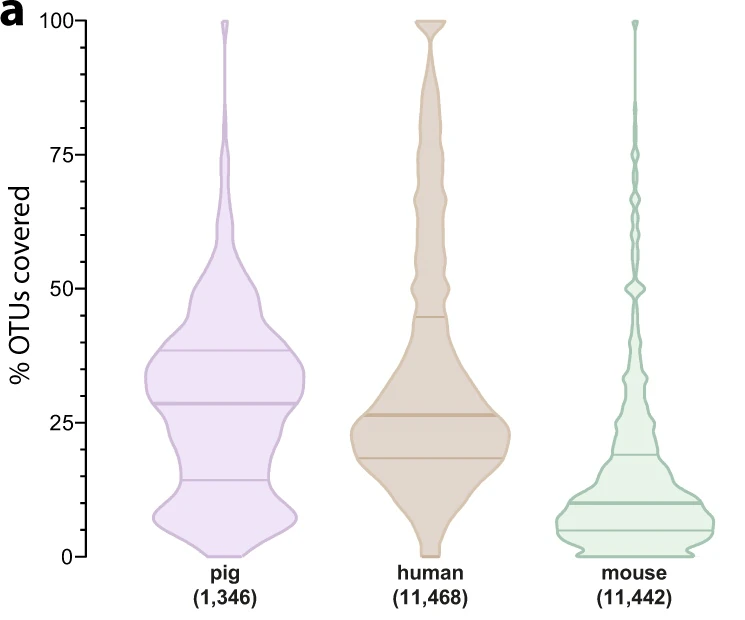
Cropped original PiBAC Fig. 4a, preserving all three distributions. Pig n=1,346, human n=11,468 and mouse n=11,442 gut 16S amplicon datasets. The y-axis shows OTU coverage (%). Horizontal lines indicate the median and 25th/75th percentiles. The author’s original plot is retained; no significance marks or pairwise comparisons are added. Coverage is not colonisation or efficacy.[1]
Competitive exclusion provides functional leads
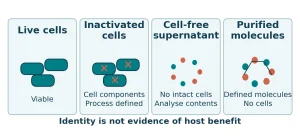
The 2026 study by Gómez-Martínez and colleagues compared 28 commensal isolates, including pig- and wild-boar-derived isolates and reference strains from culture collections. At the in vitro co-culture endpoint, C. butyricum CECT 361 and B. thermoacidophilum J1/23 YB69 showed reported reductions of approximately 2.87 and 2.63 log10 bacteria/mL relative to the monoculture control. Cell-free supernatants also showed activity, and some retained part of their activity after pH adjustment, suggesting contributions beyond nutrient competition.[2]
Bacterial abundance was estimated by qPCR. These results cannot be directly converted into viable-cell killing rates or protection rates in pigs. The article reports 20/28 isolates exceeding a one-log reduction in its abstract but 18/28 in its discussion. Because those counts disagree, no overall success rate is calculated here. Co-cultures, cell-free supernatants and specific active molecules are also different test materials; effects must remain attached to the preparation and conditions actually examined.[2]
Table 1 What the resources and studies establish
| Source and material | Direct evidence | Interpretation boundary |
|---|---|---|
| PiBAC pig gut collection [1] | 117 strains, 110 species and linked genomes | Resource and functional diversity do not establish benefit for every strain |
| HiBC human strain resource [3] | 340 strains, 198 species and accessible data | Human resources do not establish suitability for animals |
| Pig tonsil isolates [4] | 518 isolates, 23 genera; some in vitro antagonism | Oropharyngeal niche, not intestinal or field efficacy |
| Commensals and cell-free supernatants [2] | In vitro abundance changes for specific materials | Separate qPCR, viable counts and host protection |
| Live LM1 in growing pigs [7] | 145 pigs, five groups, 42 days; some host responses | No significant dose trends in growth measures |
Host responses and growth performance can diverge
Limosilactobacillus mucosae LM1 provides a useful example of endpoint-specific interpretation. A 2022 study enrolled 145 growing pigs in five groups, with six pens per group, for 42 days. Some immune and intestinal morphology measures changed, but body weight, daily gain, feed intake and gain-to-feed ratio showed no significant linear or quadratic dose trends. Figure 3 presents daily gain for every group with the pooled SEM reported in the original table. Selecting the group with the highest numerical mean would not establish growth promotion.[7]
Screening measures therefore need a clear biological interpretation. Metabolites, immune markers and production outcomes can respond differently. A non-significant trend does not establish that groups are identical; a change in an immune marker does not establish a disease or economic benefit. A functional-strain description should specify the endpoint it supports and the host and material conditions under which it was observed.[7]
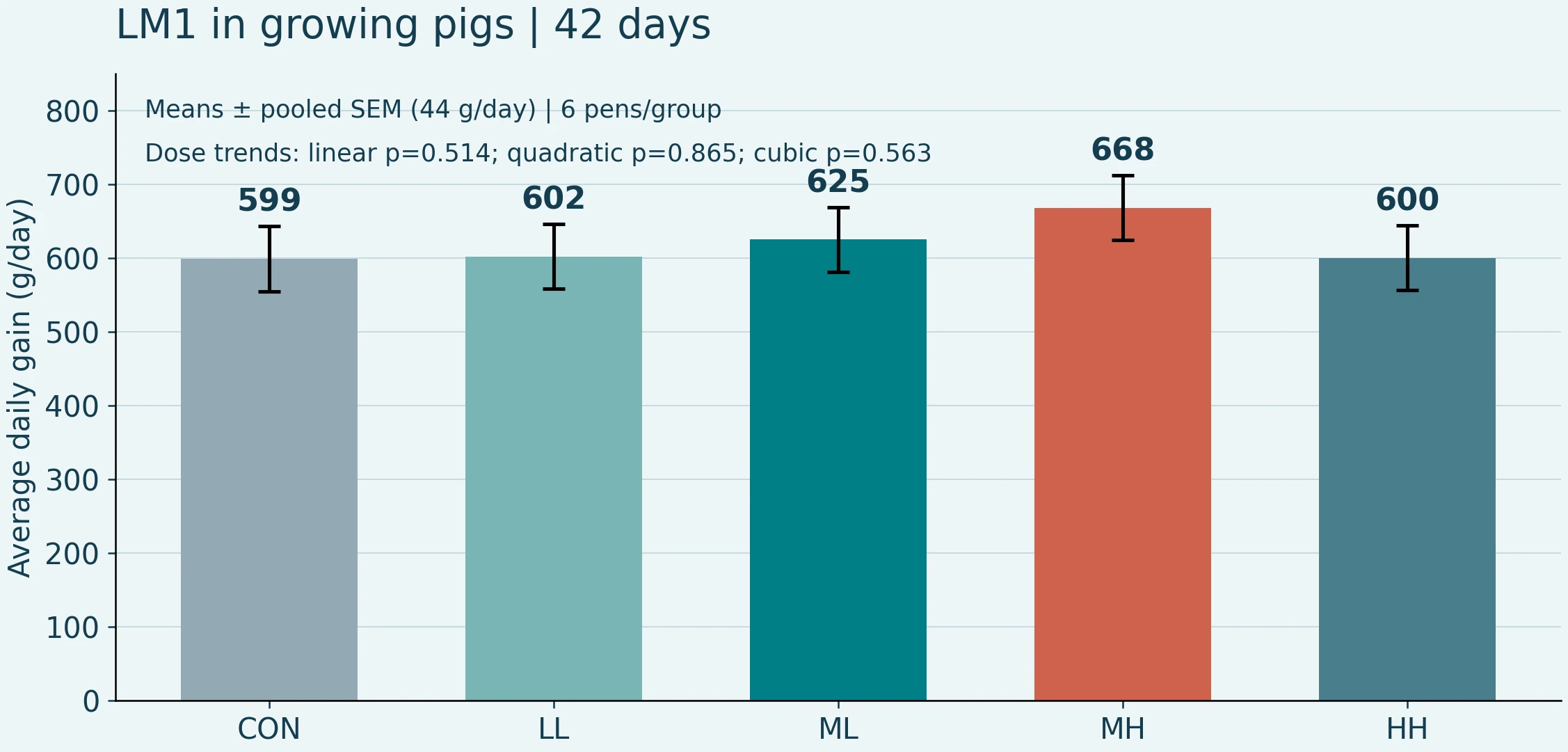
Redrawn from Zhang et al., Table 2. The 42-day trial included 145 growing pigs with six pens per group. CON denotes control; LL, ML, MH and HH denote low, moderate-low, moderate-high and high LM1 groups. Mean daily gain was 599, 602, 625, 668 and 600 g/day, respectively; error bars show pooled SEM 44 g/day. Linear p=0.514, quadratic p=0.865 and cubic p=0.563 were non-significant. No pairwise significance or stars have been added.[7]
Traceable information connects function with safety
Whole-genome sequencing can connect taxonomic identity with potential hazards. EFSA’s 2024 statement recommends genome comparisons to support identification and assessment of relevant antimicrobial-resistance, virulence and harmful-metabolite genes. Failure to detect a hazard in a genome does not establish safety under every circumstance. Sequence quality, reference data and analysis versions affect whether the assessment can be checked again.[5]
EFSA’s 2025 guidance further stresses that information must concern the specific strain under assessment and distinguishes active microorganisms, inactivated biomass and production strains. Different intended uses and final materials raise different exposure and assessment questions. For a microbial resource platform, connecting the source, aliases, deposit numbers, genome, functional test material and result versions allows procurement, research and subsequent applications to work with the same traceable identity.[6]
Together, these studies show that the central output of a resource platform is the connection between strain identity, functional evidence and host context. Species counts describe resource breadth, in vitro results identify functional leads, and host studies address specific outcomes. Retaining the conditions attached to each evidence type supports reproducible comparisons and a microbial technology knowledge base that can be updated over time.[1, 3, 6, 7]
Table 2 Information to connect in a traceable strain resource
| Information layer | What to retain | Purpose |
|---|---|---|
| Origin and identity [1, 3, 6] | Host, sampling site, strain code, aliases and deposit number | Match material to its records |
| Genome and taxonomy [5] | Sequence and analysis versions, quality and taxonomic reference | Support identification and reassessment |
| Function and material [2, 7] | Live cells or supernatant, control, experimental unit, endpoint and statistics | Attribute effects to the material tested |
| Safety and intended use [5, 6] | Relevant hazards, final material and target host | Assess the use context separately from activity |
Figure credits
Figure 1: BioRender generated concept; publication/export rights follow the connected account terms; no third-party experimental figure used. Source
Figure 2: Wylensek et al. 2020, CC BY 4.0; cropped Fig. 4a; original colours and data unchanged. Source
Figure 3: Zhang et al. 2022, CC BY; redrawn from factual Table 2 values; no individual observations reconstructed. Source
References
- Wylensek D, Hitch TCA, Riedel T, et al. (2020). A collection of bacterial isolates from the pig intestine reveals functional and taxonomic diversity. Nature Communications 11: 6389. 10.1038/s41467-020-19929-w
- Gómez-Martínez S, Pérez-Pérez L, Ucero-Carrretón A, et al. (2026). Exploring the potential for competitive exclusion of commensal probiotic candidates against the insidious swine pathogen Brachyspira hyodysenteriae. Animal Microbiome 8: 19. 10.1186/s42523-025-00511-y
- Hitch TCA, et al. (2025). HiBC: a publicly available collection of bacterial strains isolated from the human gut. Nature Communications 16: 4203. 10.1038/s41467-025-59229-9
- de Oliveira IMF, Fredriksen S, Gutiérrez MF, et al. (2025). Culturomics of the pig tonsil microbiome identifies new species and an untapped source of novel antimicrobials. Microbiome 13: 86. 10.1186/s40168-025-02064-3
- European Food Safety Authority (2024). EFSA statement on the requirements for whole genome sequence analysis of microorganisms intentionally used in the food chain. EFSA Journal 22(8): e8912. 10.2903/j.efsa.2024.8912
- EFSA Scientific Committee (2025). Guidance on the characterisation of microorganisms in support of the risk assessment of products used in the food chain. EFSA Journal 23: e9705. 10.2903/j.efsa.2025.9705
- Zhang Q, Vasquez R, Yoo JM, Kim SH, Kang DK, Kim IH. (2022). Dietary Supplementation of Limosilactobacillus mucosae LM1 Enhances Immune Functions and Modulates Gut Microbiota Without Affecting the Growth Performance of Growing Pigs. Frontiers in Veterinary Science 9: 918114. 10.3389/fvets.2022.918114
For research education; no product-specific benefit is established by this article.